
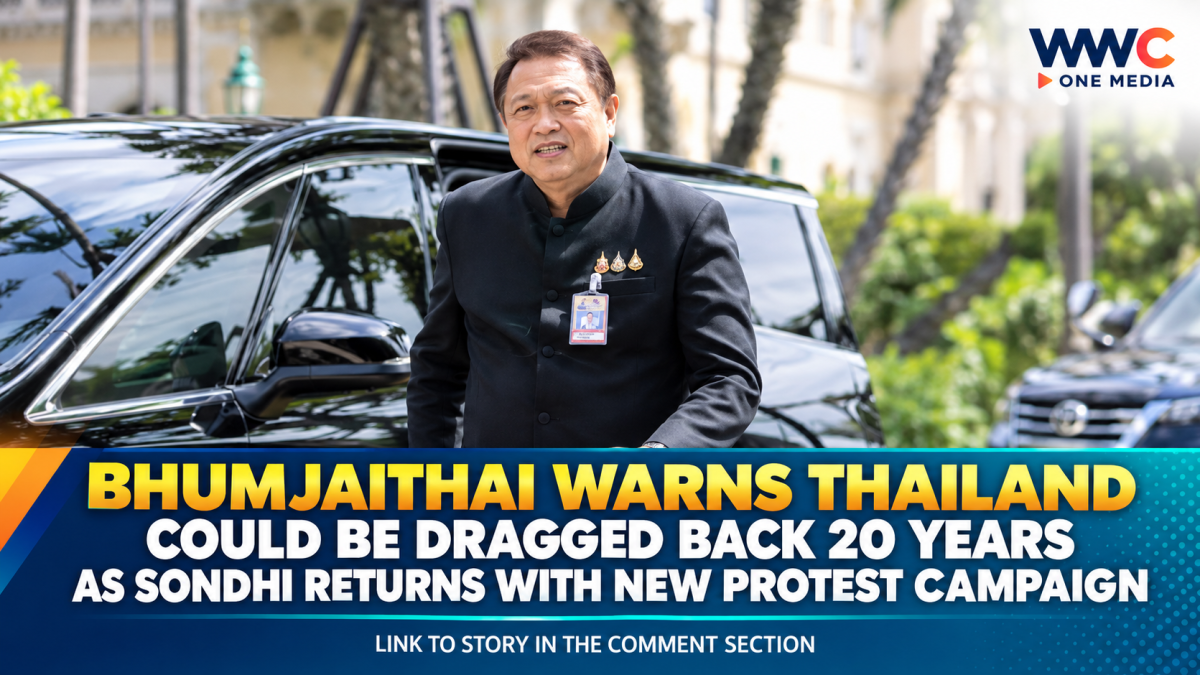
BANGKOK — Thailand’s Bhumjaithai Party has warned that a return to large-scale street protests could drag the country back two decades and damage investor confidence, as veteran activist Sondhi Limthongkul launches a new campaign to pressure the government led by Prime Minister Anutin Charnvirakul.
The warning comes as Sondhi, one of the most influential figures in Thailand’s modern protest movement, announced a new campaign called “Take Back Our Thailand” aimed at pressuring the government over what he describes as problems involving alleged “grey capital”, political influence and unequal law enforcement.
Sondhi insists he is not seeking to overthrow the government.
But he has also made clear that he intends to make life increasingly difficult for it.
And that has raised fresh concerns inside Thailand’s political establishment.
The Bhumjaithai Party’s message is blunt: Thailand has been through years of destructive political conflict before — and it does not want to go back.
BJT warns: Don’t take Thailand back 20 years
Natural Resources and Environment Minister Suchart Chomklin, speaking in response to Sondhi’s new campaign, warned that Thailand had already experienced the damaging consequences of prolonged political unrest.
He urged the public to consider what could happen if the country returned to the kind of large-scale street mobilisation that dominated Thai politics in previous decades.
Suchart argued that renewed turmoil could hurt the country’s investment climate at a time when Thailand is trying to attract more foreign capital and push ahead with major infrastructure and development projects.
The minister said the government needed time to work rather than being forced into constant political confrontation.
His warning echoed a central concern for the Bhumjaithai Party:
Political instability does not stay inside parliament.
It can affect businesses.
Jobs.
Tourism.
Foreign investment.
And public confidence.
According to the latest Bangkok Post report, BJT fears that renewed protests could undermine investor confidence and push Thailand backwards politically and economically.
Sondhi is back — and this time his campaign is called ‘Take Back Our Thailand’
Sondhi Limthongkul formally announced his new movement on Sept 7 alongside other activists and former protest figures.
The campaign is built around the slogan:
“Take Back Our Thailand.”
Its stated goal is to pressure the government to address issues including alleged illegal business networks, foreign “grey capital”, political influence and what organisers describe as unequal enforcement of the law.
Sondhi has said he does not want to bring down the Anutin government.
But he also said he wants to make the administration uncomfortable and force it to respond to public demands.
The veteran activist has also signalled that the campaign could expand if authorities fail to act on the issues raised by the movement.
Why Sondhi’s return matters
For younger readers, Sondhi’s name may not immediately carry the same weight it does for older generations.
But in Thailand’s political history, he is one of the most significant figures associated with mass street mobilisation.
Sondhi was a leading figure in the People’s Alliance for Democracy, or PAD, whose yellow-shirt protests became a major force in Thai politics during the political crises of the 2000s.
Those years were marked by massive demonstrations, deep political divisions and prolonged instability.
Thailand’s streets became a major battleground for political power.
The country later experienced further waves of political confrontation involving different movements and political camps.
That history is precisely why the Bhumjaithai Party is reacting cautiously to Sondhi’s return.
This is not simply another politician criticising the government.
Sondhi has a long history of mobilising supporters and turning political anger into large-scale public action.
And that makes his latest campaign politically significant.
‘I don’t want to bring down the government’
Sondhi has attempted to draw a distinction between his latest campaign and previous protest movements.
He has said that his objective is not to remove the government.
Instead, he says the movement wants to pressure the administration into taking action.
“I do not want to bring down this government, but I do want to make life uncomfortable for it,” Sondhi said during the launch of the campaign, according to The Nation.
The movement’s demands focus on what organisers describe as:
- Alleged “grey capital” networks
- Foreign business interests
- Equal enforcement of the law
- Political transparency
- Government accountability
- Concerns surrounding alleged election irregularities
Sondhi has also criticised the government over issues involving large business interests and state policy.
The campaign’s organisers say they intend to mobilise supporters and expand their activities around the country.
Anutin’s response: Thailand belongs to all Thais
Prime Minister Anutin Charnvirakul has responded directly to the language of Sondhi’s campaign.
His position is simple:
Thailand does not need to be “taken back”.
Anutin said Thailand belongs to all Thai people and acknowledged that citizens have a constitutional right to demonstrate, provided their actions remain within the law.
The prime minister has not attempted to ban Sondhi’s movement.
Instead, the government has stressed that peaceful political expression is permitted.
But the Bhumjaithai Party is clearly concerned about what could happen if the campaign grows into a much larger street movement.
The difference between a press conference and a nationwide protest movement can be enormous.
And Thailand has seen before how quickly public mobilisation can reshape the political landscape.
First major gathering planned
Sondhi’s campaign is expected to begin public activities with a planned gathering connected to the Israeli Embassy in Bangkok.
Organisers have said the movement will not initially follow the model of prolonged encampment-style demonstrations that characterised some of Thailand’s previous political crises.
Sondhi has suggested there may be no overnight occupation.
But he has also warned that the movement could be large and intense.
That uncertainty is part of what makes the situation politically sensitive.
The campaign may remain limited.
Or it could expand rapidly if it connects with wider public frustration.
Political observers quoted in Thai media have suggested that the movement may struggle to immediately gain nationwide momentum because the issues being raised do not yet have a single unifying trigger capable of bringing together a broad coalition.
But the situation remains fluid.
Investor confidence becomes a major concern
The Bhumjaithai Party’s strongest warning is not just about politics.
It is about the economy.
Thailand has been actively promoting itself to international investors, particularly in sectors involving infrastructure, technology, manufacturing and data centres.
The government recently highlighted international participation in Thailand Focus 2026, where hundreds of institutional investors and dozens of companies took part in meetings aimed at promoting investment opportunities in the country.
That is why government figures are particularly sensitive to the prospect of renewed political instability.
Investors tend to watch several factors closely:
- Government stability
- Policy consistency
- Public unrest
- Regulatory risks
- Political conflict
- Infrastructure reliability
A major protest movement does not automatically cause investment to disappear.
But prolonged instability can create uncertainty.
And uncertainty can delay investment decisions.
That is the argument Bhumjaithai is now making.
Thailand cannot afford to spend years fighting political battles while competing countries move ahead economically.
Thailand has painful memories of political turmoil
The phrase “dragged back 20 years” carries particular weight in Thailand.
The country experienced repeated political crises through the 2000s and 2010s.
Those years included:
- Mass street demonstrations
- Deep political divisions
- Government changes
- Court interventions
- Airport disruptions
- Military coups
- Long periods of political uncertainty
Thailand’s political landscape eventually became deeply divided between competing movements, parties and ideologies.
The effects were felt far beyond politics.
Businesses faced uncertainty.
Tourism was disrupted during some major protests.
Public trust was damaged.
And political divisions often extended into workplaces, families and communities.
Bhumjaithai’s warning is essentially an appeal to avoid repeating that history.
The party argues that Thailand has already paid the price for prolonged political conflict once.
It does not want to pay it again.
But Sondhi says the government needs pressure
Sondhi’s supporters see the issue differently.
Their argument is that governments often fail to act unless citizens apply sustained pressure.
The activist has criticised what he sees as government inaction on issues involving major business interests, foreign influence and alleged illegal networks.
He has also questioned whether the law is being applied equally.
From that perspective, his movement is not about creating chaos.
It is about forcing accountability.
That creates the central political clash.
The government’s position:
Give the elected government time to work and avoid another cycle of political unrest.
Sondhi’s position:
Without public pressure, powerful interests and unresolved problems will continue.
Both sides are now trying to win public opinion.
And that battle may determine whether the movement grows or fades.
The Senate issue could add more pressure
Sondhi’s return also comes during a sensitive period for Thai politics.
His campaign has highlighted concerns surrounding alleged irregularities and collusion connected to the 2024 Senate election.
The issue has already generated significant political debate.
The timing is important because several politically sensitive developments are expected to unfold in September.
That creates the possibility that separate controversies could begin reinforcing one another.
A protest movement can sometimes remain focused on one issue.
But when multiple political controversies emerge at the same time, public anger can become harder for governments to contain.
This is one reason analysts are closely watching whether Sondhi’s campaign can connect different grievances into a larger national movement.
Is Thailand heading for another major political crisis?
At this stage, it is too early to say.
Sondhi’s campaign has only just been launched.
There is no indication yet that Thailand is returning to the massive, sustained political confrontations of the past.
Even analysts examining the movement’s early prospects have suggested it may face difficulties attracting broad public support immediately.
But dismissing the campaign completely could also be risky.
Thailand’s political history shows that street movements can grow rapidly when they connect with public frustration.
And Sondhi has experience in political mobilisation.
The key question will be whether his campaign can attract groups beyond his traditional support base.
If it cannot, the movement may remain limited.
If it can, the political pressure on the government could grow significantly.
Bhumjaithai’s biggest fear: instability during a critical economic period
For the Anutin government, the concern is bigger than one activist.
The government is trying to project an image of:
- Political stability
- Economic confidence
- Investment readiness
- Policy continuity
A growing protest movement could complicate that message.
Especially if demonstrations become prolonged or if new political controversies emerge at the same time.
The Bhumjaithai Party therefore appears to be trying to frame the issue before the protests gain momentum.
Its argument is straightforward:
Thailand has an elected government.
The government should be allowed to work.
And the country should not return to the political chaos of previous decades.
Suchart’s warning that renewed turmoil could set Thailand back 20 years is aimed directly at that fear.
What happens next?
The next few days could be important.
Sondhi’s movement is expected to begin public activities and organisers have said they will continue monitoring political developments.
The campaign could remain a pressure movement focused on specific demands.
Or it could develop into something much larger.
Much will depend on:
- Public turnout
- Government responses
- New political controversies
- Developments surrounding the Senate issue
- Whether other activist groups join
- Whether the movement can expand beyond its traditional base
Prime Minister Anutin has so far adopted a relatively restrained response, recognising the right to protest while insisting that demonstrations must remain within the law.
Bhumjaithai, however, is making clear that it is watching closely.
The bottom line
Thailand’s Bhumjaithai Party is warning that renewed street protests could push the country back into the political turmoil of two decades ago and damage investor confidence.
The concern comes as veteran activist Sondhi Limthongkul launches his new “Take Back Our Thailand” campaign to pressure the government over alleged grey capital, political influence and other unresolved issues.
Sondhi says he does not want to overthrow Prime Minister Anutin Charnvirakul’s government.
But he has openly said he intends to make life uncomfortable for it.
That is enough to make Thailand’s political establishment pay attention.
Because the country has seen before what happens when political anger moves from social media and press conferences to the streets.
For now, Thailand is not facing another nationwide political crisis.
But with a veteran protest leader returning, sensitive political issues approaching key decisions and Bhumjaithai openly warning about renewed turmoil, the government’s biggest challenge may be keeping political pressure from turning into something much harder to control.
WWC ONE MEDIA J.M.D

Leave a Reply