
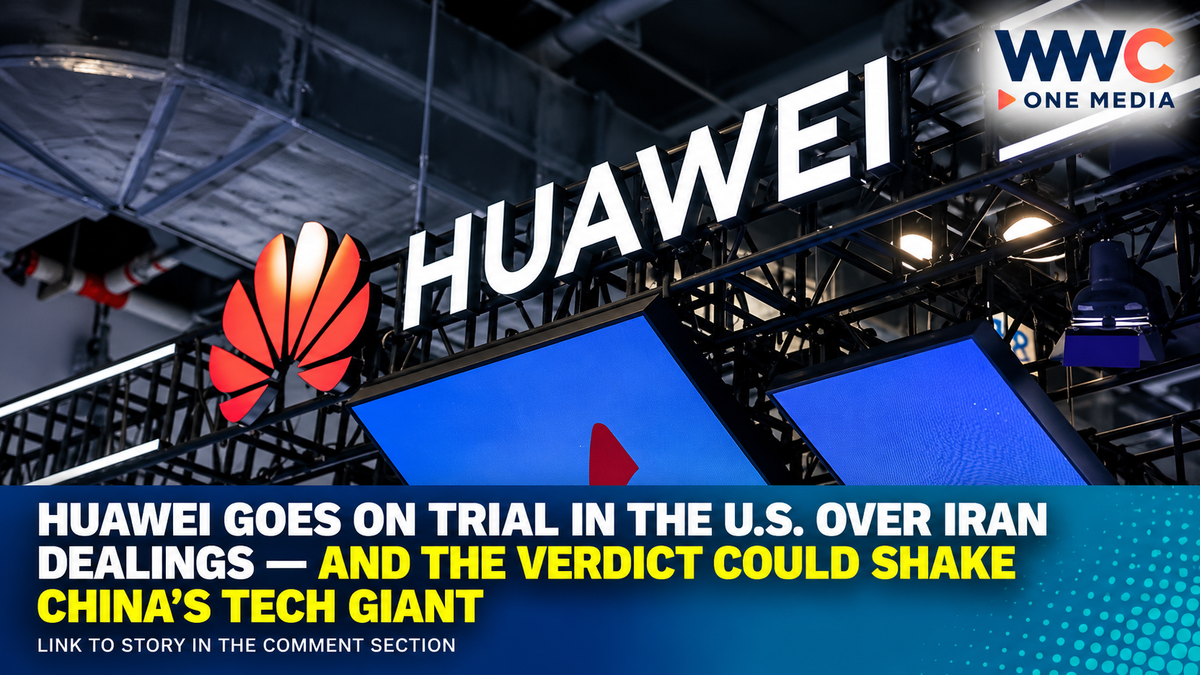
NEW YORK — One of China’s most powerful technology companies is finally facing a U.S. jury.
Huawei Technologies has gone on trial in federal court in Brooklyn over allegations that it concealed business dealings involving Iran, violated U.S. sanctions, defrauded banks and stole trade secrets from American technology companies.
Jury selection began Tuesday, nearly eight years after U.S. prosecutors first brought the case into the spotlight with the arrest of Huawei Chief Financial Officer Meng Wanzhou in Canada. The criminal proceedings now represent one of Washington’s longest-running and most consequential legal battles with a major Chinese technology company.
Huawei has pleaded not guilty and denies wrongdoing, arguing that the U.S. government’s broader case is politically motivated and designed to undermine China’s technological rise.
The Iran connection at the center of the case
U.S. prosecutors allege that Huawei used a Hong Kong-based company called Skycom to conduct business in Iran while concealing the relationship from financial institutions.
According to the indictment, the alleged scheme involved obtaining U.S.-origin goods, technology and services for Huawei’s Iran operations and moving money through the international banking system despite U.S. sanctions.
Reuters previously reported that Skycom offered to sell at least €1.3 million worth of embargoed Hewlett-Packard computer equipment to Iran’s largest mobile-phone operator in 2010. Reuters also reported that Meng had served on Skycom’s board between 2008 and 2009.
U.S. prosecutors further allege that HSBC processed more than $100 million in U.S.-dollar transactions connected to Skycom.
The government says Meng misrepresented Huawei’s relationship with Skycom during a presentation to an HSBC executive. Meng later admitted that statements she made about the relationship were false as part of an agreement with U.S. prosecutors that resolved the case against her.
The case goes far beyond Iran
The trial isn’t solely about Huawei’s alleged Iran dealings.
The company faces a broad set of allegations, including racketeering, bank fraud, wire fraud, money laundering, obstruction and conspiracy to steal trade secrets from five U.S. technology companies. Prosecutors also accuse Huawei and some subsidiaries of conducting business involving North Korea despite U.S. sanctions.
Another major allegation involves surveillance equipment that prosecutors say was supplied to Iran and used to help monitor protesters during the country’s 2009 anti-government demonstrations.
The indictment covers alleged conduct stretching from approximately 1999 through 2020, making the case unusually broad and potentially covering decades of Huawei’s international expansion.
Why Meng Wanzhou’s arrest still matters
The case traces back to December 2018, when Meng was arrested in Vancouver at the request of U.S. authorities.
Her arrest triggered a major diplomatic crisis between Washington, Beijing and Ottawa, becoming one of the defining episodes of the U.S.-China technology confrontation.
Meng was released in 2021 after reaching an agreement with U.S. prosecutors, and she returned to China. The United States subsequently dropped its extradition request and dismissed the charges against her.
However, that agreement did not end the criminal case against Huawei itself.
Meng is not a defendant in the current trial. A U.S. judge ruled in June 2026 that statements she signed could be introduced as evidence against Huawei because she made them while serving as the company’s CFO.
Huawei says the U.S. case is politically motivated
Huawei strongly disputes the government’s allegations.
The company has said the U.S. government’s overarching narrative is false and has characterized the prosecution as part of a broader effort to restrict China’s technological competitiveness.
Chinese officials have likewise criticized Washington’s treatment of Huawei, describing the U.S. campaign against Chinese technology companies as economic pressure disguised as national-security policy.
That defense will now be tested in court.
The timing could make the trial even more explosive
The trial comes at an especially sensitive moment for U.S.-China relations.
The proceedings are expected to last roughly three months, potentially overlapping with a planned September 24 meeting between U.S. President Donald Trump and Chinese President Xi Jinping in Washington.
That gives the case significance far beyond a single corporate prosecution.
Huawei has become a central player in China’s effort to build a more self-reliant technology industry, particularly in semiconductors and artificial intelligence.
Years of U.S. restrictions have limited Huawei’s access to advanced American chips and technology. In response, the company has expanded its domestic semiconductor capabilities and become increasingly involved in China’s push for technological independence.
A verdict could have consequences far beyond Huawei
If prosecutors secure convictions, the consequences could extend beyond financial penalties.
A conviction would provide Washington with a major legal victory in its long-running campaign against Huawei and could strengthen the U.S. government’s argument that restrictions imposed on the company were justified by alleged criminal conduct.
The government could also seek forfeiture of property or proceeds it says were obtained through illegal activity.
But an acquittal, or a verdict that significantly narrows the government’s case, could give Huawei and Beijing a powerful counterargument in the continuing U.S.-China technology dispute.
For Huawei, therefore, this is no longer simply an old sanctions case.
It is a courtroom test of the company’s past conduct — and potentially another major turning point in the global battle over who controls the next generation of technology.
What happens next?
The jury will ultimately have to determine whether prosecutors proved the extensive allegations against Huawei beyond a reasonable doubt.
Until that happens, the allegations remain allegations, not established facts.
But after nearly eight years of legal and diplomatic fallout, Huawei is finally before a U.S. jury — with the outcome potentially carrying consequences for the company, U.S.-China relations and the future of the global technology race.

Leave a Reply