
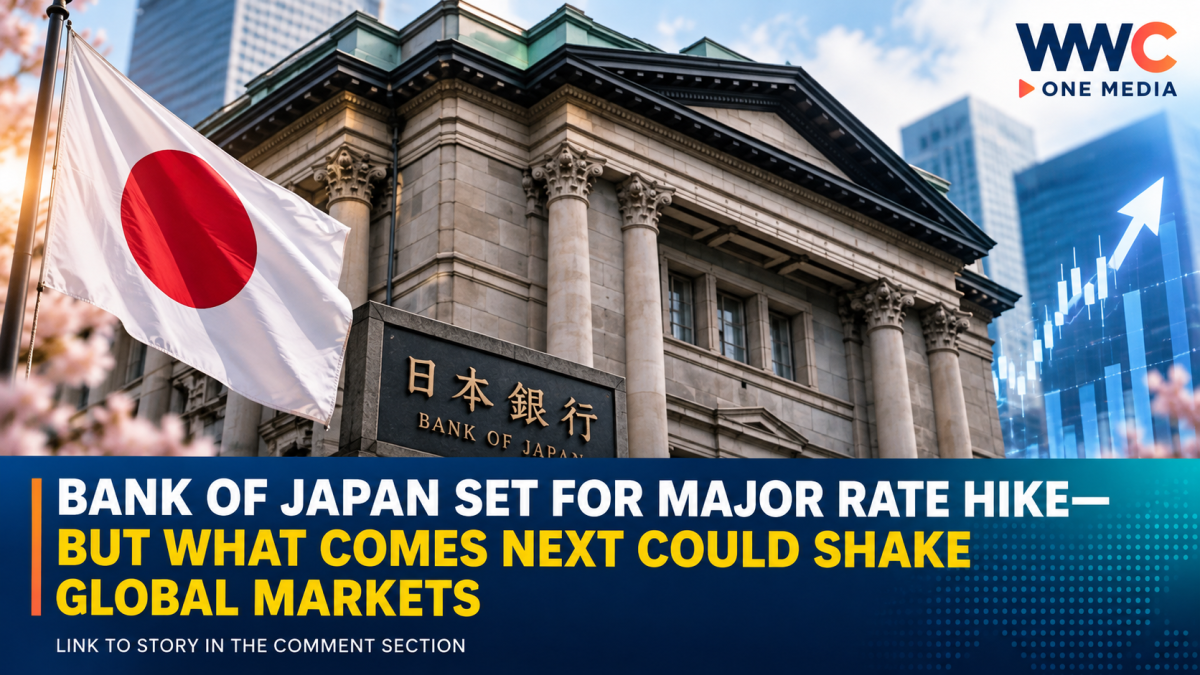
TOKYO — The Bank of Japan is widely expected to raise interest rates again next week, pushing borrowing costs to their highest level in more than three decades. But while investors are increasingly confident about the immediate decision, one major question remains unanswered: How far is Japan prepared to go?
The Bank of Japan is expected to increase its short-term policy rate by 25 basis points to 1.25% at its September 17-18 policy meeting, according to people familiar with the central bank’s thinking and recent market expectations.
If approved, the move would mark the BOJ’s second rate hike in just three months after the central bank raised rates to 1% in June—the highest level in 31 years.
But the bigger issue for global markets may not be next week’s decision.
It may be what comes after.
Markets See September Rate Hike as Nearly Certain
Expectations for a September increase have strengthened significantly in recent weeks as Japan faces renewed inflation pressure, rising energy costs and concerns that higher import prices could continue filtering through the economy.
Recent market pricing has pointed strongly toward a quarter-point increase, while a Reuters poll reported that economists expect the BOJ to lift rates to 1.25% this month and eventually reach 1.75% in the second quarter of 2027—earlier than previously expected.
Japan’s stronger-than-expected economic performance has also added to the case for tighter monetary policy.
Revised data showed Japan’s economy expanded at an annualised 1.4% in the second quarter, while real wages rose 2.4% in July from a year earlier, marking the strongest increase since May 2021 and extending a streak of wage gains.
Inflation Pressure Gives the BOJ More Reason to Act
Fresh inflation data has further complicated the outlook.
Japan’s wholesale inflation remained elevated in August, with the producer price index rising 7.6% from a year earlier, reinforcing concerns that higher energy and import costs could eventually place more pressure on consumer prices.
The sharp rise in import costs has been linked in part to surging fuel prices and currency movements, adding another challenge for policymakers trying to keep inflation under control.
BOJ policymakers have increasingly signalled concern that inflation could remain stronger than expected.
Board member Kazuyuki Masu said the central bank may eventually need to accelerate the pace of interest-rate increases if inflation picks up further, highlighting the fact that Japan’s financial conditions remain relatively accommodative.
But the BOJ May Refuse to Reveal Its Final Destination
Despite growing confidence that another rate hike is coming, investors may leave next week’s meeting with little clarity about where Japan’s tightening cycle will ultimately end.
Sources familiar with the BOJ’s thinking suggest policymakers are unlikely to provide a clear estimate of the so-called terminal rate—the level at which interest rates could eventually peak.
That uncertainty could become increasingly important for financial markets.
Governor Kazuo Ueda and other policymakers have repeatedly emphasised that future decisions will depend on economic activity, inflation trends, wage growth and whether companies continue passing higher costs on to consumers.
The BOJ expects underlying inflation pressures to remain a critical factor in determining how quickly—or how far—it can raise rates. Reuters reported that the central bank’s forecasts point to core consumer inflation reaching 2.5% by March 2027.
Why the Next BOJ Move Could Matter Far Beyond Japan
The Bank of Japan’s policy decisions are closely watched around the world because Japan spent decades operating with ultra-low—and at times negative—interest rates.
Those low borrowing costs helped fuel the global yen carry trade, where investors borrowed cheaply in yen and invested in higher-yielding assets elsewhere.
As Japanese rates rise and the yen strengthens, those positions could become less attractive, potentially triggering broader adjustments across global currency, bond and equity markets.
The yen has already strengthened sharply as expectations for a September rate hike have increased, raising concerns among investors about the potential unwinding of yen-funded trades.
Bigger Hike Still Unlikely—for Now
Some market speculation has focused on whether the BOJ could deliver a more aggressive 50-basis-point increase.
However, sources familiar with the central bank’s thinking have indicated that policymakers have little appetite for such a dramatic move at this stage, given the risk of shocking an economy and public that became accustomed to decades of near-zero borrowing costs.
The more likely scenario remains a conventional 25-basis-point hike to 1.25%.
All Eyes Now Turn to Ueda
For investors, next week’s rate decision may be only half the story.
The real focus will likely shift to Governor Ueda’s comments after the meeting.
Will the BOJ signal another increase before the end of the year?
Could rates move faster if inflation accelerates?
Or will policymakers slow down after reaching 1.25%?
For now, the message appears increasingly clear: Japan is moving further away from the era of ultra-cheap money.
But exactly where the Bank of Japan stops remains one of the biggest unanswered questions facing global markets.
And with inflation, energy prices, the yen and global financial conditions all moving rapidly, the BOJ’s next signal could prove just as important as its next rate hike.




Leave a Reply