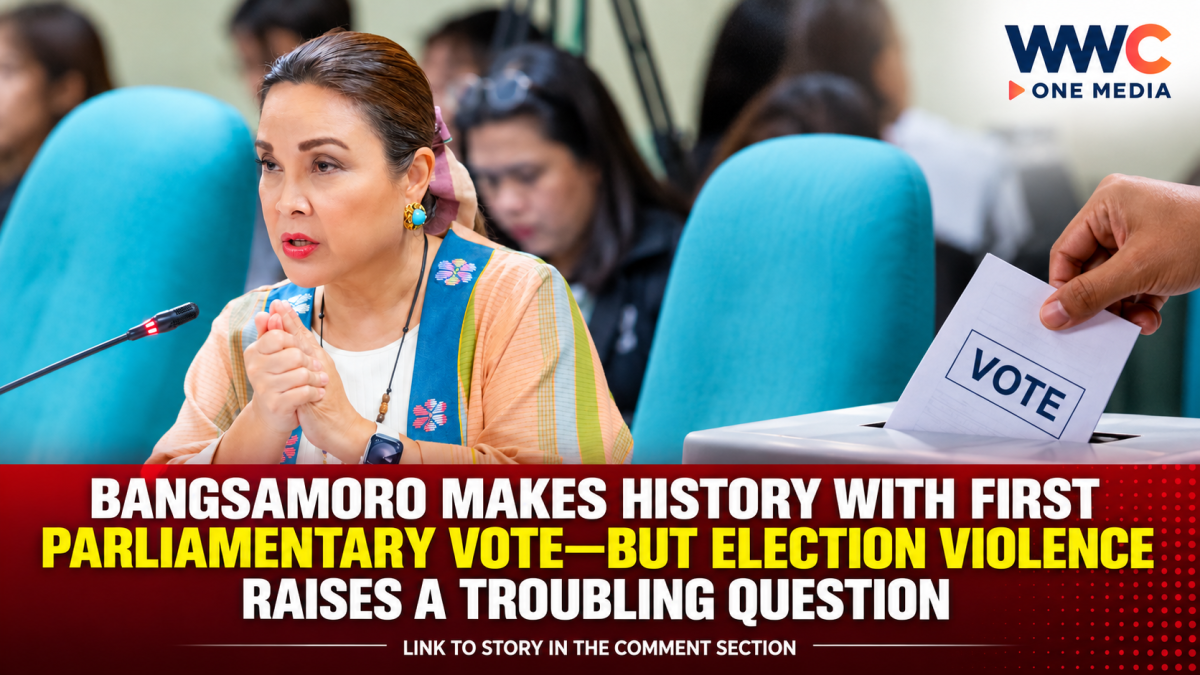
The Bangsamoro Autonomous Region in Muslim Mindanao (BARMM) has entered a new political era after voters cast ballots in the region’s first regular parliamentary elections, a milestone Senator Loren Legarda described as a historic step toward elected self-governance.
But while the September 14 vote marked a major achievement in the decades-long Bangsamoro peace process, election-related violence in Cotabato City left people dead and wounded, casting a shadow over an election that was intended to demonstrate the region’s transition from conflict to democratic governance.
Legarda welcomed the historic vote but strongly condemned the violence, saying the Bangsamoro people’s right to choose their leaders must never be determined by intimidation, fear or force.
“History was written in the Bangsamoro,” Legarda said in a statement, emphasizing that the ballot represented the culmination of years of negotiations, legislation and institution-building under the peace process.
First elected Bangsamoro Parliament
The September 14 elections were the first regular parliamentary polls held in BARMM, replacing the previous transitional arrangement in which parliament members were appointed.
The election covered 80 seats in the Bangsamoro Parliament, which is composed of 40 party representatives, 32 district representatives and eight sectoral representatives.
The elections were a key part of implementing the Bangsamoro peace framework that followed the 2014 Comprehensive Agreement on the Bangsamoro between the Philippine government and the Moro Islamic Liberation Front (MILF).
The agreement helped pave the way for the creation of BARMM and the transition from armed conflict toward regional autonomy.
The significance of the vote was underscored by the high level of participation. GMA News reported that the final voter turnout reached 84.34 percent, with 2,018,478 voters casting ballots out of approximately 2.393 million registered voters.
The turnout was viewed by election officials as a sign that voters continued to participate despite security concerns.
Violence mars historic election
The historic achievement, however, was accompanied by deadly violence.
Legarda cited Commission on Elections Chairperson George Erwin Garcia’s account that two shooting incidents in Cotabato City left four people dead and 18 others wounded. She called for a prompt and credible investigation into the incidents.
Other reports documented similar but slightly different casualty figures as authorities continued to assess the incidents. GMA News reported four deaths and 19 injuries linked to election-related incidents, including shootings at polling locations in Cotabato City.
The violence was serious enough to draw concern from election observers.
The Asian Network for Free Elections (ANFREL) and the National Democratic Institute urged political stakeholders to exercise restraint and allow Bangsamoro voters to participate freely. The groups cited concerns about an escalation of violence surrounding the election.
The Commission on Human Rights likewise said its election monitors observed reports involving security threats, election-related violence, gun-ban violations, ballot irregularities, intimidation, vote-buying and disinformation. The CHR stressed that these were reports requiring verification and should not automatically be treated as final findings.
Election described as generally peaceful
Despite the deadly incidents, election authorities characterized the overall conduct of the polls as generally peaceful.
The Commission on Elections and the Philippine National Police described the violence as isolated incidents rather than evidence of a breakdown of the entire electoral process. Malacañang also cited the PNP’s assessment that the September 14 elections were generally peaceful and orderly despite casualties in Cotabato City.
More than 20,000 security personnel were deployed across voting areas as authorities prepared for the region’s first parliamentary election.
The heightened security reflected the region’s complicated history, where political rivalries, clan conflicts and decades of armed insurgency have previously contributed to election-related violence.
Former MILF factions dominate early results
The election also revealed the political landscape that will shape the new Bangsamoro Parliament.
Partial results showed two political groups associated with rival factions of the former MILF emerging as the leading forces.
The Bangsamoro Federalist Party (BFP) led by transitional Chief Minister Abdulraof Macacua received about 35 percent of the vote, while the United Bangsamoro Justice Party (UBJP) associated with MILF chairman Ahod “Al Haj Murad” Ebrahim received about 32 percent. The BARMM Grand Coalition followed with roughly 20 percent.
Final results showed that the BFP secured 16 of the 40 party-representation seats, while the UBJP won 15. The BARMM Grand Coalition secured eight and the Raayat Democratic Party won one.
Neither major bloc secured a majority of the 80-seat Parliament, meaning cooperation among different political groups will be necessary as the new government takes shape. Reuters reported that coalition-building will be important in determining who becomes the region’s first elected chief minister.
What happens next?
The newly elected parliamentarians are scheduled to assume office on October 30, 2026, and will then elect the region’s chief minister. The first elected officials are expected to serve until June 30, 2031.
For Legarda, however, the significance of the election goes beyond simply choosing new political leaders.
She said the real test will be whether the new Bangsamoro government can translate political autonomy into safer communities, stronger institutions, better education and economic opportunities.
The senator also congratulated the newly elected parliamentarians and urged them to honor the trust placed in them by Bangsamoro voters.
A historic vote, followed by an even bigger test
The first BARMM parliamentary election represents an important stage in the Philippines‘ long-running effort to transform a conflict-affected region into an autonomous political community governed through democratic institutions.
But the violence surrounding the vote highlights the challenges that remain.
The election demonstrated that large numbers of Bangsamoro voters were willing to participate in the democratic process despite security concerns. At the same time, reports of shootings, intimidation and other election-related incidents show that the transition from armed conflict and political violence to stable democratic governance is not complete.
The question now moves beyond who won the 80 seats.
The bigger test will be whether the newly elected Bangsamoro Parliament can turn this historic electoral milestone into lasting peace, accountable government and meaningful improvements in the lives of the people it represents.