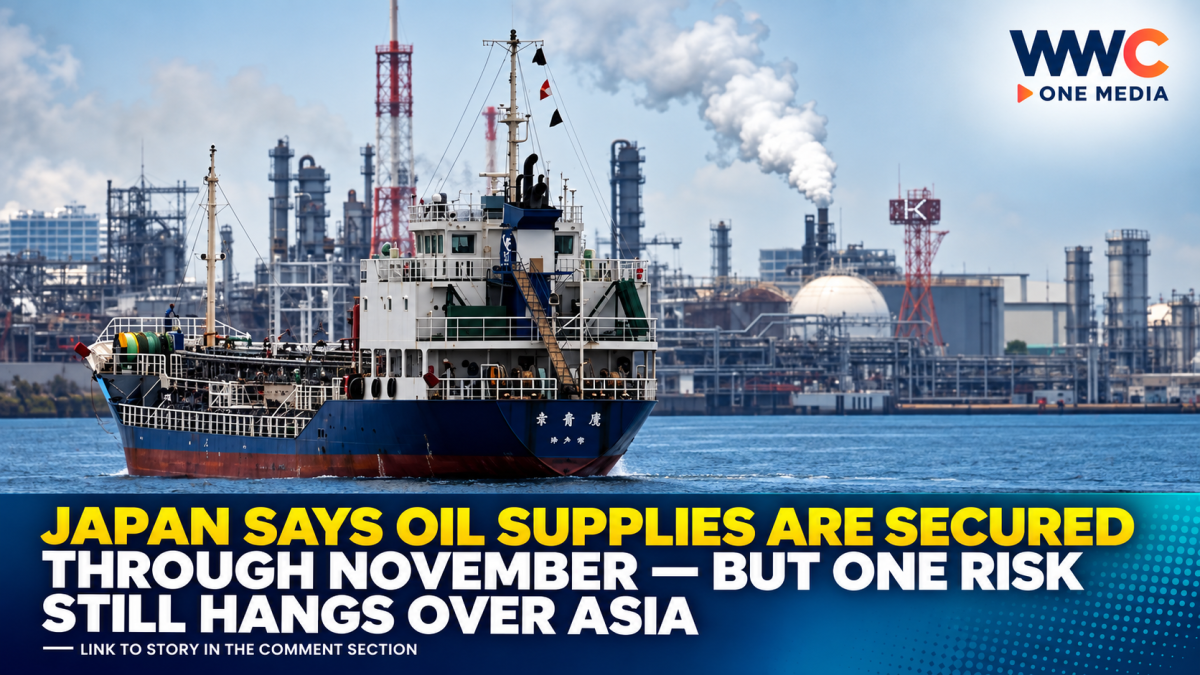
TOKYO — Japan’s oil refiners have secured enough crude to maintain supplies through November, offering temporary relief to a market still facing uncertainty over Middle Eastern oil flows.
The Petroleum Association of Japan (PAJ) said on Friday that refiners had obtained sufficient crude supplies through November despite renewed concerns over disruptions following escalating fighting involving Saudi Arabia and Yemen’s Iran-backed Houthi movement.
The announcement provides a measure of reassurance for one of Asia’s major oil-importing economies, but Japanese industry officials cautioned that the situation remains fluid and future supplies could still be affected if regional disruptions worsen.
Saudi oil is still reaching Japan — but the route has changed
PAJ President Shunichi Kito said Saudi crude shipments had not stopped completely, partly because oil can be moved through the Strait of Hormuz and then transferred to other vessels outside the Gulf.
“In some cases, oil passes through the Strait of Hormuz at Saudi Arabia’s risk before being transferred to us outside the Gulf,” Kito said, according to Reuters.
However, he warned that there was no guarantee the arrangement would continue indefinitely.
Japan’s refiners have also been able to rely on stockpiles from earlier releases of the country’s national oil reserves. Kito said the industry had secured supplies through November without requiring another release of national reserves at this stage.
Still, he did not rule out the possibility that additional emergency reserve releases could eventually be needed, depending on how the regional conflict develops.
Why Japan remains vulnerable
Japan is particularly exposed to disruptions in the Middle East because of its heavy reliance on imported crude.
Earlier Reuters reporting showed that Japanese refiners have been working to diversify their supplies. Eneos, Japan’s largest refiner, previously said it had secured alternative crude from sources including the United States while also obtaining Middle Eastern barrels through routes that avoid or reduce exposure to the Strait of Hormuz.
The pressure on Asian refiners has become increasingly visible. Bloomberg-reported industry data showed that Japanese refiners Eneos and Idemitsu Kosan moved to purchase Oman crude for loading as early as October, earlier than their normal procurement schedules, as competition for prompt Middle Eastern barrels intensified.
That competition has also pushed up premiums for some crude cargoes as refiners across Asia search for alternative supplies.
Saudi Arabia offers another potential supply route
There are signs that Saudi Arabia is finding ways to maintain some exports despite disruption to its Red Sea infrastructure.
Reuters reported on Friday that Saudi Aramco had sold roughly 60 million barrels of crude from its Gulf export terminal at Ras Tanura for loading in September and October through ship-to-ship transfers near Oman.
The additional Gulf exports could partially compensate for reduced volumes from Saudi Arabia’s Red Sea port of Yanbu, where crude flows were disrupted after an attack damaged the East-West pipeline.
Some of those barrels are expected to head toward Asian buyers, including refiners in China, South Korea, India and Japan.
Oil prices remain above $100 despite the supply concerns
The developments have also been reflected in global oil markets.
Brent crude had climbed to around four-month highs earlier in the week as traders reacted to disruptions involving Saudi infrastructure and concerns about Middle Eastern supply.
By Friday, however, oil prices were moving lower as markets responded to signs that alternative supply routes could limit the immediate impact of the disruptions.
Reuters reported Brent crude falling about 2% to around $102.68 a barrel, while U.S. West Texas Intermediate dropped to about $100.08 during Friday trading.
The move illustrates the tension facing the market: supply risks remain significant, but traders are also watching whether producers can reroute enough crude to prevent a deeper shortage.
Japan’s November supply cushion is not a guarantee
The PAJ’s announcement does not mean Japan is insulated from the crisis.
Rather, it indicates that Japanese refiners currently have enough secured crude, inventories and alternative arrangements to cover their needs through November.
The bigger question is what happens after that if disruptions persist.
Japan has already been looking beyond traditional Middle Eastern supplies. Earlier this year, Eneos said it was pursuing greater diversification, including U.S. crude and supplies from other producing regions, while maintaining relationships with Middle Eastern suppliers.
The International Energy Agency has also continued to monitor the effects of Middle Eastern disruptions on global oil supply, inventories, demand and refining activity in its September Oil Market Report.
For now, Japan’s refiners have a buffer.
But with Middle Eastern shipping routes and export infrastructure still under pressure, the durability of that buffer will depend on whether crude flows stabilize — or whether another disruption forces Asian buyers back into an increasingly competitive spot market.