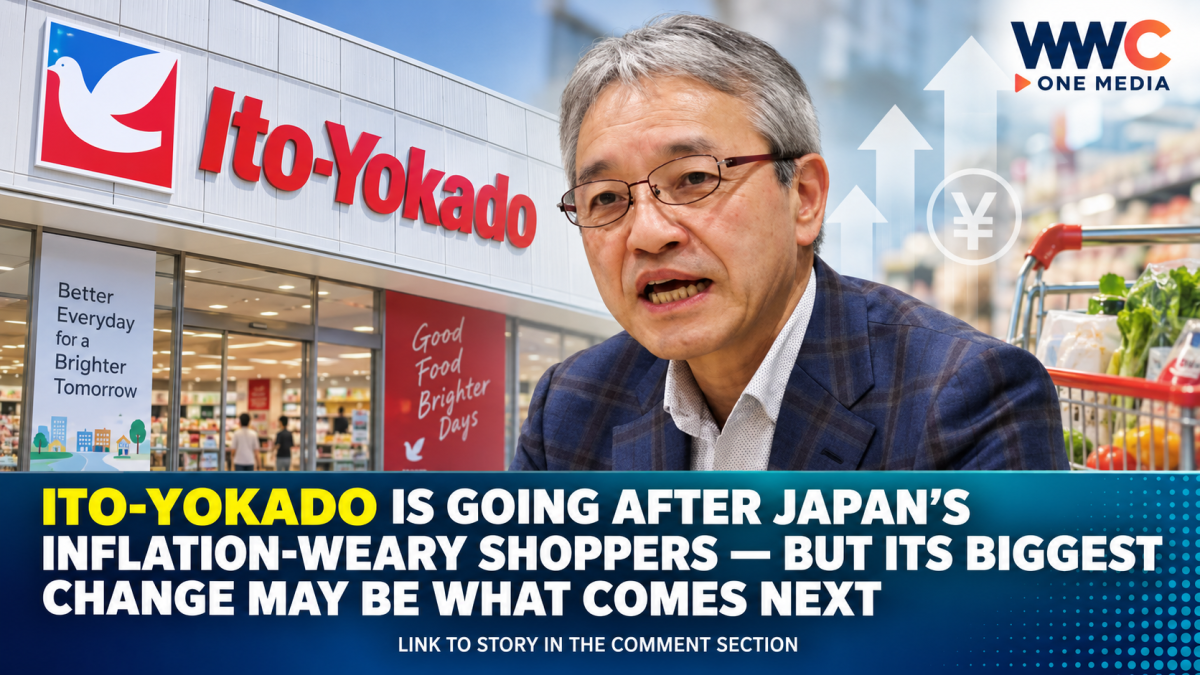
TOKYO — Ito-Yokado is stepping up its push for lower-priced products as Japanese consumers become increasingly sensitive to rising living costs, with its parent York Holdings seeking to win back shoppers while preparing for a potential stock-market listing as early as 2028.
York Holdings CEO Seiichiro Itabashi told Reuters that the operator of Ito-Yokado and York-Benimaru is expanding its low-cost private-label offerings and reviewing its pricing strategy as inflation changes how Japanese households shop.
“Many customer groups are extremely sensitive to price,” Itabashi said, according to Reuters. He added that getting price increases wrong during an inflationary period could mean losing customers.
The strategy comes as Japanese retailers face growing competition from discount-focused supermarket chains and consumers increasingly compare prices before spending.
Ito-Yokado plans about 400 low-price products
One of the key elements of the strategy is the expansion of Seven The Price, Ito-Yokado’s lower-priced private-label brand.
Ito-Yokado announced in March that it planned to expand the range to about 400 products during fiscal 2026, roughly 30% more than the previous fiscal year. The company said the initiative is designed to respond to stronger demand for savings amid continuing price increases.
The retailer says it is seeking to keep costs down through measures including simplified packaging, more efficient logistics and production, and streamlined product design.
The company has also reported strong growth in existing-store sales for the Seven The Price range, saying sales reached roughly twice the previous year’s level in fiscal 2024 and about 1.5 times the previous year’s level in fiscal 2025. It is targeting another increase in fiscal 2026.
Japanese business publication ITmedia reported in March that the expanded lineup includes everyday products such as mayonnaise, seaweed, instant coffee and other household staples, with some products designed around larger package sizes to reduce the unit cost for consumers.
Why prices have become such a critical issue
The move comes as Japanese households continue to face elevated food costs.
According to The Japan Times, citing Teikoku Databank, 4,923 food and beverage products from 195 major manufacturers were scheduled for price increases in September 2026. The number of products with confirmed price increases for the year had reached 19,083 by the end of August, putting 2026 on track to exceed 20,000 for the second consecutive year.
Higher crude oil prices, a weaker yen and rising logistics costs have contributed to pressure on food prices.
At the same time, Japan’s core consumer inflation remained at 1.7% year-on-year in August, according to Reuters, while an inflation measure excluding fresh food and fuel rose 1.9%.
That environment is making value increasingly important for supermarkets competing for everyday grocery spending.
York Holdings wants to shed Ito-Yokado’s expensive image
Itabashi said York Holdings is also trying to broaden Ito-Yokado’s customer base and move away from an image associated with relatively high prices.
The company is investing in stores and looking to attract younger consumers while maintaining its existing customer base, which currently skews older, Reuters reported.
York is also considering whether some private-label products should eventually carry different prices in its supermarkets and at Seven & i Holdings’ 7-Eleven convenience stores.
At present, company-branded products have the same prices across the two formats, Reuters reported.
A major change since Seven & i
The strategy comes after Ito-Yokado became part of a new ownership structure.
Seven & i Holdings transferred its supermarket and other retail businesses into York Holdings as part of a transaction involving Bain Capital in 2025. Seven & i retained a 35.07% stake, while Bain Capital held 60%, with the remaining stake held by the Ito founder family, according to Seven & i’s disclosure.
York Holdings now includes Ito-Yokado, York-Benimaru, Loft, Akachan Honpo and other businesses.
The ownership change has also put greater emphasis on restructuring the supermarket business and preparing it for future growth.
The bigger supermarket battle
Japan’s supermarket industry remains highly fragmented, making scale and pricing increasingly important.
Itabashi told Reuters that the country’s 10 largest supermarket operators collectively account for only about 20% of the market. He said larger players will ultimately need substantially greater market share to remain competitive.
York is therefore looking not only at pricing but also at store formats and potential acquisitions.
A separate Reuters interview published on Friday reported that York Holdings is considering smaller-format Ito-Yokado supermarkets in central Tokyo, where available retail space can be difficult to secure and competitors such as Aeon and Trial Holdings are also expanding smaller store formats.
What shoppers could see next
For consumers, the most visible change is likely to be a broader selection of lower-priced private-label products rather than across-the-board price cuts.
Ito-Yokado’s own strategy emphasizes lowering costs through product design, packaging, logistics and production efficiencies, allowing the company to offer selected products at more competitive prices.
That distinction matters because Japan’s food industry is still facing substantial cost pressures. Industry data cited by The Japan Times suggests manufacturers continue to announce price increases even as some retailers and food-service companies experiment with targeted price reductions.
For York Holdings, the challenge is therefore broader than simply cutting prices. It is trying to make Ito-Yokado more competitive in a market where shoppers are increasingly focused on value, while simultaneously investing in stores, expanding private-label products and positioning the group for a possible 2028 initial public offering.
The next phase of Ito-Yokado’s transformation could ultimately come down to a simple question for shoppers: Can the retailer convince customers that its prices—and not just its products—are worth coming back for?