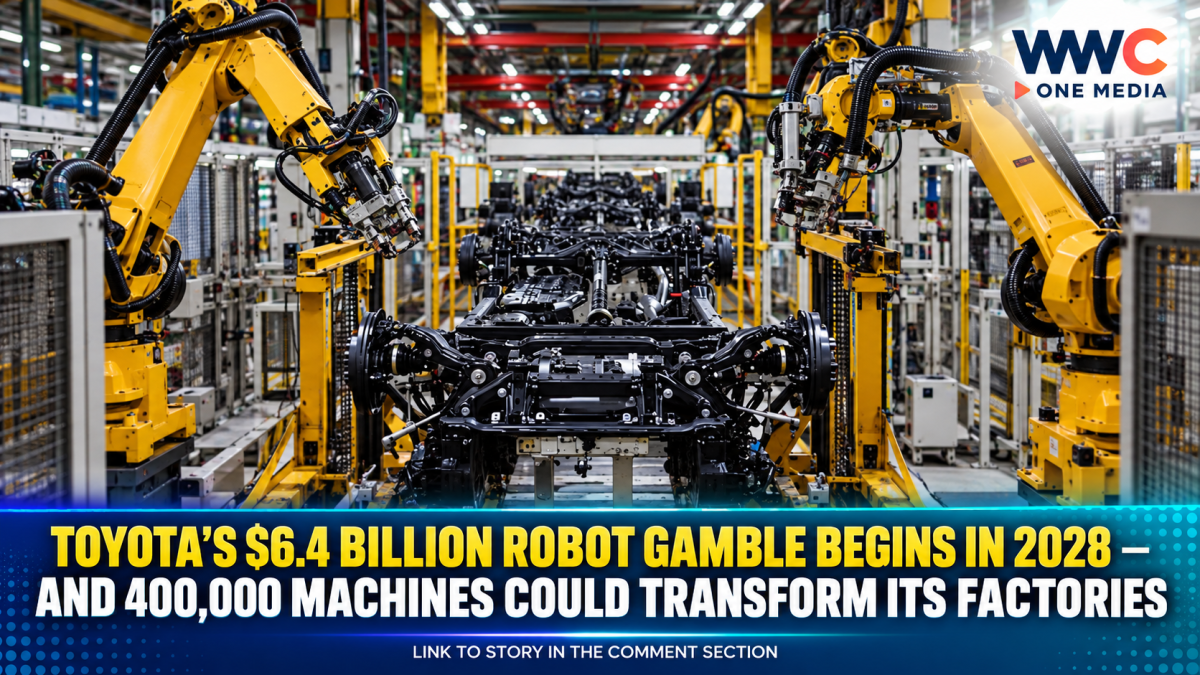
TOKYO — Toyota Motor is preparing for one of the biggest automation pushes in its manufacturing history, estimating that factory modernization could require around 1 trillion yen (US$6.4 billion) in spending every year from 2028.
The Japanese automaker says the potential investment would cover Toyota, its group companies and major suppliers as it accelerates the use of robotics, automated logistics and technologies designed to allow humans and machines to work together on factory floors.
But the size of the plan is only part of the story.
Toyota told investors that roughly 400,000 robots could be needed across the wider Toyota production network. The figure includes both humanoid and conventional industrial robots, as well as machines replacing existing equipment and robots added for new automation capabilities.
The company has not committed to spending exactly 1 trillion yen every year for a specified number of years. Toyota has described the amount and robot requirement as estimates tied to its broader factory-modernization strategy. Bloomberg reporting likewise described the figures as estimates rather than a firm spending commitment.
Why Toyota is betting so heavily on robots
Toyota’s push comes as automakers face two pressures at the same time: the need to modernize aging production infrastructure and growing shortages of manufacturing labor.
For Toyota, automation is also becoming part of a broader strategy to connect physical manufacturing with artificial intelligence.
The company’s latest plan goes beyond simply installing robotic arms on assembly lines. The automation push includes industrial robots, automated movement of parts and materials, and future systems in which humans and robots work alongside each other.
Toyota has already been developing robotics technology through its research operations. Its FY2026 materials describe factory demonstrations involving automated parts transportation and parts picking, while the company says it wants robots to improve productivity while creating more comfortable working environments for people.
Toyota’s 400,000-robot figure is bigger than it first sounds
The roughly 400,000 robots are not all planned for Toyota-owned factories.
Japanese industry reporting says the broader figure includes approximately 150,000 robots operated by Toyota and Toyota group companies and another 250,000 at suppliers. The modernization program is intended to connect production across the wider supply chain rather than treating individual factories as isolated operations.
That means Toyota’s automation strategy could extend well beyond vehicle assembly.
The company is looking at an increasingly connected manufacturing environment in which factories, robots, logistics systems and production data communicate with one another.
Japanese automotive publication Car Watch reported that Toyota is targeting what it describes as a new generation of factory automation, including the use of so-called Large Behavior Models, or LBM, to help robots learn physical tasks.
Meet ELEY: Toyota’s physical-AI experiment
One of Toyota’s more closely watched projects is a robot called ELEY, developed as part of its research into what is increasingly being called “physical AI.”
Unlike conventional industrial machines that are programmed for highly specific repetitive movements, physical-AI systems are intended to allow robots to learn and adapt to tasks in the real world.
Car Watch reported that Toyota demonstrated ELEY learning tasks such as folding a T-shirt using a Large Behavior Model. The demonstration was intended to show how robots can learn physical behavior from humans and subsequently perform actions autonomously.
Yomiuri Shimbun also reported that Toyota is developing robots designed to work alongside people, with the company ultimately considering selling the technology outside the Toyota Group to businesses that share its human-assistance approach.
That could eventually turn Toyota’s robotics research into a business in its own right rather than simply an internal manufacturing tool.
Toyota says humans still have a role
The rapid expansion of automation naturally raises questions about what happens to factory jobs.
Toyota’s stated approach is not simply to replace workers with machines. The automaker has previously described its robotics strategy as one based on collaboration between people and robots, with automation taking on tasks while workers move toward activities requiring greater human judgment and expertise.
Toyota’s experience at its Kamigo Plant illustrates that approach.
The company has already automated some engine-production processes while using knowledge developed by workers who previously performed those tasks manually. Toyota says this human experience can help teach robots how to carry out more complicated physical operations.
Toyota is not alone in the robot race
The shift is happening across the global auto industry.
Hyundai Motor, which owns Boston Dynamics, has said it plans to deploy humanoid robots at its US manufacturing operations in Georgia from 2028. That places Toyota’s timetable within a broader race among automakers to determine how far humanoid and AI-enabled robots can be integrated into mass production.
The difference is that Toyota’s latest estimate involves the entire manufacturing ecosystem — factories, group companies and major suppliers — rather than a single experimental production line.
What the $6.4 billion estimate really means
Toyota’s potential 1 trillion-yen annual spending estimate should not be interpreted as Toyota simply writing a $6.4 billion check for robots every year.
The figure encompasses a much broader modernization effort involving factories and production equipment, including robot replacement, new installations, logistics automation and human-robot collaboration. Bloomberg and Japanese industry reports also indicate that the estimate is tied to factory renewal and modernization rather than a fixed, unconditional annual robotics budget.
The scale nevertheless signals how seriously Toyota is approaching automation.
For the world’s largest automaker by vehicle sales, the factory of the future may increasingly depend on a combination of skilled workers, connected production systems and AI-powered machines.
And if Toyota succeeds in deploying physical-AI robots across its factories and suppliers, the bigger transformation may not be what happens inside Toyota’s plants — but what happens to the wider automotive manufacturing industry afterward.