
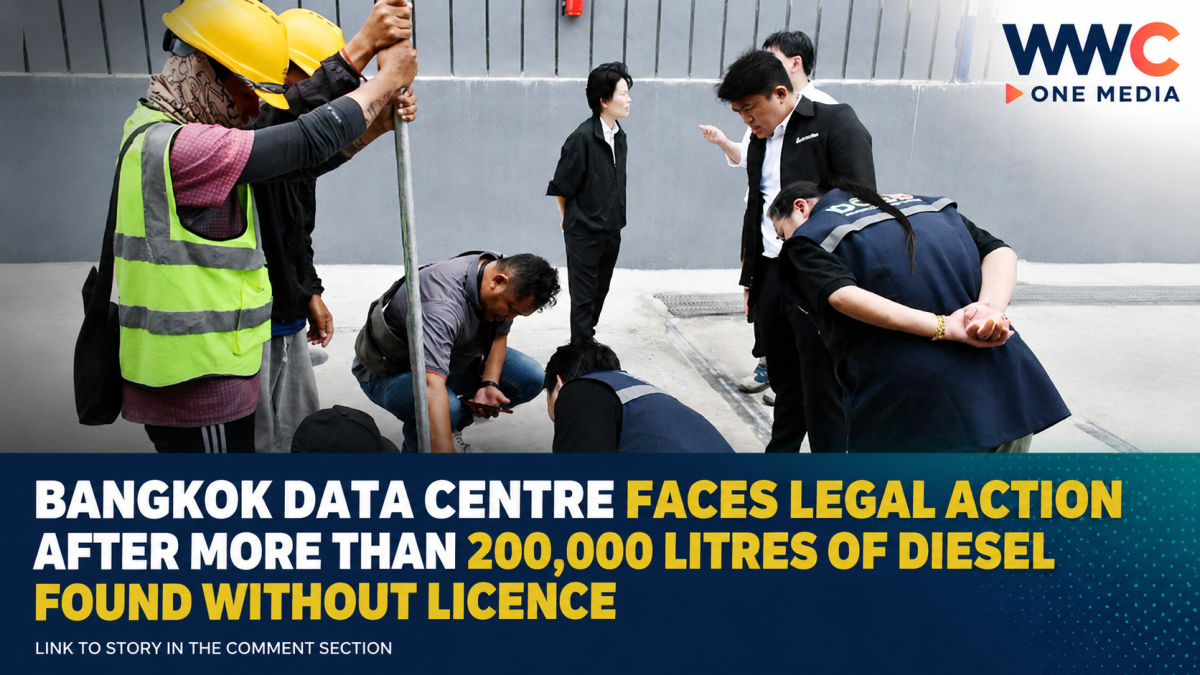
BANGKOK — A data centre on Bangkok’s Rama 9 Road is facing possible legal action after Thailand’s Department of Energy Business found more than 200,000 litres of diesel stored for emergency generators without the required licence, prompting authorities to order the fuel removed from the site.
The case has triggered wider scrutiny of how data centres are approved and regulated in Bangkok, particularly when large backup-fuel supplies are located in densely populated urban areas.
Officials are preparing to file a complaint with police under Thailand’s Fuel Control Act after an inspection found diesel stored in tanks with a combined capacity exceeding 200,000 litres. The operator was subsequently ordered to remove the fuel, and a follow-up inspection found that the tanks had been emptied.
Complaints about fuel-like odour sparked inspection
The inspection followed complaints from nearby residents and businesses about a strong smell resembling fuel that had reportedly persisted for more than two months.
According to officials cited by Thai PBS and The Nation, the smell was particularly noticeable during periods of heavy rain. Some people reportedly experienced symptoms including dizziness and vomiting, although these complaints do not by themselves establish that the fuel caused those symptoms.
The facility is located near Rama 9 Hospital, adding to concerns raised about the presence of substantial quantities of diesel in a densely developed part of Bangkok.
What makes the diesel storage a legal issue?
The key issue is not simply that the facility had backup generators.
Large data centres commonly maintain emergency generators because uninterrupted electricity is essential to their operations. The regulatory question is how much fuel can legally be stored, where it can be stored and whether the required permits have been obtained.
Thailand’s Department of Energy Business said the Rama 9 facility had stored more than 200,000 litres of diesel without the necessary authorisation. Under the law cited by officials, a proven violation can carry a maximum penalty of two years’ imprisonment, a fine of up to 200,000 baht, or both.
Importantly, authorities have ordered the fuel removed, but the potential criminal liability remains a matter for the legal process to determine.
Bangkok now reviewing data-centre rules
The Rama 9 case comes as Bangkok authorities are taking a broader look at the rapid expansion of data centres across the capital.
On September 2, Bangkok Governor Chadchart Sittipunt and representatives of the Bangkok Metropolitan Administration, Metropolitan Electricity Authority, Metropolitan Waterworks Authority and Energy Ministry discussed tighter oversight of data-centre developments.
Authorities have temporarily halted consideration of three planned standalone data-centre projects while relevant standards are reviewed. The government is also examining rules covering land use, building controls, environmental impacts, electricity, water consumption and emergency fuel storage.
A regulatory loophole is also under scrutiny
Another issue emerging from the investigation is that Thailand’s existing regulations were not originally designed around today’s large standalone data centres.
Officials and Bangkok authorities have said some projects may have been approved under classifications such as warehouses, potentially allowing them to proceed without being subjected to regulatory requirements that would apply to other types of major facilities.
Thailand has now formally introduced a definition of a data centre, with authorities planning to use that definition when reviewing zoning, building and environmental regulations.
Authorities are particularly concerned about ensuring that future projects cannot exploit gaps between different regulatory systems.
Electricity and water concerns are being examined too
Fuel storage is only one part of the wider debate.
Bangkok officials have also been examining whether data centres could place excessive demands on the city’s electricity and water infrastructure.
According to Bangkok authorities cited by MGR Online and The Standard, data centres operating in Bangkok generally use around 8–20 megawatts of electricity, while cooling-water consumption has been estimated at roughly 7,800 cubic metres per month for the facilities discussed. Officials said these levels are comparatively lower than the consumption of some major hospitals and shopping centres.
That does not mean the concerns have been dismissed. Instead, authorities are seeking clearer standards that account for the location, size and infrastructure requirements of individual data-centre projects.
Diesel storage rules could become stricter
The Energy Ministry has indicated that it does not want emergency diesel storage facilities serving data centres to be established in densely populated urban communities.
Authorities are also temporarily suspending new approvals for such fuel-storage facilities while broader criteria are developed.
MGR Online reported that officials are considering a framework that would address emergency fuel supplies, zoning, environmental requirements and the relationship between data centres and surrounding communities.
The bigger question: Can Bangkok’s data-centre boom continue?
Thailand is actively encouraging investment in data centres because of their importance to the country’s digital economy, cloud infrastructure and emerging AI industry.
But the Rama 9 investigation highlights a growing challenge: how can Bangkok attract high-tech infrastructure without allowing safety, environmental and urban-planning rules to fall behind the speed of investment?
The government is scheduled to hold the first meeting of its Data Centre Business Policy Committee on September 4, where officials are expected to discuss zoning criteria and reviews of building, environmental and safety regulations.
For the Rama 9 facility, meanwhile, the immediate issue is much narrower — and potentially more serious.
Authorities say the diesel has been removed.
But the question of whether the operator illegally stored more than 200,000 litres of fuel — and whether anyone will ultimately be held criminally responsible — is now moving to the next stage.
What we know so far
- Location: Rama 9 Road, Bangkok, near Rama 9 Hospital.
- Fuel involved: More than 200,000 litres of diesel stored for emergency generators.
- Regulatory issue: Authorities say the required fuel-storage licence had not been obtained.
- Action taken: Officials ordered the diesel removed; a follow-up inspection found the tanks emptied.
- Potential penalty: Up to two years in prison, a fine of up to 200,000 baht, or both, if an offence is established.
- Next step: The Department of Energy Business is preparing a police complaint.
- Wider response: Bangkok and national authorities are reviewing data-centre zoning, environmental, safety and fuel-storage regulations.
WWC ONE MEDIA G.A



Leave a Reply