
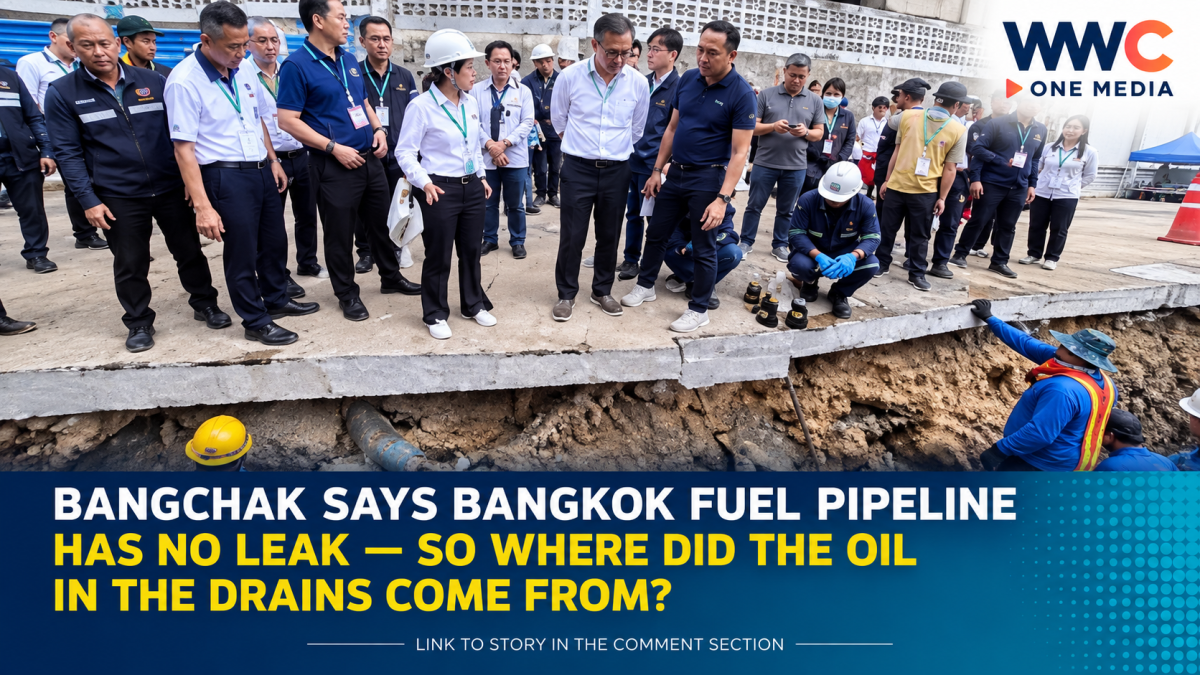
Bangchak Group says pressure testing has found no active leak in the underground fuel pipeline near Chuea Phloeng Road and Bangkok’s Rama 3 elevated road, adding a new twist to an investigation that began after oil contamination was discovered in the area’s drainage system.
The company’s pipeline operator, Bangkok Fuel Pipeline and Logistics Co. (BFPL), said a controlled pressure test conducted on September 11 showed no abnormal pressure drop or liquid seepage. The result came after several days of excavation and inspections following reports of oil contamination around the boundary of Khlong Toei and Yan Nawa districts.
But that does not mean the broader incident has been solved.
Authorities are still trying to establish exactly how the oil entered the drainage system and whether there was a previous or localized source of contamination that is no longer detectable under current pipeline conditions.
What the Latest Pipeline Test Found
BFPL said it temporarily suspended fuel transportation through the pipeline on September 8 as a safety precaution.
Engineers subsequently carried out a Direct Current Voltage Gradient (DCVG) inspection to look for abnormalities in the pipeline’s external protective coating. Three locations were identified for further examination and were excavated on September 10.
At one excavation site, workers found water mixed with oil, but the source could not immediately be established.
That prompted a more definitive pressure test the following day.
According to Bangchak, pressure was gradually raised from 10 barg to the pipeline’s normal operating pressure of 28 barg and maintained for one hour.
The company said there was no abnormal pressure loss, no liquid seepage and no other evidence indicating a pipeline leak during the test. Government representatives, including officials from the Energy Ministry, Department of Energy Business, Bangkok Metropolitan Administration and Pollution Control Department, observed the inspection.
Why This Is More Complicated Than a Simple “No Leak” Finding
The latest announcement needs to be viewed alongside what happened earlier in the week.
Oil contamination was discovered in drainage infrastructure along Chuea Phloeng Road and beneath the Rama 3 elevated road, accompanied by strong oil-like odours.
Bangkok authorities responded by blocking portions of the drainage system, deploying oil-absorbent barriers and pumping contaminated water out of the drains. Officials reported recovering approximately 22,000 litres of contaminated material during the early response.
Earlier reports also said excavation had located an apparent leak area and prompted Thailand’s Energy Ministry to order the companies involved with the pipeline system to investigate, repair the affected infrastructure and cover appropriate cleanup and compensation costs.
The subsequent pressure test, however, produced a different finding: no active pipeline leak was detected under the test conditions.
That distinction is important.
It would be inaccurate to conclude that investigators have definitively determined the contamination did not come from the pipeline. The investigation into the source remains ongoing.
Bangchak Orders More Advanced Tests
BFPL says it will not stop with the pressure test.
The company plans to conduct short- and long-range ultrasonic testing along approximately one kilometre of pipeline around the affected area, together with radar scanning.
It also plans to send an Intelligent Pig through the pipeline next week.
An Intelligent Pig is an inspection device that travels through a pipeline and can provide detailed information about the internal condition of the pipe, helping engineers identify problems that may not be visible through external inspections or a conventional pressure test.
The results are expected to be submitted to Thailand’s Department of Energy Business before normal pipeline operations can resume.
Bangkok Had Warned of Fire Risk
The incident also triggered significant safety precautions because petroleum contamination inside drainage infrastructure can create potentially flammable vapours.
Firefighters maintained a 24-hour presence around the affected area while authorities monitored concentrations of flammable vapours using lower explosive limit measurements. Residents were urged not to smoke or create sparks near affected drain openings.
Authorities previously said evacuation of nearby communities was not necessary based on their assessments at the time.
Bangkok officials also said the contaminated material removed from the drainage system would be properly treated rather than discharged into public waterways.
Will Bangkok’s Fuel Supply Be Affected?
So far, there is no indication of a major disruption to aviation-fuel supplies.
Bangkok Aviation Fuel Services (BAFS), whose subsidiary owns the pipeline system involved, previously said the pipeline operator halted transportation after the contamination was discovered. BAFS said aviation-fuel deliveries to Don Mueang and Suvarnabhumi airports were not affected, and inland fuel transportation to northern Thailand continued to be managed.
Bangchak also says alternative transportation arrangements have been prepared to maintain product deliveries while the pipeline remains under investigation.
Bangchak Says It Will Pay If Its Operations Are Proven Responsible
Bangchak Group said it has been assisting affected residents, communities and businesses during the investigation, including providing food, drinking water and temporary accommodation where necessary.
The company also said that if the investigation ultimately establishes that damage or contamination resulted from BFPL’s operations, it is prepared to accept responsibility and provide appropriate and fair compensation.
That statement is significant because authorities had earlier instructed the companies involved to undertake cleanup, restoration and compensation related to confirmed damage from the incident.
The Big Question Now: Where Did the Oil Come From?
The latest pressure test has changed the direction of the investigation but has not ended it.
There is confirmed oil contamination in the drainage system. There were earlier concerns about a pipeline leak. Excavation found oil-mixed water at one location. Yet the subsequent controlled pressure test did not show an active leak in the fuel pipeline.
That leaves investigators with a critical question:
If the pipeline is currently holding pressure without leaking, what caused the oil contamination in Bangkok’s drains — and could there have been an earlier or localized release that is no longer detectable?
The planned ultrasonic, radar and Intelligent Pig inspections could provide the next major clue.




Leave a Reply