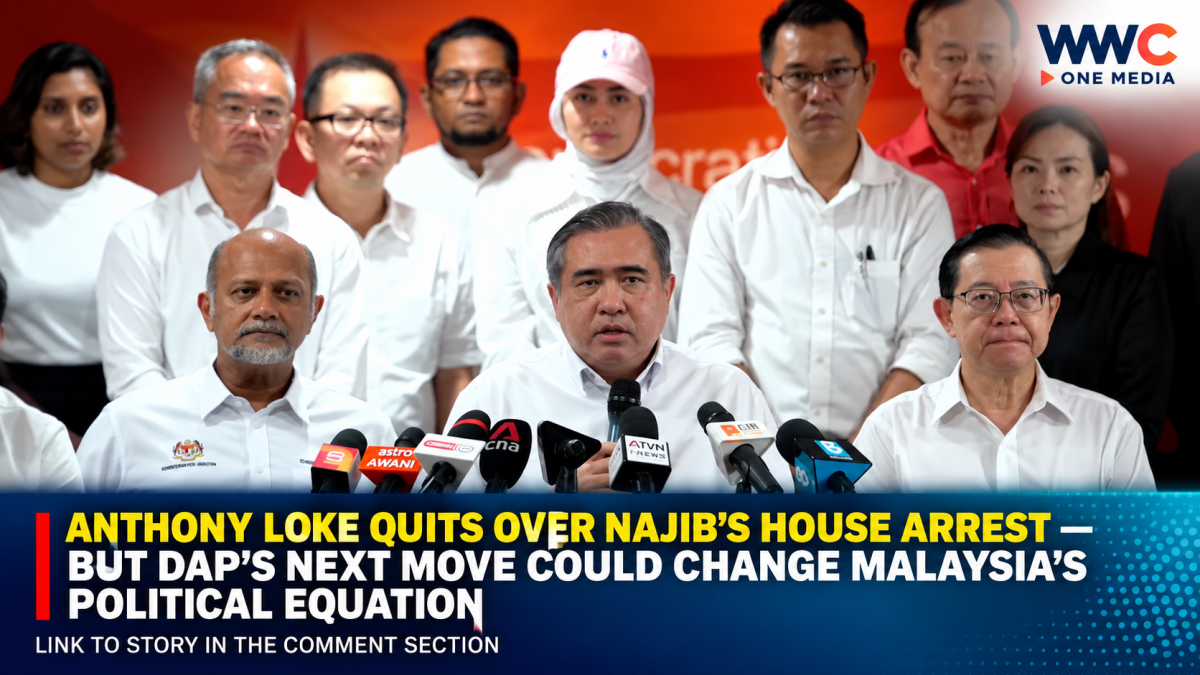
KUALA LUMPUR — Malaysia’s political tensions have intensified after Democratic Action Party (DAP) secretary-general Anthony Loke offered to resign as Transport Minister in protest against former prime minister Najib Razak being allowed to serve the remainder of his prison sentence under house arrest.
Loke announced the decision on Sept. 19, following a nearly three-hour emergency meeting of the DAP’s central executive committee.
But the move stops short of a Cabinet-wide DAP withdrawal.
Loke said he would be the only DAP minister to leave the Cabinet for now, while other DAP ministers would remain in Prime Minister Anwar Ibrahim’s unity government in the interests of political stability.
The decision creates an unusual split within one of the key parties supporting Anwar: Loke is stepping away from the Cabinet over the Najib decision, while DAP continues to support the government.
Why Loke is leaving
Loke said DAP respects the constitutional authority of Malaysia’s King to grant pardons, but argued that the decision to allow a convicted prisoner to serve the remainder of his sentence under house arrest was difficult for the party to accept.
He said the party had spent about three hours debating its response before deciding that he would offer his resignation.
Loke is expected to remain DAP secretary-general and continue serving as the Member of Parliament for Seremban.
His decision was framed by DAP as a personal ministerial resignation rather than an attempt to bring down the Anwar administration.
Loke said other DAP ministers were prepared to resign if necessary, but argued that a mass departure could destabilise the federal government.
DAP is staying in government
Despite Loke’s resignation, DAP will remain part of Anwar’s governing coalition.
The party currently holds several Cabinet positions, including Digital Minister Gobind Singh Deo, Federal Territories Minister Hannah Yeoh, Entrepreneur Development and Cooperatives Minister Steven Sim and Housing and Local Government Minister Nga Kor Ming.
Loke said the decision was intended to balance DAP’s position on accountability with the need to maintain political stability.
That means the immediate political consequence is not the collapse of Anwar’s government, but a visible disagreement within the ruling coalition over how the Najib case has been handled.
What happened to Najib?
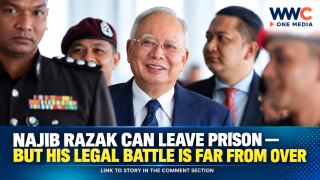
On Sept. 18, Malaysia’s King, Sultan Ibrahim, granted Najib Razak a conditional pardon allowing him to serve the remainder of his sentence under house arrest.
Najib, 73, had been serving a six-year sentence at Kajang Prison following his conviction in the SRC International case, involving RM42 million linked to a former unit of state fund 1Malaysia Development Bhd (1MDB).
His original 12-year sentence was reduced to six years in 2024, while his fine was reduced from RM210 million to RM50 million.
Under the latest decision, Najib can serve the remainder of his sentence under house arrest until Aug. 23, 2028, subject to the payment of the RM50 million fine.
Malaysia’s Attorney-General has said the Prisons Department is expected to issue standard operating procedures covering matters such as visitation, monitoring and control of Najib’s movements. The RM50 million fine must also be paid before the house-arrest process can proceed.
A decision with wider political consequences
The house-arrest decision comes at a sensitive moment for Anwar’s unity government.
Anwar came to power promising institutional reform and stronger action against corruption, while DAP has long positioned itself around issues of accountability and governance.
The Najib decision has therefore created political tension within the coalition, particularly for DAP, which has historically taken a strong position on the 1MDB scandal.
Reuters reported that Loke’s resignation reflects growing tensions over corruption and governance within Anwar’s coalition, while DAP’s decision to remain in government indicates that the party is not currently seeking to bring down the administration.
CNA reported that the house-arrest arrangement also raises legal and political questions because experts described it as potentially putting Malaysia in relatively uncharted territory, with questions surrounding how such an arrangement would operate in practice.
Najib still faces another major legal battle
The house-arrest decision does not resolve Najib’s separate 1MDB conviction.
Najib was convicted on 25 charges in a separate case concerning the 1MDB scandal in December 2025 and received an additional 15-year sentence. That case remains subject to appeal.
The distinction is important: the latest conditional pardon concerns the sentence arising from the SRC International case, while the separate 1MDB proceedings remain a separate legal matter.
What happens next?
Loke is expected to formally submit his resignation to Anwar, while remaining DAP secretary-general and Seremban MP.
The Transport Ministry is also expected to continue operating normally, with Loke saying approved projects would continue despite the ministerial change.
For Anwar’s government, the immediate challenge is managing the political fallout without losing the support of DAP or allowing the dispute over Najib’s house arrest to widen into a broader coalition crisis.
For DAP, the decision represents a delicate balancing act: publicly distancing itself from the house-arrest decision while keeping its ministers inside the government.
And for Najib, the royal decision could significantly change how he serves the remainder of his SRC International sentence — but it does not erase the separate legal proceedings surrounding the 1MDB scandal.
The bigger question now is whether Loke’s resignation remains an isolated Cabinet departure — or becomes the first sign of a much larger political realignment inside Malaysia’s unity government.