
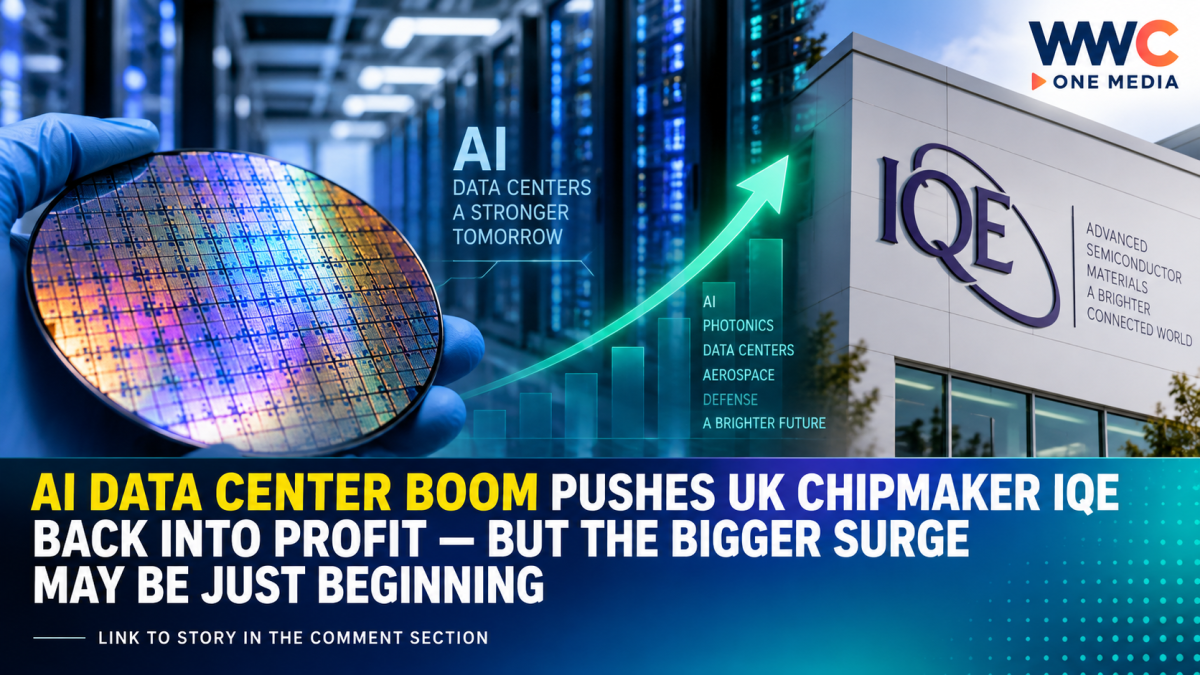
CARDIFF, United Kingdom — The global race to build artificial intelligence infrastructure is creating winners far beyond the companies making AI chatbots and graphics processors — and British semiconductor materials specialist IQE is emerging as one of them.
IQE has returned to profitability in the first half of 2026 as surging demand for technology used in artificial intelligence and data center infrastructure lifted its performance, underscoring how the AI boom is reshaping the global semiconductor supply chain.
The Cardiff-based company manufactures advanced compound semiconductor wafers and materials used in technologies ranging from optical communications and wireless devices to aerospace and defense systems.
Its latest performance builds on a strong trading update issued in July, when IQE said first-half trading had exceeded management expectations and forecast revenue of at least £64 million for the six months ended June 30. The company also raised its full-year 2026 revenue growth outlook to more than 30%, up from its earlier forecast of over 20%.
AI Demand Is Changing IQE’s Fortunes
At the center of IQE’s turnaround is growing demand for Indium Phosphide, or InP, a semiconductor material used in optical photonics — technology that helps move enormous volumes of data at high speeds.
That capability is becoming increasingly important as technology companies build larger and more powerful AI data centers.
Unlike traditional computing systems, AI workloads require massive amounts of data to move rapidly between processors, servers and networking equipment. That is increasing demand not only for powerful AI chips but also for the specialized optical technologies that connect the machines behind them.
IQE has described accelerating demand for its InP products as a major driver of growth, particularly for optical photonics used in AI and data center infrastructure.
The company’s momentum represents a significant shift from 2025, when IQE reported full-year revenue of £97.3 million and a reported loss before tax of £37 million.
Management said improving market conditions and stronger demand in AI photonics, data centers, aerospace, defense and wireless products were already beginning to improve the company’s trajectory in the second half of that year.
More Than Just Nvidia: The AI Supply Chain Is Expanding
IQE’s recovery highlights a broader transformation underway in the technology industry.
The AI boom is no longer benefiting only companies producing graphics processors and AI accelerators. Demand is spreading across the entire infrastructure ecosystem — including networking, optical communications, servers, cooling systems, power equipment and semiconductor materials.
Recent industry reports have pointed to growing investment in data center infrastructure worldwide, with companies supplying the power and cooling systems behind AI facilities also reporting strong demand.
Meanwhile, Broadcom recently raised its expectations for AI chip revenue as major technology companies continue increasing spending on artificial intelligence infrastructure and custom semiconductor systems.
Dell Technologies has also benefited from strong demand for AI-optimized servers, highlighting how the infrastructure buildout is extending from chipmakers to companies supplying the physical systems needed to run artificial intelligence at scale.
For IQE, the opportunity lies deeper in that supply chain.
The company does not manufacture the finished AI chips used by consumers or businesses. Instead, it produces advanced semiconductor materials that can become critical components in the technologies powering high-speed communications and next-generation computing systems.
Aerospace, Defense and Wireless Add Another Layer of Growth
AI infrastructure is not IQE’s only source of momentum.
The company has also reported continued strength in aerospace and defense, alongside demand for 3D sensing and wireless products. That diversification could be important as IQE attempts to build a more stable growth platform across multiple technology markets.
IQE’s earlier results also pointed to strong demand for gallium nitride, or GaN, radio-frequency products used in areas including defense radar, satellite communications and other high-performance systems.
That means IQE’s growth story is increasingly tied to several major global investment trends at once: artificial intelligence, hyperscale data centers, advanced communications, defense technology and space-based connectivity.
A Stronger Balance Sheet Could Give IQE More Room to Grow
IQE has also been working to strengthen its finances.
In May, the company announced the completion of an £81 million fundraise, including a strategic investment from MACOM Technology Solutions and new long-term supply agreements.
The company said the transaction strengthened its capital structure and provided additional resources to invest in future growth.
By July, IQE said it remained bank-debt free and had £41.6 million in cash, according to its trading update.
The stronger financial position could become increasingly important as the company attempts to scale production and capture more demand from the rapidly expanding AI infrastructure market.
The Bigger Question: Can IQE Keep Up With the AI Boom?
IQE’s return to profit is an important milestone, but the bigger story may be what happens next.
The company has already raised its 2026 revenue growth forecast to more than 30%, betting that demand for AI and data center infrastructure will remain strong through the rest of the year.
But the AI infrastructure race is also becoming increasingly competitive and capital-intensive.
Companies across the technology sector are investing heavily in chips, servers, networking, power and data center capacity. Analysts and investors are also watching whether the enormous spending can continue at its current pace.
Still, one trend appears increasingly clear: the AI revolution is creating opportunities far beyond the companies whose names dominate the headlines.
For IQE, a British specialist in semiconductor materials, the rapid expansion of artificial intelligence infrastructure could be turning into something much bigger than a short-term sales boost.
The AI boom may have helped bring IQE back into profit — but its real test will be whether it can turn today’s explosive demand into long-term, sustainable growth.
WWC ONE MEDIA J.M.S

Leave a Reply