
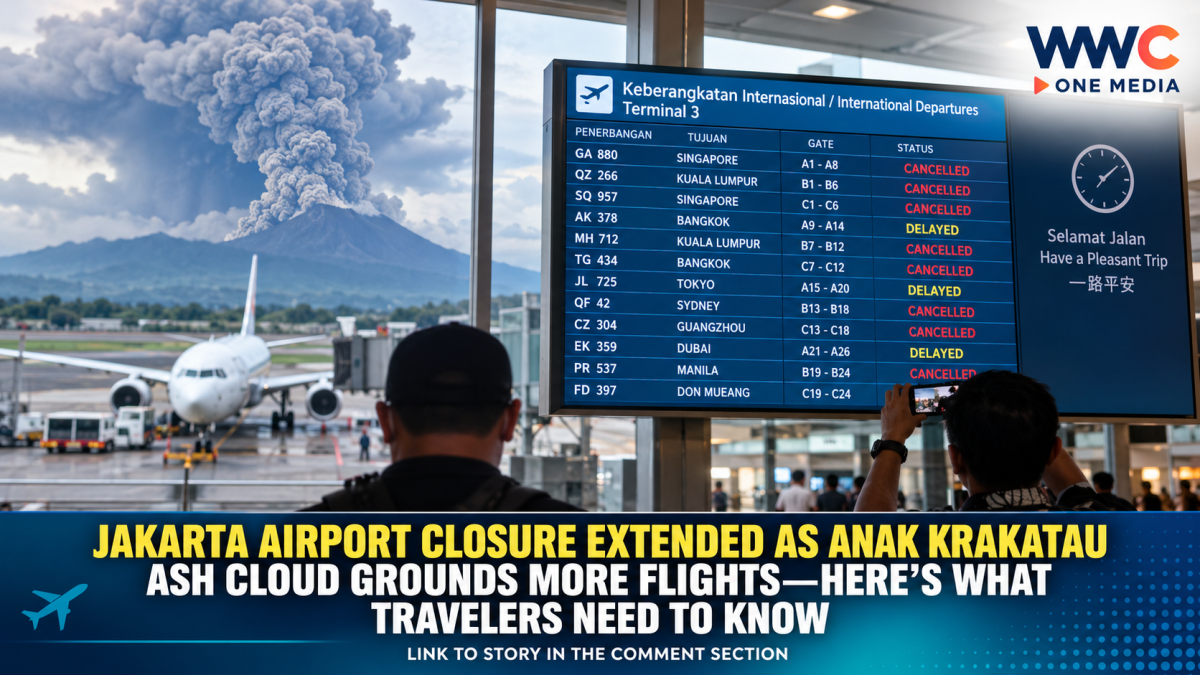
JAKARTA, Indonesia — Air travel across Indonesia remains severely disrupted after the eruption of Mount Anak Krakatau sent volcanic ash into the atmosphere, forcing authorities to extend the closure of Jakarta’s main international airport and several other airports in Java and Sumatra.
The Soekarno-Hatta International Airport in Tangerang, the country’s primary aviation gateway serving Jakarta, is among the airports that remain temporarily closed as authorities continue monitoring volcanic ash that could pose a serious risk to aircraft.
Indonesia’s Transportation Ministry said Monday that operations at affected airports would remain suspended until 6 p.m. local time on September 7, although the schedule could change depending on the latest volcanic-ash and weather conditions.
The decision came after fresh activity from Anak Krakatau and continuing ash dispersal raised concerns over aviation safety.
More than 270,000 passengers affected
The disruption has grown substantially since the initial airport closures.
According to Indonesia’s Transportation Ministry, approximately 2,300 flights involving more than 270,000 passengers had been affected as of 9 a.m. Monday. The figure includes cancelled, delayed and diverted flights since September 5.
Of those, about 1,397 flights and 177,579 passengers were directly affected at airports that were temporarily closed. Another 922 flights involving roughly 92,758 passengers were affected by route adjustments and other operational changes.
The scale of the disruption is significantly larger than the initial estimates reported when the airport shutdowns began.
Reuters also reported that seven Indonesian airports remained closed Monday, with Soekarno-Hatta among the facilities affected. The agency said the eruption had disrupted more than 2,300 flights and affected over 270,000 passengers.
Volcanic ash remains the biggest aviation threat
The concern is not simply the eruption itself but the movement of volcanic ash through airspace used by commercial aircraft.
Indonesia’s Meteorology, Climatology and Geophysics Agency (BMKG) said volcanic ash was still detected at elevations reaching 15,000 feet and as high as 50,000 feet.
At lower levels, the ash was spreading toward parts of Banten, western and southern West Java, Lampung and Bengkulu. At higher elevations, ash was detected farther over the Indian Ocean.
BMKG said the ash was moving generally westward at about 15 knots in its latest aviation weather assessment.
The agency has issued dozens of aviation weather warnings since the eruption began, while ground testing also confirmed the presence of volcanic ash around affected airports.
Volcanic ash is particularly dangerous to aircraft because it can enter engines, damage components and reduce visibility, making continued operations unsafe.
Eight airports were initially affected
The airport closures have extended beyond Jakarta.
Authorities identified affected facilities including:
- Soekarno-Hatta International Airport
- Halim Perdanakusuma Airport
- Radin Inten II Airport
- Husein Sastranegara Airport
- Budiarto Airport
- Pondok Cabe Airport
- Muhammad Taufiq Kiemas Airport
- Atung Bungsu Airport
The Transportation Ministry said Atung Bungsu Airport in Pagar Alam had returned to normal operations Monday morning, while the other affected airports continued to face restrictions.
Airlines scramble as passengers face delays and cancellations
The eruption has forced airlines to cancel, delay or reroute services involving Jakarta.
Singapore Airlines, Scoot, Malaysia Airlines, AirAsia and Lion Air Group were among carriers affected by the disruption, according to reports.
Singapore Airlines alone cancelled multiple Jakarta services as the airport shutdown continued, while Scoot also suspended flights between Singapore and Jakarta.
Passengers stranded at Soekarno-Hatta have faced long queues as they seek refunds, rebooking options and information about when flights can resume.
Government prepares alternative airports
To prevent an even larger buildup of passengers, Indonesian authorities are preparing alternative airports for airlines able to reroute services.
The Transportation Ministry identified Kertajati, Juanda, Yogyakarta International Airport, Adisutjipto, Ahmad Yani and Adi Soemarmo as potential alternatives, depending on airline routes and operational readiness.
Authorities are also coordinating alternative ground transportation for passengers whose flights are moved to another airport.
Officials stressed, however, that the availability of alternative airports does not automatically mean every affected flight can be transferred.
Why Anak Krakatau is being closely watched
Anak Krakatau sits in the Sunda Strait between Java and Sumatra and has a history of significant volcanic activity.
The volcano emerged from the caldera left by the catastrophic 1883 Krakatau eruption. Its activity became particularly notorious again in 2018, when a collapse associated with Anak Krakatau triggered a tsunami that killed hundreds of people along coastal areas of Java and Sumatra.
However, Indonesian authorities have not reported an imminent tsunami threat from the current eruption. BMKG said its latest monitoring found no sea-level anomaly indicating a tsunami in the Sunda Strait.
BMKG also reported that current monitoring showed a low probability of a tsunami in the Sunda Strait, while sea conditions remained within monitored parameters.
Schools move online as ash spreads
The eruption’s effects are also being felt beyond airports.
Authorities in Jakarta and Lampung have moved schools toward remote learning because of concerns over exposure to volcanic ash. Residents in affected areas have been advised to limit outdoor activities, wear masks and protect their eyes when ash is present.
The Indonesian disaster management agency has also urged residents to remain calm while staying alert to changing conditions.
When will Jakarta Airport reopen?
That remains the biggest question for thousands of travelers.
The Transportation Ministry said the 6 p.m. Monday target is subject to change, because airport operations depend on the actual movement and concentration of volcanic ash.
Officials emphasized that reopening will only happen when conditions are considered safe.
Once operations resume, airports will also need to conduct inspections and cleaning of runways, taxiways and aprons. Aircraft may require additional checks to ensure volcanic ash has not affected engines or other critical systems.
For passengers, authorities are urging travelers not to head to the airport without first checking directly with their airline.
The situation remains fluid, and flight schedules can change quickly as wind direction and volcanic activity evolve.
For now, Jakarta’s airport shutdown is not simply a flight-delay story—it is a major regional aviation disruption being driven by a volcano whose ash continues to move through critical airspace.
WWC ONE MEDIA J.M.S




Leave a Reply