
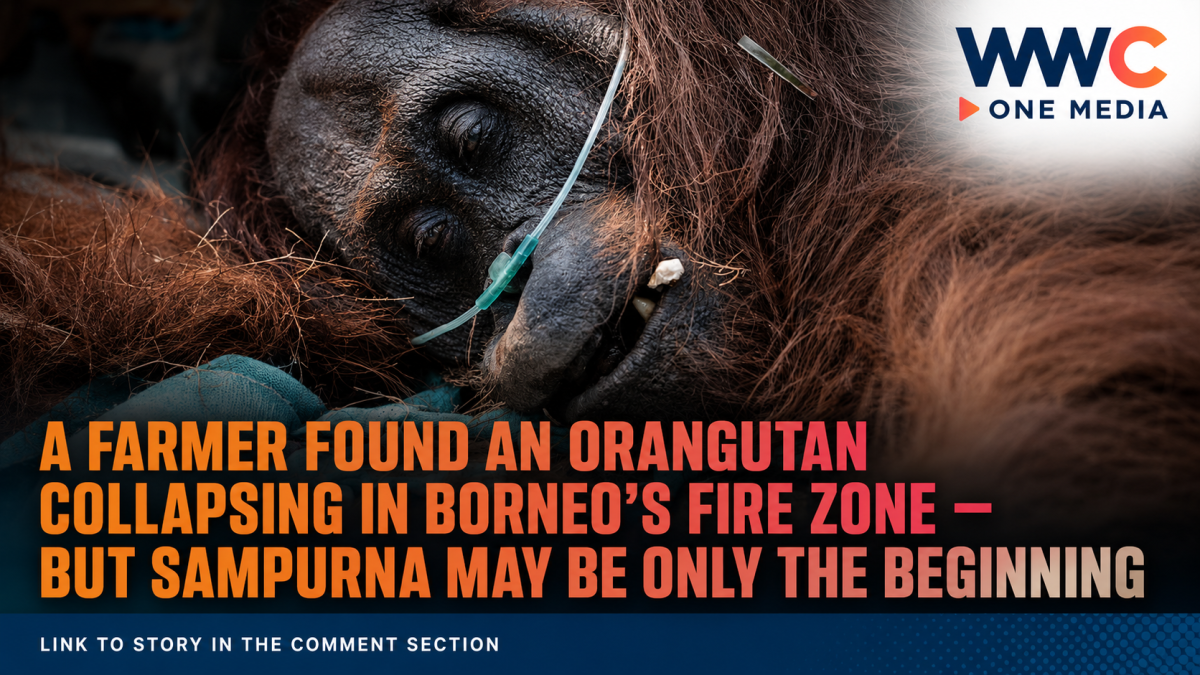
KETAPANG, Indonesia — A farmer heading to his land in Indonesia’s West Kalimantan province came across a distressing sight on Sunday: an orangutan lying weak and struggling on the ground near an area engulfed by forest and peatland fires.
The orangutan, later named Sampurna, had apparently been overwhelmed not by severe burns but by something rescuers say can be just as dangerous — the thick smoke blanketing parts of Indonesian Borneo.
Farmer Jais found the animal on an oil-palm plantation in Ketapang, one of the areas caught in Indonesia’s escalating wildfire emergency. He gave the weakened orangutan water before residents contacted wildlife rescuers. By the time a veterinary team from Yayasan Inisiasi Alam Rehabilitasi Indonesia (YIARI) arrived about two hours later, the animal had lost consciousness.
Smoke, Not Flames, Nearly Killed Sampurna
Veterinarians estimated Sampurna to be around 20 years old. Encouragingly, the animal did not appear to have suffered serious fire-related burns.
But rescuers found another potentially dangerous problem.
YIARI chief executive Karmele Llano Sánchez said the orangutan had suffered hypoxia — insufficient oxygen reaching the body — after exposure to extremely heavy smoke. Veterinarian Komara also reported breathing problems and vomiting, with the team suspecting an acute respiratory infection.
Sampurna was given oxygen through nasal tubes and intravenous fluids at the plantation before arrangements were made to transfer the animal to a rehabilitation facility for further treatment.
If its condition improves sufficiently, conservationists hope Sampurna can eventually be returned to the wild.
But Sampurna is far from an isolated case.
YIARI says it has already rescued seven orangutans because of the current fires, underscoring how Indonesia’s wildfire disaster is increasingly becoming a wildlife emergency as well as a public-health and environmental crisis.
Indonesia’s Fire Crisis Is Expanding Fast
The scale of the fires surrounding Sampurna’s rescue makes the incident particularly significant.
Indonesia’s Forestry Ministry says at least 202,010 hectares of land burned between January and July 2026. The total had stood at 107,465 hectares through June, meaning the amount of affected land rose dramatically in July.
Reuters reported on Monday that almost 95,000 hectares burned in July alone, while more than 9,000 fire hotspots were recorded in August — considerably above the 5,077 registered during August 2015, the year of one of Southeast Asia’s most notorious haze disasters. The overall destruction has not yet reached 2015 levels, however.
Officials and climate experts say the developing El Niño is not itself starting the fires, but hotter and drier conditions are allowing fires to ignite and spread much more aggressively. Peatlands pose a particular challenge because fires can continue smouldering underground, making them extremely difficult to extinguish completely.
More Than 24,000 Firefighters Deployed
Indonesia has mounted a large-scale response.
Associated Press reported that more than 24,000 firefighters have been deployed across Sumatra and Borneo, supported by aircraft conducting cloud-seeding and water-bombing operations.
Satellite figures cited by AP recently put West Kalimantan at the top of Indonesia’s hotspot count with 3,120, ahead of Central Kalimantan with 2,314 and South Sumatra with 1,500. Smoke from the fires has also crossed borders into parts of Malaysia and Brunei.
Authorities are also pursuing suspected fire starters. Indonesian police had arrested 72 people suspected of involvement in forest and peatland fires, while six forestry concession holders were sanctioned after fires were discovered within areas under their management. One company had its permit suspended, AP reported.
The distinction matters: drought and El Niño can intensify the conditions in which fires spread, but Indonesia has long struggled with fires linked to land clearing, agriculture and degraded peatlands.
Orangutans Are Being Squeezed From Both Sides
The danger to Borneo’s orangutans began long before this fire season.
WWF classifies the Bornean orangutan (Pongo pygmaeus) as critically endangered and says its population has fallen by more than 50% over the past six decades, while its habitat has shrunk substantially.
Logging, mining, agricultural expansion, hunting and forest fires have all contributed to the decline. Much of the remaining orangutan population also lives outside fully protected areas, increasing the possibility of encounters with plantations and other human activity when forests are damaged.
The current fires are putting conservation infrastructure itself under pressure.
Earlier in August, Mongabay reported that flames reached the boundary of a YIARI orangutan rehabilitation centre in Ketapang, where more than 60 rescued orangutans were being rehabilitated. Nearly 100 government personnel, police, military personnel and conservation workers fought the blaze before it could reach the animals.
That makes Sampurna’s appearance on an oil-palm plantation especially revealing. As forests burn or become fragmented, orangutans can be pushed into landscapes occupied by farms and plantations — potentially increasing dangerous encounters between people and wildlife.
Sampurna’s Rescue Is a Warning of What Comes Next
For now, Sampurna has a second chance.
A farmer noticed the struggling animal. Residents called for help. Veterinarians reached it before smoke exposure became fatal.
But rescuing individual animals will not solve the larger problem facing Borneo.
YIARI’s Sánchez warned that authorities must prepare not just for extinguishing today’s flames, but for the longer-term consequences for human health, forests and wildlife.
That warning could become increasingly important as Indonesia moves deeper into its dry season.
Reuters reported that Indonesian authorities remain anxious to avoid anything resembling the catastrophic 2015 fire and haze crisis. Although the scale of land burned in 2026 has not yet reached that disaster, some current indicators — including August hotspot numbers — demonstrate how quickly conditions could deteriorate.
Sampurna survived the smoke.
The bigger question is how many other orangutans are still trapped in forests where rescuers have not yet reached them.




Leave a Reply