
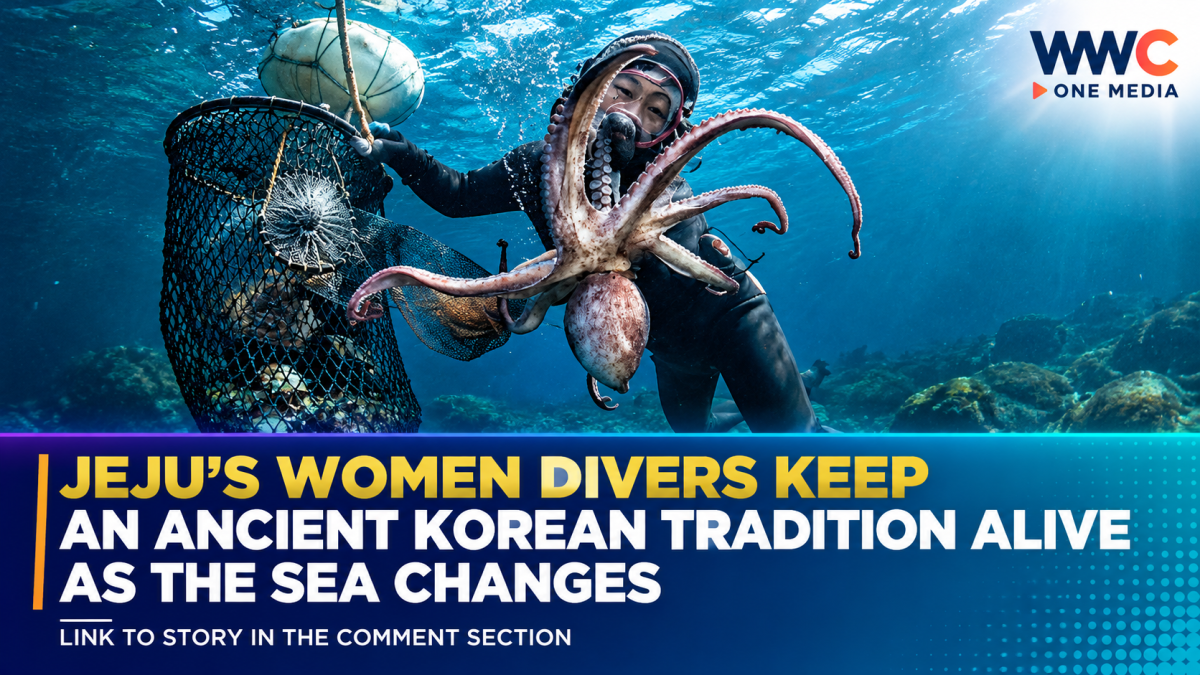
On South Korea’s Jeju Island, a centuries-old tradition is finding new relevance as women continue to take to the sea as haenyeo, the island’s famed female divers.
But this is not simply a story about women escaping the pressures of modern Korean life. It is a story about cultural identity, livelihood and a rapidly changing ocean—and about women determined to keep an extraordinary tradition alive despite mounting challenges.
The culture of Jeju haenyeo was inscribed on UNESCO’s Representative List of the Intangible Cultural Heritage of Humanity in 2016, recognizing the knowledge, skills and community traditions surrounding the island’s women divers.
A tradition built around the sea
Haenyeo traditionally gather marine life such as shellfish and seaweed without relying on conventional underwater breathing equipment. Their knowledge includes the tides, weather, marine ecosystems and sustainable harvesting practices passed between generations.
The tradition has also created a distinctive social structure. Haenyeo communities have historically organized themselves through fishing cooperatives and communal practices, with older divers passing knowledge to younger generations.
For many Jeju families, the sea was not simply a workplace—it was a source of income and a foundation of community life.
A new generation faces an old challenge
The biggest challenge for the haenyeo tradition has long been demographic change.
Many practicing divers are older women, while fewer younger women have chosen the physically demanding occupation. That has raised concerns about whether the knowledge accumulated over generations can continue to be transmitted.
Yet the tradition has not simply disappeared.
Training programs, including Haenyeo Schools, have helped introduce younger people to the culture and skills associated with diving. The continuation of the tradition increasingly depends on whether new generations see a future in it.
That makes stories of women entering or returning to the tradition particularly significant—not because they are literally abandoning modern society, but because they are choosing to preserve a distinctive part of Jeju’s cultural identity.
The ocean itself is becoming the bigger threat
Now, however, the haenyeo face an even more fundamental problem: the marine environment they depend upon is changing.
A recent Reuters report documented deterioration in Jeju’s soft-coral reefs, with researchers and local divers observing coral “slumping” linked to environmental stress, rising sea temperatures and severe weather. Scientists are monitoring the phenomenon because Jeju’s soft-coral communities form an important part of the island’s marine ecosystem.
Traditional divers are also noticing changes in what they can harvest.
Reuters reported that third-generation haenyeo Ko Myeong-hyo has observed deteriorating coral conditions, while her mother, 70-year-old diver Son Choon-sook, recalled a time when species such as abalone, sea cucumbers and turban shells were more abundant.
The changing conditions have affected not only catches but also the amount of time some divers can spend working at sea.
Why Jeju’s haenyeo matter beyond Korea
The haenyeo story has become increasingly important internationally because it sits at the intersection of women’s work, cultural heritage, community resilience and climate change.
Their traditional knowledge also offers an unusual perspective on environmental change: generations of women who have worked directly in the ocean can notice shifts in marine life and conditions that may otherwise be difficult to capture through statistics alone.
That makes protecting the haenyeo tradition about more than preserving a historical practice.
It also means protecting the marine environment that makes the tradition possible.
A culture caught between generations and climate change
The future of the haenyeo will depend on two connected questions: Can enough younger people continue the tradition, and can Jeju’s marine ecosystem remain healthy enough to support it?
For women who continue diving, the answer is being written one season at a time.
The haenyeo have survived social change, economic transformation and generations of shifting attitudes toward women’s work. But today’s challenge is different.
The sea itself is changing.
And if the ocean that sustained Jeju’s women for generations continues to warm and deteriorate, preserving the haenyeo tradition may ultimately require protecting the environment beneath them as much as preserving the culture above it.
WWC ONE MEDIA G.A




Leave a Reply