
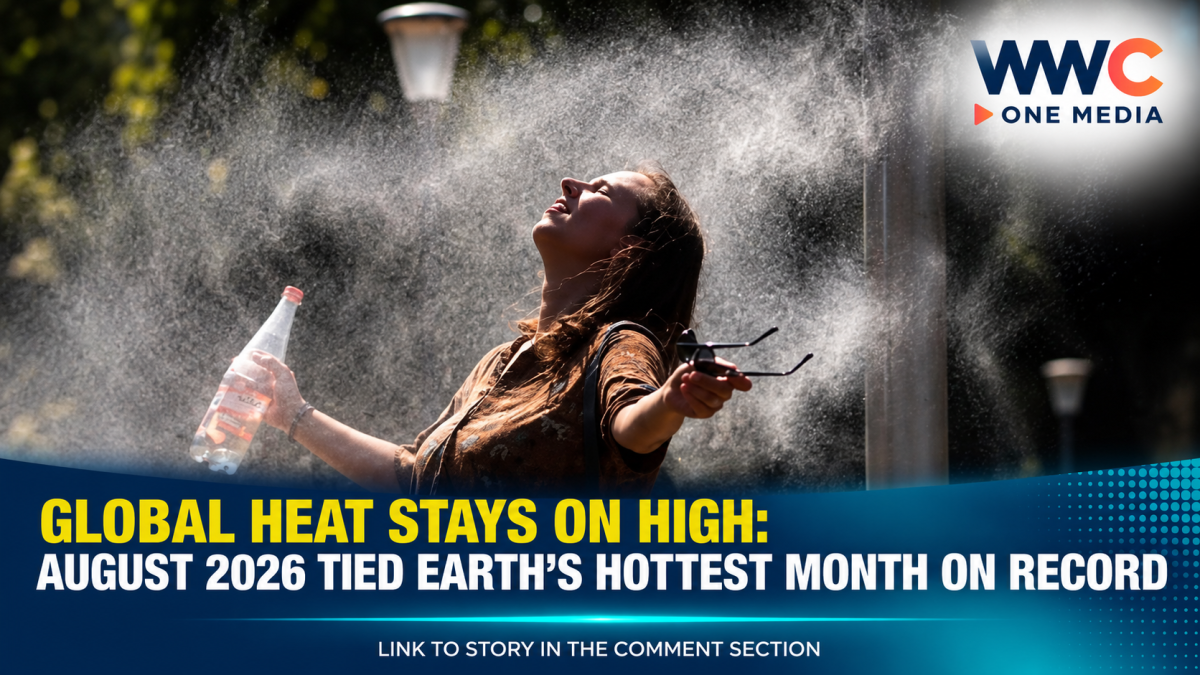
Earth’s extraordinary heat showed little sign of easing in August, as global temperatures reached a level that scientists say ranks among the most alarming in the modern climate record.
According to the European Union’s Copernicus Climate Change Service (C3S), August 2026 had a global average surface air temperature of 16.96°C, tying July 2023 for the hottest month ever recorded in the dataset.
The figure was 1.65°C above the estimated pre-industrial average for 1850–1900, marking the first monthly reading above 1.5°C since November 2025.
The result does not mean the Paris Agreement’s 1.5°C threshold has been permanently breached. That target concerns long-term global warming, not an individual month. But scientists say the continued appearance of exceptionally hot months demonstrates how much warmer the climate has become.
A record that came with a warning
August’s global temperature was not simply a number on a chart.
Across different parts of the world, extreme heat was accompanied by wildfires, drought, floods, crop damage and other climate-related disruptions.
Western Europe experienced its hottest summer on record, while parts of Europe struggled with unusually dry conditions and low river levels. Italy, for example, recorded its hottest summer since measurements began in 1950, according to its National Research Council.
The United States also experienced its hottest summer on record, according to reporting based on U.S. climate data.
The combination illustrates an increasingly familiar pattern: global warming does not simply produce higher average temperatures. It increases the likelihood and intensity of dangerous heat extremes and can worsen other climate hazards.
The oceans are running hot too
The heat was not confined to the atmosphere.
Global ocean surface temperatures also reached extraordinary levels in August, with the average sea-surface temperature reaching about 21.07°C, according to Copernicus data cited by international media.
Scientists are watching ocean temperatures closely because the world’s oceans absorb enormous amounts of excess heat from the climate system.
Warmer oceans can also influence weather patterns, marine ecosystems and the intensity of some storms.
The latest figures therefore point to a climate system experiencing sustained and widespread heat—not simply a short-lived hot spell over one continent.
El Niño is adding heat—but it isn’t the main cause
Another factor complicating the 2026 temperature picture is El Niño, the naturally occurring climate pattern associated with warmer-than-average tropical Pacific waters.
Scientists say the current El Niño is contributing to the elevated temperatures.
But it is not responsible for the underlying long-term warming trend.
The dominant driver remains the accumulation of greenhouse gases from human activities, particularly the continued burning of fossil fuels. Reuters and AP both cited scientists emphasizing that human-caused climate change remains the primary reason temperatures are reaching such extreme levels.
That distinction matters.
Natural climate patterns can temporarily push temperatures higher or lower, but they operate on top of a planet that is already significantly warmer because of human-caused climate change.
What does 1.65°C actually mean?
The August number has generated headlines because it crossed the 1.5°C level associated with the Paris Agreement.
But scientists caution against interpreting one month as the failure of the Paris temperature goal.
The Paris Agreement’s 1.5°C objective is assessed over a longer-term climate average, generally understood as multiple decades.
A single month above 1.5°C therefore does not mean the world has permanently crossed that threshold.
It does, however, show how close the climate system is moving toward levels of warming that scientists have long warned would bring increasingly severe impacts.
The heat is becoming harder to dismiss as an anomaly
One of the most significant aspects of the latest data is not merely that August tied a record.
It is that exceptionally high temperatures have become increasingly common.
The world has experienced a succession of record or near-record temperatures in recent years, with 2023 and 2024 producing particularly extraordinary heat.
Scientists stress that individual months will naturally fluctuate, but the long-term trend continues upward.
That makes every new temperature record part of a much larger story.
What happens next?
Scientists are watching the remainder of 2026 closely, particularly because El Niño conditions can continue influencing global temperatures after they develop.
Some climate researchers cited by international media warn that the combination of a warming planet and natural climate variability could produce additional extreme heat in the months ahead.
But the bigger issue extends beyond the next temperature ranking.
The latest data reinforce a conclusion scientists have repeated for decades: reducing greenhouse-gas emissions can limit how much additional warming the planet experiences, while adaptation can help communities cope with the heat and other impacts that are already occurring.
August 2026 has now entered the climate record alongside July 2023 as the hottest month ever measured in the Copernicus dataset.
And perhaps the most unsettling part is not that one month broke a record.
It is that the planet is increasingly making extraordinary heat feel ordinary.
WWC ONE MEDIA G.A




Leave a Reply