
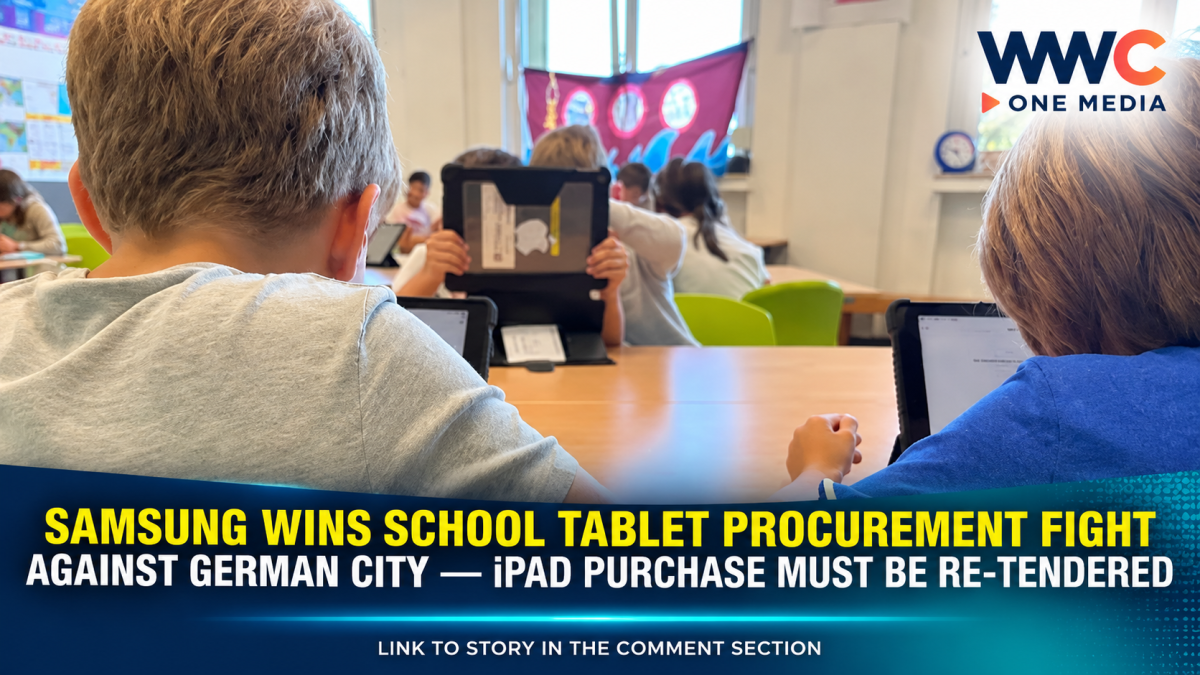
DATTELN, Germany — Samsung has scored a significant legal victory in a dispute over how German schools buy tablets after a court ruled that the city of Datteln could not proceed with a planned purchase of hundreds of Apple iPads under its existing procurement terms.
The Düsseldorf Higher Regional Court (Oberlandesgericht Düsseldorf) ruled on September 2 that Datteln must restart the procurement process and conduct a new tender that does not simply favor a particular manufacturer.
The decision followed a challenge by Samsung, which argued that the city should not be able to specify Apple iPads in a way that effectively excludes competing manufacturers.
The ruling has attracted attention well beyond Datteln because it touches on a much larger question facing schools across Germany: How far can public authorities go when they want to stick with technology they already use?
Why Samsung challenged Datteln
Datteln, a city of around 36,000 people in North Rhine-Westphalia, already uses thousands of Apple tablets in its schools.
The city planned to replace roughly 650 aging iPads with new devices. In its procurement process, however, the requested equipment was specifically based on Apple’s iPad platform, excluding tablets using other operating systems.
Samsung challenged the procurement, arguing for a manufacturer-neutral tender that would allow competing suppliers to participate.
The company said open standards and product-neutral procurement would promote competition, technological flexibility and potentially better value for public institutions.
Court says the city must start again
The case initially went in Datteln’s favor.
A procurement chamber had previously rejected Samsung’s complaint, allowing the city to move forward with its planned purchase. Samsung appealed that decision, sending the dispute to the Düsseldorf higher regional court.
The higher court ultimately sided with Samsung.
According to German public broadcaster WDR, the court found that procurement specifications tied directly to a particular product are permissible only in exceptional circumstances and must be strongly justified. The court concluded that Datteln’s tender did not meet that threshold.
As a result, the city cannot simply proceed with the planned iPad order. It must launch a new procurement process.
Datteln says the decision is bad news for students
The legal fight has had a practical consequence: students have been waiting for replacement devices.
Datteln says around 2,700 iPads are currently in use in its schools, while several hundred additional devices were supposed to be purchased as replacements.
The city said the ruling means the replacement process will be delayed again.
In a statement following the decision, Mayor André Dora acknowledged that the ruling was disappointing for students waiting for new tablets but said the city would accept the decision and consult its legal and technical experts about the next steps.
The delay has already affected classroom technology. Earlier reporting said some first-grade classes were temporarily being taught without the new tablets because the procurement dispute had prevented the city from completing the replacement order.
Why the operating system matters
For Datteln, switching away from Apple’s ecosystem would not simply mean buying a different tablet.
The city has argued that moving from Apple devices to another operating system would create considerable technical and organizational complications.
That could involve existing software, device-management systems, teacher workflows and the infrastructure already established around the city’s school technology.
Datteln’s IT leadership previously argued that such a system change would create significant complications and would not be reasonable for the municipality.
Samsung, however, challenged the assumption that those difficulties were enough to justify a procurement process that effectively locked out competing manufacturers.
A bigger battle over Germany’s school-tech market
The dispute matters because German schools have become a major market for technology companies.
Thousands of tablets were purchased across Germany during the country’s school-digitization push, including through the DigitalPakt Schule, which provided billions of euros for digital infrastructure and equipment.
Many of those devices are now reaching the point where they need to be replaced.
Germany is also preparing the next phase of school digitization. Reporting cited by German media says the DigitalPakt 2.0 includes another €5 billion in federal and state funding for improving schools’ digital infrastructure.
That means procurement decisions like the one in Datteln could become increasingly important for Apple, Samsung and other technology suppliers competing for public-sector contracts.
Does the ruling mean every German city must stop buying iPads?
Not necessarily.
WDR specifically reported that the Datteln decision is an individual case and does not automatically dictate the procurement policy of every German municipality.
The important legal issue is the justification behind a manufacturer-specific procurement.
German public authorities can, under certain circumstances, specify particular technical requirements or products. But those circumstances are narrowly defined, and authorities must be able to justify why restricting the tender is necessary.
The Datteln ruling therefore provides an important signal to municipalities: simply wanting to continue with an existing technology ecosystem may not, by itself, be enough to exclude competing suppliers.
Samsung’s unexpected school-market victory
The case also highlights how intense competition has become in the education-technology market.
For years, Apple’s iPad has been widely used in German schools, creating established ecosystems around the devices.
Samsung’s legal challenge shows that rival manufacturers are willing to contest procurement decisions rather than accept established technology preferences.
For schools and municipalities, the issue is ultimately bigger than Apple versus Samsung.
It is about whether public money should be spent through procurement processes that preserve existing technology ecosystems—or through open competitions that give multiple manufacturers a chance to compete.
For students in Datteln, however, the immediate consequence is much simpler: the tablets they were waiting for will have to wait a little longer.
And the next tender could determine whether those replacement devices are iPads again—or whether another manufacturer finally gets a chance to enter Datteln’s classrooms.
WWC ONE MEDIA G.A




Leave a Reply