
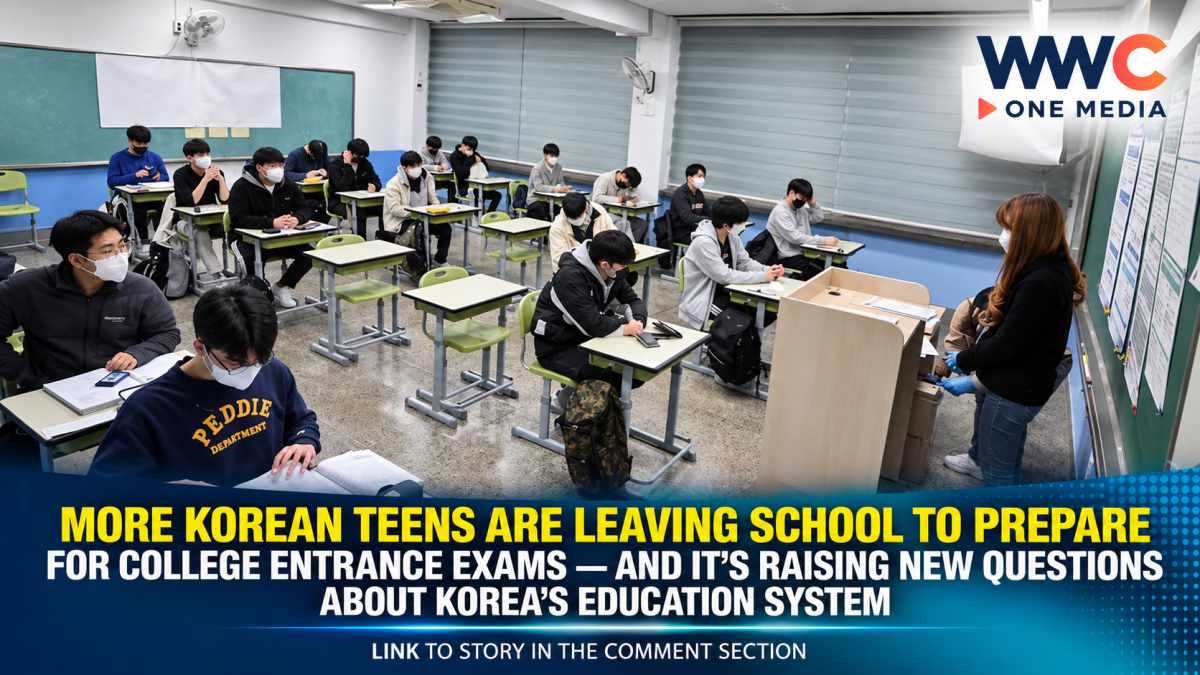
A growing number of South Korean teenagers are choosing to leave high school before graduation, with some turning to equivalency exams and intensive preparation for the country’s notoriously competitive college entrance process.
The trend is drawing renewed attention because an increasing share of students appear to be treating leaving school not as the end of their education, but as an alternative route toward university admission.
Recent reporting cited data showing that more than 10,000 first-year high school students left school in 2025, as some students pursued equivalency examinations and preparation for the College Scholastic Ability Test, commonly known as the Suneung or CSAT.
The development is particularly significant in a country where the university entrance exam remains one of the biggest academic milestones in a student’s life.
Why are students leaving school?
For some teenagers, the calculation is straightforward: spend less time following the regular school curriculum and more time preparing for the exams and admissions routes they believe will determine their university prospects.
Korean media have reported a rise in high-school students choosing to leave school as they seek greater control over their study schedules and prepare for the CSAT or the national high-school equivalency examination.
Education analysts have warned, however, that leaving school specifically to pursue a higher CSAT score may not provide the advantage some students expect.
A July 2026 report quoted the Ministry of Education as warning that dropping out to prepare for the Suneung could actually put students at a disadvantage under changing university admissions rules.
The admissions system is changing
One reason the strategy is becoming more complicated is that Korean universities do not rely exclusively on CSAT scores.
Admissions can involve a mixture of school records, academic performance, attendance, university-specific requirements and standardized-test results, depending on the admissions track.
That means leaving high school can remove some of the advantages available to students who remain enrolled and build conventional school records.
A June 2026 analysis of admissions plans for major Seoul universities found that the proportion of regular-admission places incorporating high-school records was expected to increase for the 2028 admissions cycle, compared with the 2027 cycle.
The shift challenges the idea that simply leaving school and concentrating exclusively on the CSAT is automatically the better strategy.
The numbers are attracting attention
South Korea has been watching the increase in school dropouts for several years.
Education data cited by Korean media show the high-school academic-interruption rate rising from 1.1% in 2020 to a higher level by 2024, reflecting a broader increase in students leaving the traditional school system.
But the statistics should not be interpreted as proof that every student leaves school to study for university.
Students leave for many reasons, including career decisions, difficulties adapting to school, alternative education and personal circumstances. What is changing is that college preparation has become an increasingly visible reason for some students to pursue an alternative educational path.
The rise of the “school-outside” student
In South Korea, students who leave the formal school system can still pursue education through other routes.
One increasingly important option is the high-school equivalency examination, known as the geomjeonggosi. Passing the examination can allow students without a conventional high-school diploma to meet educational requirements for further study.
Korean reporting has also pointed to a growing population of so-called “school-outside” test takers—students who are no longer enrolled in high school but continue preparing for university entrance.
Data cited in Korean media indicate that equivalency-exam applicants who subsequently take the CSAT have remained above 20,000 in recent years, underscoring the size of the alternative pathway.
Why the Suneung remains so powerful
The CSAT continues to play a major role in South Korea’s university admissions system, particularly for regular admissions.
That pressure has helped create a huge private-education industry. Students commonly attend hagwons, or private academies, for additional instruction and exam preparation.
The result is an education environment in which some teenagers and parents believe every additional hour of preparation could affect which university a student ultimately enters.
For students who believe school classes are taking time away from exam preparation, leaving school can therefore appear attractive.
But education experts and officials are increasingly emphasizing a crucial point: the admissions system itself is changing.
A risky gamble for students?
The growing dropout trend has triggered concern because the decision can have consequences that are difficult to reverse.
A student who leaves school may gain additional time for exam preparation, but could also lose opportunities connected to school-based records and other admissions pathways.
That is particularly important as universities adjust how they evaluate applicants.
The debate therefore goes beyond whether students should study more or less.
It raises a much bigger question about whether Korea’s education system has created an environment where teenagers feel they must choose between traditional schooling and maximizing their chances of entering a top university.
Korea’s education pressure is entering a new phase
South Korea has spent years trying to reduce excessive dependence on private education and ease the intense competition surrounding university admissions.
Yet the growing number of students pursuing alternative routes suggests that the pressure has not disappeared.
Instead, some students appear to be finding new ways around the conventional school system.
For policymakers, the challenge is now twofold: ensure that students who remain in school receive meaningful educational opportunities while also ensuring that students who choose alternative routes are not unintentionally disadvantaged.
And for families, the latest trend carries a warning: leaving school may create more study time, but it does not automatically create a better path to university.
As Korea’s admissions rules continue to evolve, the real question may no longer be how many hours a student studies—but whether the education system is giving teenagers enough viable ways to reach their goals without feeling that they have to leave school to do it.
WWC ONE MEDIA G.A




Leave a Reply