
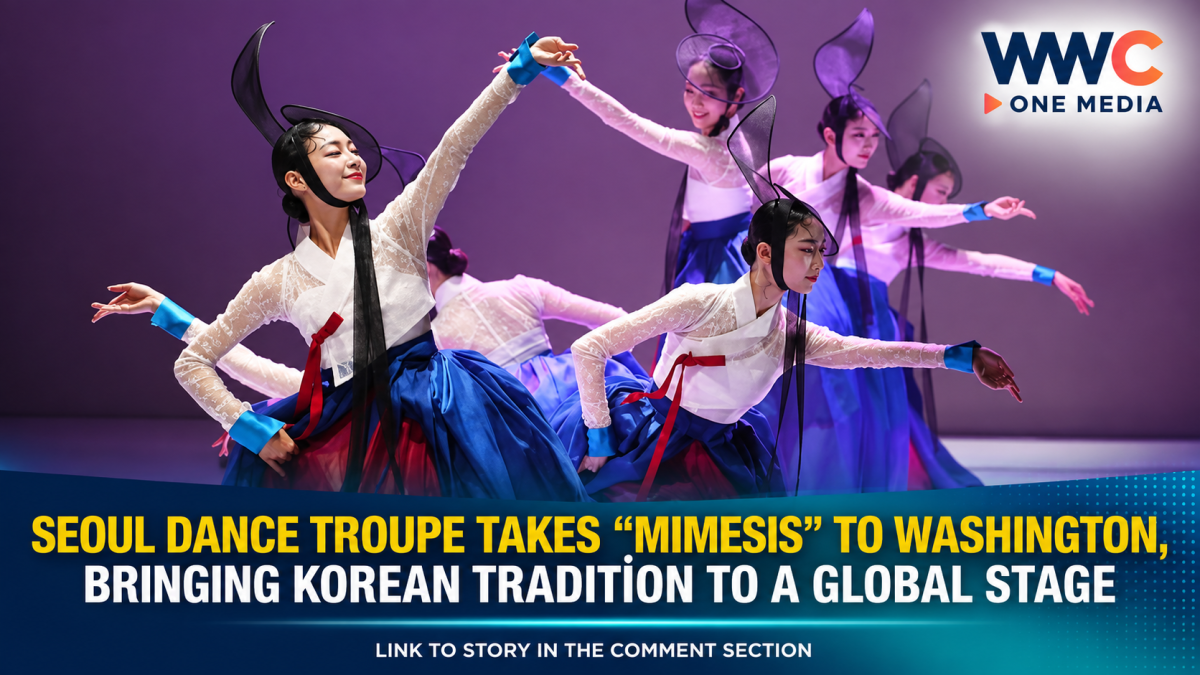
WASHINGTON, D.C. — A celebrated Seoul dance troupe is taking one of South Korea’s most ambitious contemporary interpretations of traditional dance across the Pacific.
The Seoul Metropolitan Dance Theatre will bring its acclaimed production “Mimesis” to Washington, D.C., for its international debut this September, offering American audiences a new way to experience centuries-old Korean dance traditions through contemporary choreography.
The full production will be performed at the Warner Theatre on September 27, while an approximately 15-minute excerpt is scheduled for September 29 at the National Portrait Gallery during a Korean national holiday celebration. The Washington performances are being hosted by the Korean Cultural Center Washington, D.C., and the Embassy of Korea.
Eight traditional dances, reimagined
“Mimesis” premiered at the Sejong Center for the Performing Arts in Seoul in 2025.
Rather than simply reproducing traditional choreography, the production reinterprets eight Korean dance forms, including Gyobangmu, Hanryangmu, Sogochum, Janggum, Salpuri, Seungmu, shamanic dance and Taepyeongmu.
Artistic director and choreographer Yoon Hye-jung, a former principal dancer with the National Dance Company of Korea, structures the performance around the movement and power of nature.
Water, wind, earth, lightning, sky, fire and light become conceptual elements connecting the traditional forms with a more contemporary theatrical language.
From Seoul to Washington
The international journey represents an important milestone for the Seoul Metropolitan Dance Theatre.
The production reportedly sold out its Seoul performances two weeks before opening, demonstrating strong domestic interest before the work began its international expansion.
Now Washington audiences will see the work at a particularly symbolic moment: the United States is marking its 250th anniversary in 2026.
That timing gives the performances an added cultural dimension, placing Korean traditional arts within a year of major American national celebrations.
More than a performance
“Mimesis” also reflects a broader effort to bring Korean traditional culture to international audiences without presenting it simply as a historical artifact.
The production uses recognizable traditional dance vocabulary while giving the choreography a contemporary framework.
That balance—preserving cultural identity while experimenting with new forms—is increasingly important as Korean culture reaches audiences well beyond music and television.
Korean popular culture has become globally influential, but performances such as “Mimesis” highlight another side of the country’s international cultural presence: traditional arts adapted for modern audiences.
A troupe with decades of international experience
The Seoul Metropolitan Dance Theatre was founded in 1974 and has represented Korea at international cultural events while touring extensively across Europe, the United States, South America and Northern Europe.
The company has also recently gained additional international attention. Its production “Ilmu” received recognition from the New York Dance and Performance Awards, commonly known as the Bessies, further strengthening the troupe’s profile outside Korea.
“Mimesis” now gives the company another opportunity to introduce Korean dance to an international audience.
Why this matters for Korean culture
Korean cultural diplomacy is increasingly moving beyond the familiar global images of K-pop and Korean dramas.
Traditional dance, music, cuisine, crafts and heritage are becoming increasingly important parts of Korea’s international cultural presence.
“Mimesis” fits directly into that evolution.
Instead of asking international audiences to experience Korean tradition exactly as it existed centuries ago, the production asks a different question:
What happens when traditional Korean movement is reimagined through the eyes of contemporary performers?
Washington audiences will soon have the chance to find out.
And if the response matches the production’s success in Seoul, “Mimesis” could become another example of how Korea’s traditional culture is finding a new audience far beyond its borders.
WWC ONE MEDIA G.A




Leave a Reply