
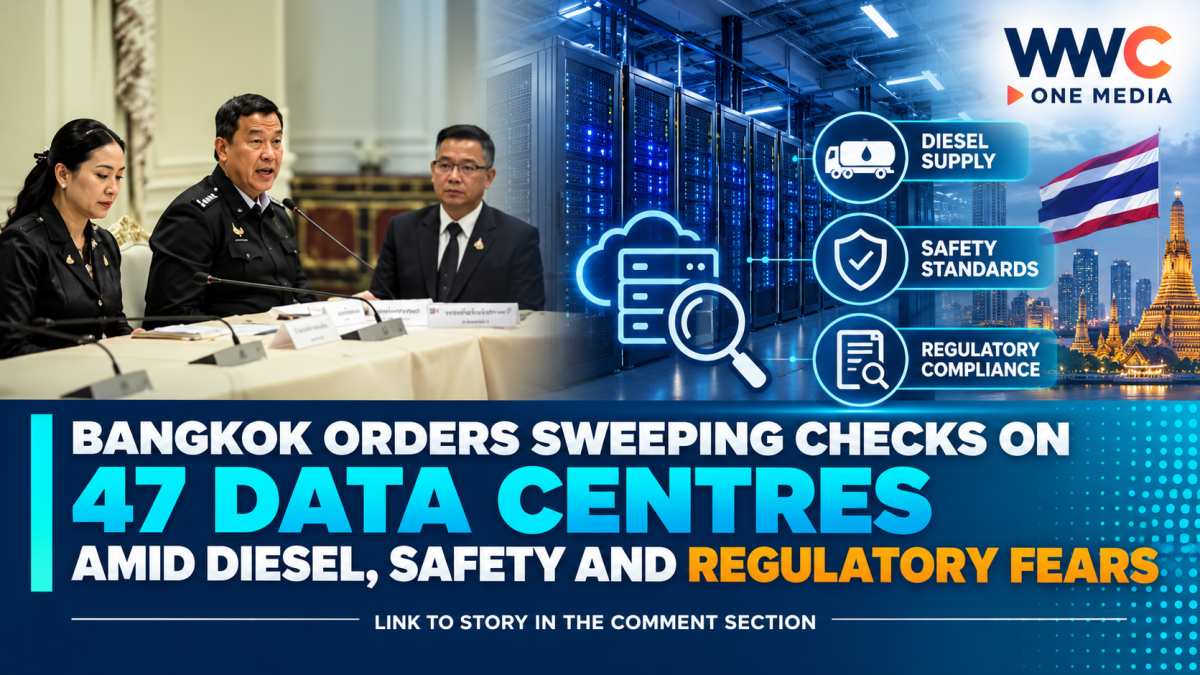
BANGKOK, Thailand — Bangkok authorities have launched a sweeping review of approximately 47 data centres across the capital, escalating a crackdown on the rapidly expanding industry amid growing concerns over massive diesel storage, electricity consumption, noise, heat and potential regulatory loopholes.
Bangkok Governor Chadchart Sittipunt said the Bangkok Metropolitan Administration (BMA) is gathering and examining information on data centres throughout the city after coordinating with the Ministry of Digital Economy and Society and reviewing publicly available information.
District offices have been ordered to inspect facilities and their surrounding areas, focusing on power consumption, backup fuel storage, emergency electricity systems, noise, heat and complaints from nearby communities.
The review comes as Thailand’s booming data centre industry faces one of its biggest regulatory challenges yet.
Why Is Bangkok Checking 47 Data Centres?
The inspections follow mounting public concern that some data centres have been operating in residential and commercial areas under regulations that were never specifically designed for the massive computing facilities now being built to support cloud services and artificial intelligence.
Channel News Asia reported that data centres have expanded rapidly across Bangkok amid growing demand for computing capacity, with some facilities located close to workplaces, hospitals and busy commercial areas.
Some facilities have reportedly been classified as warehouses or offices rather than industrial facilities, potentially allowing them to avoid stricter requirements covering safety, environmental impacts and zoning.
The regulatory concerns became more urgent after questions emerged over large quantities of diesel stored for backup generators at some facilities.
Diesel Storage Sparks Major Safety Concerns
One of the most serious issues driving the crackdown is the storage of large volumes of fuel.
Earlier reports said authorities were investigating a Bangkok data centre where concerns were raised over approximately 429,000 litres of diesel stored at a facility in Bang Kapi district.
The controversy exposed what critics describe as a regulatory grey area surrounding fuel storage and data centre operations.
The Energy Ministry has since expanded its response, ordering a broader review of Bangkok’s data centres after inspectors found fuel tanks that allegedly lacked the required licences.
Energy Minister Akanat Promphan said the inspection process could take several months as authorities examine facilities across the capital and work toward a unified regulatory framework.
Bangkok Has Already Halted Three New Projects
The BMA has also put the brakes on new projects while regulators develop clearer standards.
Six standalone data centre projects have reportedly applied for permits in Bangkok since 2021 and 2022. Three were previously approved, while three others have been suspended and sent back for further review pending clearer regulations.
The proposed new rules are expected to address critical issues including:
- Fuel and diesel storage
- Fire and building safety
- Land use and zoning
- Electricity consumption
- Water consumption
- Environmental impacts
- Noise and heat
- Community complaints
The government is also examining how data centres should be legally classified to close loopholes that may have allowed some projects to be developed under rules intended for warehouses or other types of buildings.
Thailand’s AI Boom Is Driving a Data Centre Explosion
The crackdown comes at a crucial moment for Thailand’s ambitions to become a major regional digital hub.
The country has attracted massive investment into cloud computing, artificial intelligence and digital infrastructure. In May, Thailand’s Board of Investment approved major projects worth approximately 958 billion baht, with a huge share linked to digital infrastructure and data centre development.
Reuters reported that one of the largest projects involved a major TikTok-related investment aimed at expanding data infrastructure across Bangkok and neighbouring provinces.
But the rapid growth has also raised a difficult question for policymakers:
Can Thailand become Southeast Asia’s next major data centre hub without overwhelming cities, power networks and local communities?
Residents and Businesses Raise Concerns
The issue is no longer confined to government offices and parliamentary debate.
Residents and businesses located near some data centres have raised concerns about potential noise, heat, fuel smells and safety risks.
One recent case involved complaints about a fuel-like smell near a Bangkok data centre, prompting government inspections. Authorities reportedly found approximately 200,000 litres of diesel stored at the site without the required licence and ordered action against the facility.
The case has become a major test of Thailand’s ability to regulate the industry while still encouraging billions of dollars in foreign and domestic investment.
New Rules Could Be Coming Soon
Bangkok authorities are now waiting for clearer national guidelines from a dedicated data centre regulatory body.
According to recent reports, the BMA is continuing its citywide data collection and inspections while authorities work on new standards that could reshape how data centres are approved and operated in the capital.
The broader review is expected to determine whether existing facilities comply with current laws and whether additional rules are needed for an industry that has expanded far faster than Thailand’s traditional regulatory framework.
The Bottom Line
Bangkok’s inspection of 47 data centres marks a major turning point for Thailand’s fast-growing digital infrastructure industry.
Authorities are not only checking individual facilities. They are also confronting a much larger problem: whether Thailand’s existing laws are capable of regulating modern, power-hungry data centres operating in densely populated urban areas.
With concerns ranging from hundreds of thousands of litres of diesel to electricity demand, water consumption, noise, heat and land-use loopholes, the government now faces a delicate balancing act.
Thailand wants the investment.
Thailand wants the AI boom.
But Bangkok is making one thing increasingly clear:
The race to become a regional data centre powerhouse cannot come at the expense of public safety and local communities.
WWC ONE MEDIA J.M.D




Leave a Reply