
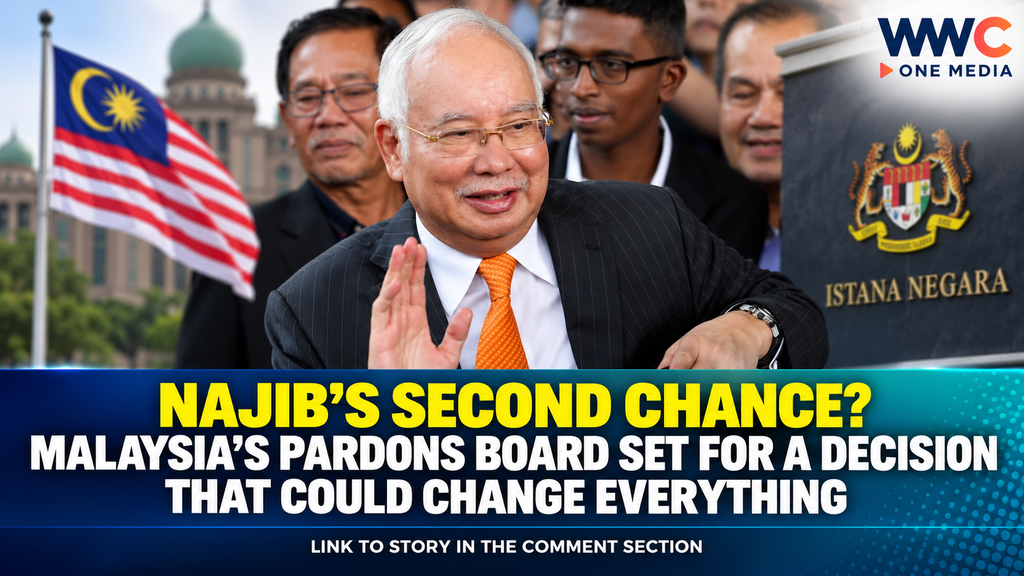
KUALA LUMPUR — Former Malaysian Prime Minister Najib Razak could once again find himself at the center of a major political and legal showdown as the country’s Federal Territories Pardons Board is expected to discuss his latest clemency application on September 11.
Reports from Channel NewsAsia, Reuters, Free Malaysia Today and other Malaysian media outlets indicate that Najib’s application is expected to be among the matters considered when the board meets, although there is no confirmation that a final decision will be announced during the meeting.
The possibility of another royal intervention has immediately reignited debate over Malaysia’s rule of law, corruption fight and the political future of Najib, who remains a powerful figure within the United Malays National Organisation (UMNO).
HOUSE ARREST ALSO BACK ON THE TABLE
The latest reports suggest that the issue could go beyond a pardon.
Bloomberg, as cited by CNA, reported that a possible house-arrest arrangement could also be considered, although the details remain uncertain and officials have not publicly confirmed what the board will decide.
Najib has been serving his prison sentence at Kajang Prison since August 2022 after his conviction in the SRC International case, involving RM42 million transferred from an SRC International account into accounts linked to him.
His original sentence was 12 years in prison and a RM210 million fine.
That punishment was dramatically reduced in 2024 when the Pardons Board cut his prison term to six years and reduced the fine to RM50 million. His scheduled release date under that decision is August 23, 2028.
THE HOUSE-ARREST FIGHT THAT REFUSES TO DISAPPEAR
Najib subsequently argued that an additional royal order had allowed him to serve the remainder of his sentence under house arrest.
But that legal strategy suffered a major setback in December 2025 when the Kuala Lumpur High Court rejected his bid.
Justice Alice Loke ruled that although the existence of the alleged royal addendum was not disputed, the house-arrest arrangement had not been deliberated on during the relevant Pardons Board meeting and therefore did not comply with the constitutional framework governing the exercise of the royal power of mercy.
Najib initially appealed but later withdrew that appeal in April 2026.
ANOTHER 15-YEAR SENTENCE IS WAITING
The stakes are even higher because Najib is facing another major prison term.
In December 2025, the High Court sentenced him to another 15 years in prison after convicting him on 25 charges involving abuse of power and money laundering in a separate 1MDB-related case. He was also ordered to pay a massive RM11.38 billion fine.
That additional sentence is scheduled to begin after his current sentence is completed.
The 1MDB scandal has been one of the largest corruption scandals to hit Malaysia. Investigators in Malaysia and the United States have estimated that approximately US$4.5 billion was misappropriated from 1MDB.
Najib has consistently maintained his innocence and has argued that he was misled by fugitive financier Jho Low and others about the source and nature of funds deposited into his accounts.
ANWAR’S COALITION ISSUES A WARNING
The possible clemency bid has now created a fresh political fault line inside Malaysia’s unity government.
Prime Minister Anwar Ibrahim’s Pakatan Harapan (PH) coalition issued a statement saying that people convicted of corruption or abuse of power, particularly in high-profile cases, should serve the full sentences imposed by the courts.
Although PH did not name Najib, its statement came as reports emerged that the Pardons Board could consider his latest application. The coalition also warned that high-profile cases must be handled in a way that protects public confidence in Malaysia’s anti-corruption and institutional-reform agenda.
Reuters reported that the issue could carry significant political risks for Anwar, whose government depends on cooperation with UMNO — the party Najib once led.
UMNO FIRES BACK
UMNO, meanwhile, has accused PH of applying a double standard.
UMNO secretary-general Asyraf Wajdi Dusuki pointed to Anwar’s own 2018 royal pardon, arguing that Anwar had also been released before completing his original prison term.
UMNO stressed that it would not pre-empt the Pardons Board’s decision, but argued that the constitutional authority of the Yang di-Pertuan Agong to grant pardons should not be questioned.
The dispute highlights an uncomfortable reality for Anwar’s government: Najib’s fate is no longer simply a legal matter — it has become a test of the fragile political alliance holding Malaysia’s government together.
WHAT HAPPENS NEXT?
The immediate question is what will happen on September 11.
The Federal Territories Pardons Board is expected to consider Najib’s application, but reports emphasize that discussion does not necessarily mean an immediate decision.
If the board recommends another form of clemency or an arrangement allowing Najib to serve his remaining sentence outside prison, the move could trigger another intense political and public debate over corruption, royal powers and Malaysia’s commitment to institutional reform.
If the application is rejected, Najib would remain behind bars while facing the consequences of his separate 1MDB conviction.
For now, one thing is clear:
Najib Razak’s legal saga is far from over — and Malaysia may be approaching another political showdown over the fate of its most controversial former prime minister.
Leave a Reply