
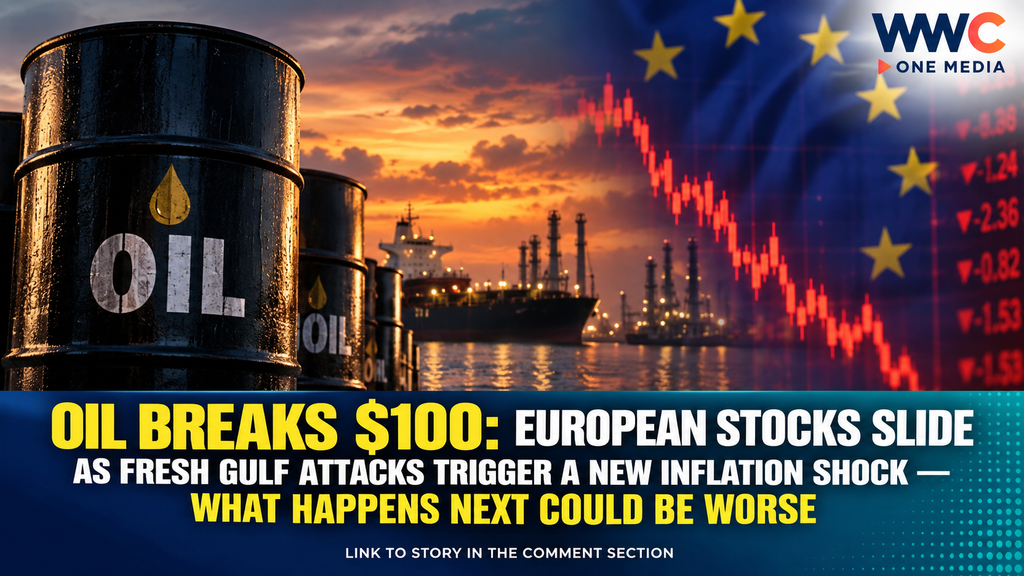
LONDON — Oil prices have surged back above the psychologically important $100-a-barrel mark, sending European stocks lower as a fresh escalation in the Middle East raises fears of prolonged energy disruptions and another wave of global inflation.
Brent crude, the international oil benchmark, climbed as high as $100.19 a barrel on Wednesday, its first move above $100 since July 24. Reuters reported that the contract was up about 2.3% at its session high, while U.S. West Texas Intermediate crude also advanced.
The jump came as the conflict involving the United States and Iran intensified. Iran said it had fired ballistic missiles at a U.S. base in Jordan, while both sides reported attacks involving vessels. The latest developments have added to concerns that the conflict could further disrupt oil flows from the Gulf region.
EUROPEAN STOCKS TAKE A HIT
The market reaction was immediate.
The STOXX 600, Europe’s broad benchmark, fell about 0.7% in early trading, with economically sensitive industrial and banking shares among the biggest decliners, according to Reuters. Separate market coverage showed Germany’s DAX, France’s CAC 40 and Britain’s FTSE 100 also under pressure.
Energy companies were among the relative beneficiaries of higher crude prices, but the broader market faced a more troubling question: how high can oil go before expensive energy begins damaging economic growth?
Societe Generale strategist Manish Kabra said the $100 level is psychologically significant, although he estimated crude would need to approach $150 a barrel to cause a major demand shock in developed economies. He warned, however, that higher diesel prices could still feed through into inflation and services.
STRAIT OF HORMUZ BECOMES THE BIGGEST MARKET FEAR
At the center of the oil-market anxiety is the Strait of Hormuz, one of the world’s most important energy chokepoints.
Reuters reported that oil flows through the waterway have fallen sharply amid the conflict. Before the latest escalation, flows had recovered to roughly 8 million to 9 million barrels per day, but more recently they had fallen below 2 million barrels per day, according to Rystad Energy data cited by Reuters.
That matters because the waterway traditionally carries a huge share of global oil and liquefied natural gas shipments.
The situation has become even more complicated after attacks by Iran-backed Houthi forces on Saudi energy facilities, raising concerns about disruptions not only in the Gulf but also along the Red Sea shipping route.
The Financial Times likewise reported that oil flows through the Strait have been severely disrupted and that the confrontation between the U.S. and Iran has created a growing threat to global energy supplies.
THE INFLATION PROBLEM IS BACK
For investors, the biggest concern may not simply be expensive gasoline or crude oil.
It is inflation.
Higher energy costs can raise transportation, manufacturing and electricity expenses, eventually feeding into the prices consumers pay for goods and services.
That could complicate decisions by major central banks just as policymakers are trying to determine whether inflation is finally cooling.
Markets are already watching upcoming U.S. inflation data closely. Reuters reported that traders were assigning roughly 60% odds to either a quarter-point Federal Reserve rate hike or a hold at next week’s meeting, while expectations for a Bank of Japan rate increase were also strengthening.
The European Central Bank is also facing renewed inflation pressure ahead of its policy decision.
GOLD RISES AS INVESTORS SEEK SHELTER
The market’s defensive mood was also visible in other assets.
Gold climbed roughly 1% to around $4,401 an ounce, while the Japanese yen strengthened as investors moved toward assets viewed as safer during periods of geopolitical uncertainty.
U.S. stock futures were relatively stable on Wednesday, but that followed a weaker session on Tuesday, when the Dow Jones Industrial Average fell 1.18%, the S&P 500 lost 0.58% and the Nasdaq declined 0.32%.
THE QUESTION NOW: HOW FAR CAN OIL GO?
The $100 threshold is more than a headline number.
If the conflict continues disrupting shipments, markets will increasingly have to price in the possibility of higher oil prices lasting for longer.
That creates a difficult chain reaction:
More conflict → tighter oil supplies → higher crude prices → higher fuel and production costs → renewed inflation → pressure on central banks to keep rates higher.
And that is precisely the scenario investors have been hoping to avoid.
For now, markets are watching the Middle East, the Strait of Hormuz and upcoming inflation data for clues about whether the latest oil surge will prove temporary — or become the beginning of another global inflation shock.
The biggest question is no longer whether oil can break $100. It already has. The question is what happens if it stays there.
Leave a Reply