
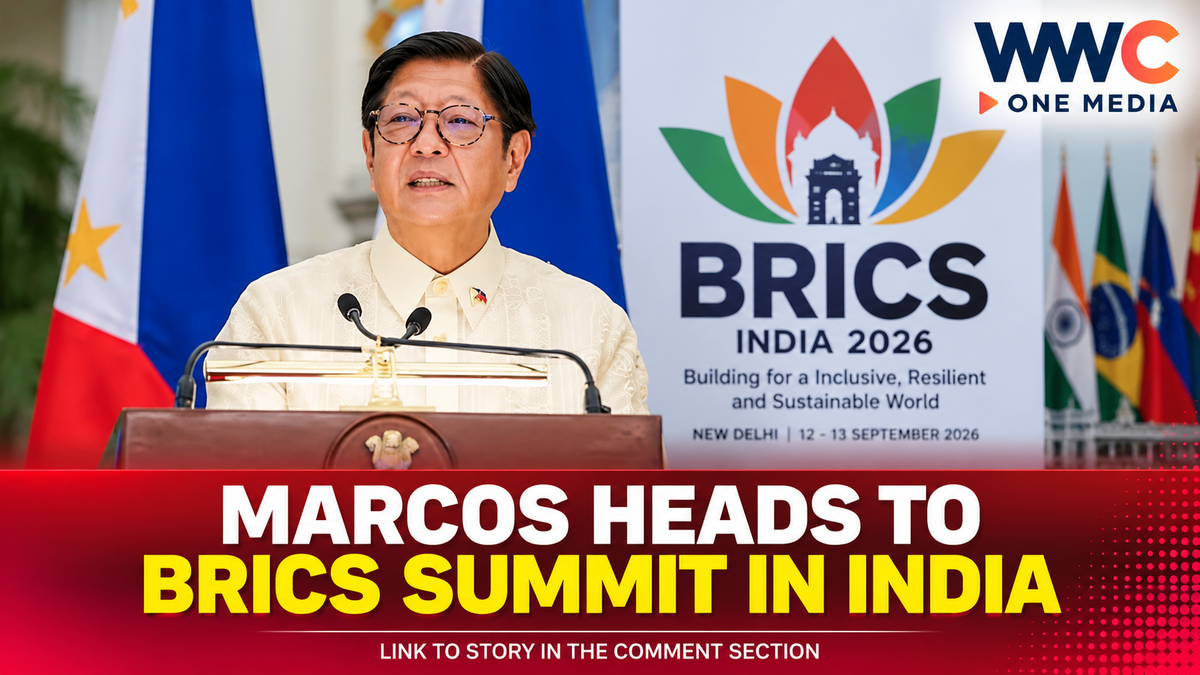
MANILA — President Ferdinand Marcos Jr. is set to travel to New Delhi, India, on September 12–13 to attend the 18th BRICS Summit, putting the Philippines in the room with some of the world’s major emerging economies at a time of heightened geopolitical and economic uncertainty.
Marcos was invited by Indian Prime Minister Narendra Modi to attend the summit, according to the Department of Foreign Affairs. The Palace has said the President will attend in his capacity as chair of ASEAN for 2026, giving Manila an opportunity to present regional priorities directly to BRICS leaders.
The visit is particularly significant because BRICS has expanded into an influential Global South forum. The group now has 11 members: Brazil, Russia, India, China, South Africa, Saudi Arabia, Egypt, the United Arab Emirates, Ethiopia, Iran and Indonesia.
Marcos expected to push ASEAN priorities
DFA Assistant Secretary and spokesperson Analyn Ratonel said Marcos’ participation gives the Philippines a strategic opportunity to monitor emerging economic frameworks and represent ASEAN’s priorities and perspectives while engaging directly with leaders of major emerging economies.
Among the issues expected to feature prominently at the summit are global economic uncertainties, digital public infrastructure and climate action.
For Manila, however, the trip is not simply about attending another international summit.
It could also provide an opportunity to strengthen economic and investment ties with India and other major economies represented at BRICS.
Billions in Indian investment pledges on the table
The Philippine News Agency reported that Marcos is also expected to follow up on Indian investment commitments totaling about $5.8 billion.
The investment pledges are an important component of the trip because the Philippines and India have been deepening their economic relationship alongside cooperation in defense, maritime security, science and technology, digital innovation, tourism, legal assistance and culture.
Marcos previously visited India in August 2025, when the Philippines and India formally launched a Strategic Partnership. His return to New Delhi therefore comes as both countries seek to translate that diplomatic relationship into concrete economic and strategic cooperation.
Why this BRICS summit matters
India is hosting the 18th BRICS Summit at Bharat Mandapam in New Delhi under the theme “Building for Resilience, Innovation, Cooperation and Sustainability.”
India’s 2026 chairship has focused on strengthening cooperation in trade, investment, finance, technology, energy, health, agriculture and sustainable development. More than 350 BRICS meetings and high-level engagements have reportedly been held across more than 25 Indian cities ahead of the leaders’ summit.
The summit is therefore expected to go beyond traditional diplomatic discussions.
India is pushing for practical cooperation in areas such as resilient supply chains, trade finance, digital payments, small and medium-sized businesses, startups, energy security and technological innovation.
For the Philippines, these areas could be particularly relevant as ASEAN economies navigate shifting supply chains, energy concerns and increasing competition for investment.
A major diplomatic gathering
The summit is also attracting attention because of the expected presence of major world leaders.
Reuters reported that Chinese President Xi Jinping was likely to attend the New Delhi summit, potentially making his first visit to India in seven years. Reuters said the possibility of Xi’s attendance was being closely watched because it could provide another opportunity for India and China to manage their complicated relationship following years of border tensions.
The gathering could consequently become an important venue for discussions involving trade, energy, security and the changing balance of power among major economies.
For Marcos, that creates an opportunity to engage with leaders beyond the Philippines’ traditional diplomatic partners while maintaining Manila’s existing alliances and partnerships.
BRICS is no longer the same bloc it was years ago
BRICS began with Brazil, Russia, India and China before South Africa joined in 2011. The bloc subsequently expanded, adding Egypt, Ethiopia, Iran, Saudi Arabia and the United Arab Emirates, while Indonesia formally became a full member in January 2025.
The expansion has given BRICS greater economic and geopolitical weight, but it has also made the group more diverse — and potentially more difficult to coordinate because its members have different national interests.
That makes the Philippines’ participation particularly notable.
Rather than seeking membership, Manila’s immediate opportunity is to use Marcos’ presence to advance ASEAN interests, strengthen economic relationships and explore areas where cooperation with BRICS economies could produce tangible benefits for the region.
And with billions of dollars in potential investments, a rapidly expanding BRICS bloc and major geopolitical players converging in New Delhi, Marcos’ September 12–13 visit could become much more than a ceremonial trip.
The bigger question is what the Philippines can bring home from the summit — and whether the diplomatic meetings will translate into actual investments, stronger trade and concrete opportunities for Filipinos.



Leave a Reply