
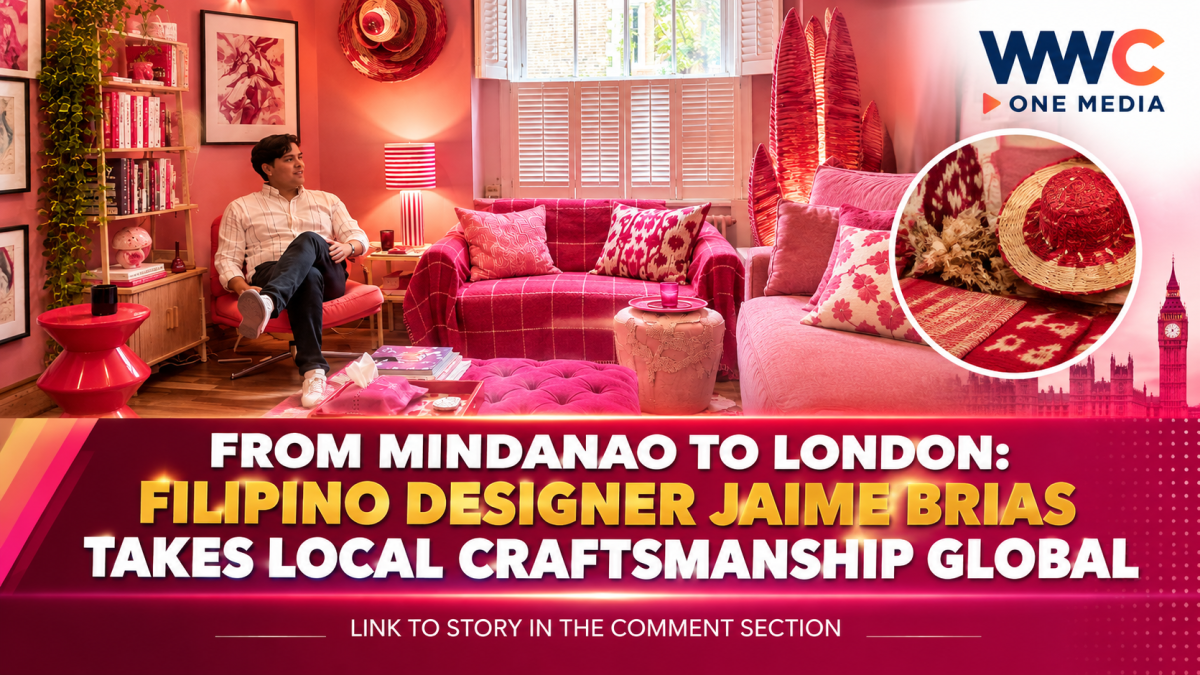
LONDON — Filipino designer Jaime Brias is bringing the materials, traditions and craftsmanship of the Philippines to an international audience, transforming centuries-old techniques into contemporary furniture and lighting designs.
Brias, who grew up between Davao and Manila and is now based in London, has built his work around a simple idea: Filipino craftsmanship does not need to be reinvented to appeal globally.
Instead, he believes traditional skills can be elevated through thoughtful contemporary design while preserving the identity of the artisans and communities behind them.
A family connection to Mindanao’s artisans
Brias’s connection to Filipino craftsmanship began long before his own design career.
His mother, Maricris Floirendo Brias, has worked with the T’boli community of Mindanao since the late 1980s through initiatives linked to TADECO, helping create sustainable livelihood opportunities for local artisans.
The T’boli, sometimes known as the Dreamweavers, are renowned for T’nalak, a traditional textile made from abaca fibres.
For generations, artisans have transformed the natural fibre into detailed woven designs with deep cultural significance.
Today, Brias continues to work with Filipino makers through TADECO Home, contributing as a designer while helping develop traditional materials and techniques for contemporary markets.
Working with tradition instead of replacing it
Brias’s approach begins with understanding what artisans already do best.
Rather than introducing an entirely new design language, he studies their materials, methods and existing work before identifying ways to develop the craft further.
His collaborators work with materials including:
- Abaca
- Bamboo
- Traditional woven fibres
- Indigenous textiles
The goal, he says, is to respect the knowledge that already exists while creating pieces that feel relevant to contemporary interiors and international audiences.
Filipino heritage meets international design
Brias’s own background reflects the mix of influences behind his work.
He trained at the Rhode Island School of Design and Parsons School of Design before working in product design and creative strategy in New York and Manila.
In 2024, he completed a master’s degree in Art Business at the Sotheby’s Institute and later established himself in London.
Despite his international career, his work remains closely connected to the Philippines.
His home in West Kensington reflects that balance, combining traditional English architectural elements with T’nalak textiles, tropical accents and Filipino art.
The same mixture of local identity and global influence can be seen in his furniture and lighting designs.
Heart of Abaca brings Filipino fibre to Paris
One of Brias’s most notable recent pieces is the Heart of Abaca, a lighting work created with his mother for TADECO Home.
The piece was unveiled at the 2025 Révélations Biennial at the Grand Palais in Paris, an international event celebrating fine craftsmanship and contemporary creation.
Standing nearly four feet tall, the work uses several layers of abaca fibre to represent different stages of the material’s journey.
Its outer layer reflects raw, untreated abaca, while the inner layers incorporate increasingly refined weaving techniques and references to traditional T’nalak patterns.
The result is both a contemporary design object and a tribute to the process behind one of the Philippines’ best-known natural materials.
Seeing materials as creative partners
For Brias, the material itself plays an important role in shaping the final design.
Natural fibres can be unpredictable, which means the design process requires a balance between control and allowing the material to retain its own character.
That approach also extends to traditional techniques.
Brias believes contemporary designers should find ways to move heritage crafts forward without stripping away the cultural knowledge and identity that make them distinctive.
His work ranges from lighting to furniture, often using similar natural materials and handcrafted processes across different pieces.
Taking Philippine design beyond mass production
Brias hopes Filipino design can carve out a stronger position in the international market.
Rather than competing directly with countries known for large-scale manufacturing, he believes the Philippines should focus on what makes its products different.
That includes:
- Handcrafted processes
- Indigenous materials
- Artisan knowledge
- Cultural identity
- Limited and bespoke production
- The story behind each piece
His vision is to position Philippine-made products less as mass-manufactured goods and more as collectible works shaped by craftsmanship and cultural heritage.
New collection planned for Manila
Brias is set to return his focus to the Philippines later in 2026.
In October, he and TADECO Home are expected to present a new collection of bespoke handcrafted pieces in Manila.
The collection will continue exploring how local materials can be combined with contemporary design.
It is also intended to provide inspiration for a new generation of Filipino designers, artists and artisans looking to bring local traditions into modern creative industries.
The bottom line
Jaime Brias is helping bring Filipino craftsmanship into the global design conversation without leaving its roots behind.
From abaca and T’nalak textiles to contemporary furniture and lighting, his work connects the traditions of Mindanao with international design centres such as London and Paris.
His message for Philippine design is clear:
The country’s strength may not lie in competing through mass production, but in showcasing the craftsmanship, cultural identity and stories that make Filipino-made pieces unique.
WWC ONE MEDIA J.M.D




Leave a Reply