
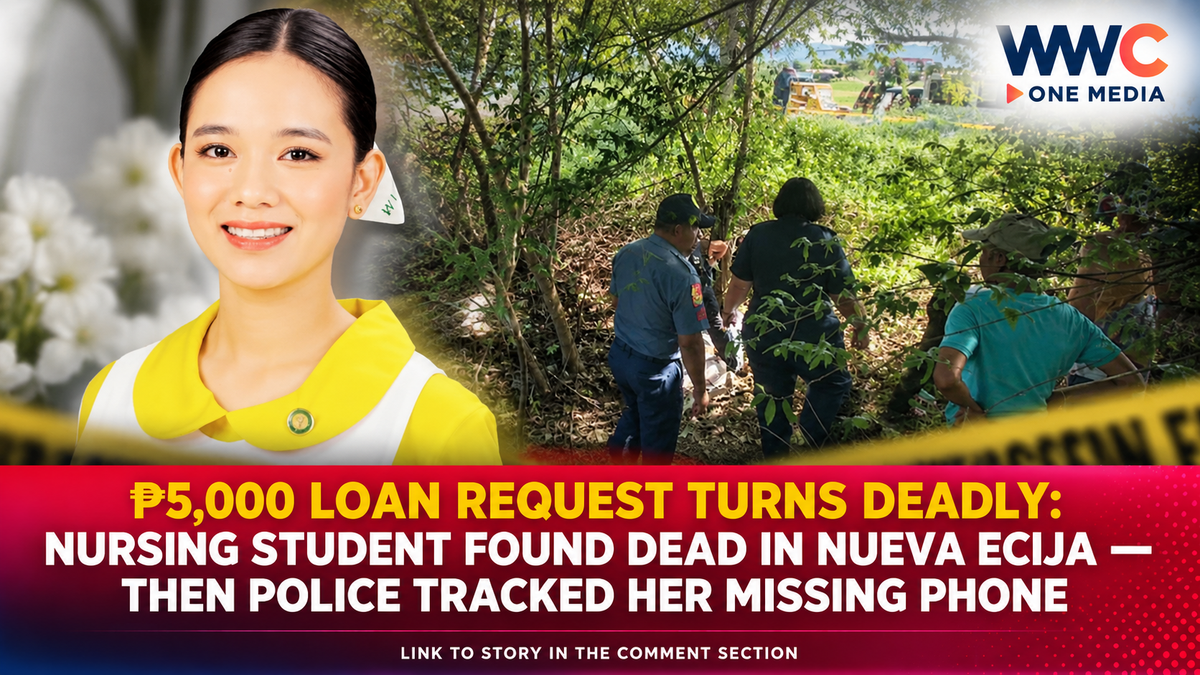
A 21-year-old nursing student and university scholar in Nueva Ecija was killed inside her home after a relative allegedly asked to borrow ₱5,000, according to police and multiple reports.
The victim was identified as Ann Pauline Fajardo, a fourth-year nursing student at Wesleyan University-Philippines in Cabanatuan City. She was found dead at her residence in Barangay Sto. Cristo, San Antonio, Nueva Ecija, on September 6.
What initially appeared to be a suicide quickly turned into a murder investigation after police noticed circumstances that did not fit the initial report.
What happened?
According to police accounts cited by GMA News and other Philippine media, authorities were initially alerted to a possible suicide at Fajardo’s home.
Responding officers found her lifeless, with a blanket around her neck. Investigators, however, became suspicious after discovering that one of her two mobile phones was missing.
Police eventually used the phone’s tracking capability to locate the missing device. Reports identified it as an iPhone 16 Plus valued at about ₱66,990, which investigators traced to a male relative of the victim.
The relative was subsequently arrested.
Police say ₱5,000 dispute preceded the killing
Investigators said the suspect went to Fajardo’s home to ask for a ₱5,000 loan.
When she allegedly refused to lend him the money, an argument reportedly followed. Police said the suspect subsequently strangled Fajardo.
The suspect allegedly later admitted responsibility in an extrajudicial confession, according to reports citing police.
Authorities have filed a murder complaint against the suspect.
It is important to note that the allegations and confession are part of the ongoing criminal case and do not constitute a final court judgment.
The alleged suicide scene raised questions
One of the most disturbing aspects of the investigation was the initial appearance of the death scene.
According to the Philippine Star and other reports, investigators said the suspect allegedly attempted to make the killing appear to be a suicide by using the blanket around the victim’s neck and attaching it to the bed frame.
The circumstances prompted further forensic examination.
An autopsy subsequently listed “asphyxia by strangulation” as the cause of death, according to reports citing the medico-legal findings.
A missing cellphone helped police find the suspect
The missing cellphone became a key piece of the investigation.
Police reportedly used the device’s Find My tracking feature to determine its location and eventually linked it to the suspect. This helped investigators move beyond the initial suicide theory.
The case demonstrates how digital evidence can become crucial in modern criminal investigations, particularly when investigators are trying to establish the movements of a person or locate property taken from a crime scene.
She was a scholar and aspiring nurse
Fajardo was not only a nursing student but also a scholar of Wesleyan University-Philippines.
The university expressed shock and strongly condemned her killing.
Wesleyan University-Philippines described Fajardo as a dedicated student, friend and “promising future nurse,” saying her death represented a devastating loss to the university community.
Her death came as she was nearing completion of her nursing studies.
Multiple reports confirm the key details
The core details of the case have been independently reported by GMA News, Inquirer, Philippine Star, Punto Central Luzon, CLTV36 and Bombo Radyo, including Fajardo’s identity, her status as a fourth-year nursing student, the alleged ₱5,000 loan request, the missing cellphone, the arrest of a male relative and the murder complaint.
There are some differences among reports regarding the exact relationship between the victim and suspect and the precise timeline of the initial discovery. For that reason, the safest formulation for publication is “relative/cousin” unless the police case documents establish the exact relationship.
A life lost over an alleged dispute
The case has sparked shock because the alleged dispute involved a relatively small amount of money, while the victim was a young woman preparing for a career in nursing.
But the central issue now extends far beyond the reported ₱5,000 request.
Investigators must establish the complete sequence of events, the circumstances surrounding the alleged confession, the forensic evidence and the motive that led to the killing.
For Fajardo’s family, classmates and teachers, however, the consequences are already permanent: a young scholar who was preparing to become a nurse will no longer get the chance to fulfill that dream.
The suspect remains entitled to due process, and the allegations will ultimately have to be tested in court.




Leave a Reply