
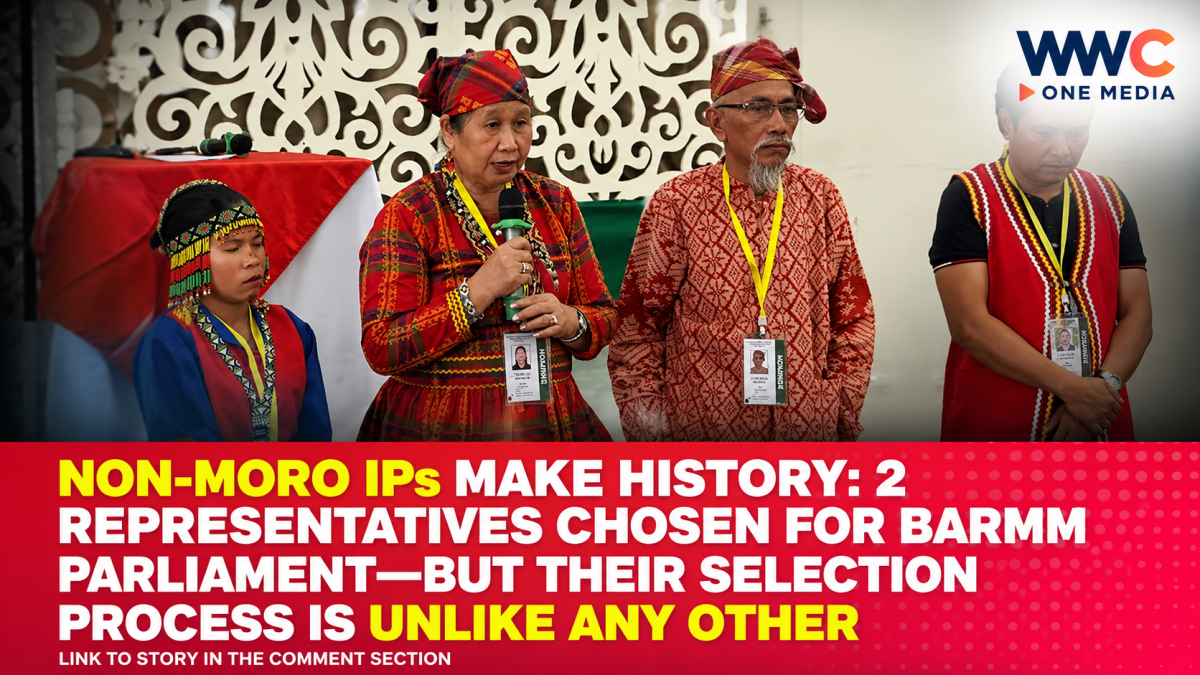
COTABATO CITY — Two representatives of the Non-Moro Indigenous Peoples (NMIPs) have already been selected for the incoming Bangsamoro Parliament, making them among the first members of the region’s regular legislature to be determined ahead of the September 14 parliamentary elections.
The representatives are Jo Genna M. Jover of the Teduray tribe, who will occupy the female NMIP slot, and Timuay Leticio L. Datuwata of the Lambangian tribe, who will occupy the male slot.
Their selection took place on August 25, 2026, during a regional inter-tribal convention at the Pagana Convention Center in Cotabato City. Rather than being decided through the conventional ballot-box system, the selection followed customary Indigenous processes, consensus-building and the political structures of the participating tribes.
A different kind of election
The process involved six major Non-Moro Indigenous Peoples groups in BARMM: Teduray, Lambangian, Erumanen ne Menuvu, Dulangan Manobo, Blaan, and Limbubungan Higaonon.
Before the regional convention, the participating tribes conducted their own tribal assemblies to select nominees and delegates. Those delegates then took part in the regional inter-tribal convention where the final representatives were determined through consensus.
The process is specifically recognized under the Bangsamoro legal framework.
The Bangsamoro Organic Law, or Republic Act No. 11054, guarantees two reserved parliamentary seats for Non-Moro Indigenous Peoples. It also provides that their selection should respect customary laws and Indigenous political processes, including consensus-building, community acceptability, inclusive participation, collective interests and gender equality.
COMELEC subsequently issued Resolution No. 11235, providing the implementing rules for the 2026 selection of NMIP representatives.
Teduray and Lambangian get the first rotation
The convention also settled an important question: which tribes would provide the first two representatives.
Delegates agreed that Teduray and Lambangian would take the first rotation.
That resulted in the selection of Jover of the Teduray tribe and Datuwata of the Lambangian tribe.
The agreed rotation is expected to continue in succeeding parliamentary terms. The Erumanen ne Menuvu and Dulangan Manobo groups are next in line, followed by the Blaan and Limbubungan Higaonon groups.
This arrangement gives the six participating Indigenous groups an agreed framework for sharing representation over successive parliamentary terms.
Why this matters for the Bangsamoro Parliament
The incoming Bangsamoro Parliament is structured to include both elected political representatives and reserved sectoral representation.
The Bangsamoro Organic Law provides for reserved seats for Non-Moro Indigenous Peoples and settler communities, alongside sectoral representation for women, youth, traditional leaders and the Ulama.
For the first regular parliamentary elections, the Parliament will have 80 seats, including 40 party representatives, 32 district representatives and eight sectoral or reserved seats. The two NMIP representatives form part of those eight sectoral seats.
Unlike most of the parliamentary positions that will be decided through the September 14 elections, however, the NMIP representatives were chosen through their own legally recognized Indigenous selection mechanism.
The distinction is significant: the process is intended to protect Indigenous political structures and ensure that their representatives are chosen by the communities they are expected to represent.
Comelec witnesses historic selection
COMELEC Chairman George Erwin Garcia witnessed the convention along with other observers.
According to the Philippine Daily Inquirer, Garcia described the process as a quiet, orderly and traditional method of selecting members of the Bangsamoro Parliament. He noted that the two NMIP representatives had effectively been chosen before the September 14 elections.
The process also stood in sharp contrast to conventional political campaigning, with the selection relying on consensus and customary decision-making rather than campaign rallies and ordinary election-day voting.
For Indigenous communities, the exercise represents more than simply filling two parliamentary seats. It is also an effort to preserve their customary political institutions while integrating them into the formal governance structure of the Bangsamoro region.
The bigger test comes next
The selection of Jover and Datuwata comes at a crucial moment for BARMM.
The region is preparing for its first regular parliamentary elections on September 14, 2026, a milestone in the Bangsamoro political transition.
COMELEC said it had completed about 90% of its preparations as of August 27, with training for election personnel largely completed and election equipment being distributed to provincial hubs. The poll body expects between 65% and 75% of roughly 2.4 million registered voters to participate.
The election will determine the bulk of the new Parliament, while the NMIP representatives have already been selected through their distinct customary process.
That makes their selection one of the clearest examples yet of how the Bangsamoro parliamentary system is attempting to combine electoral democracy with Indigenous self-governance.
For Jover, Datuwata and the communities they represent, the real challenge now begins after the selection: turning two reserved seats into an effective voice for Indigenous peoples in the policies, laws and decisions that will shape the future of BARMM.




Leave a Reply