
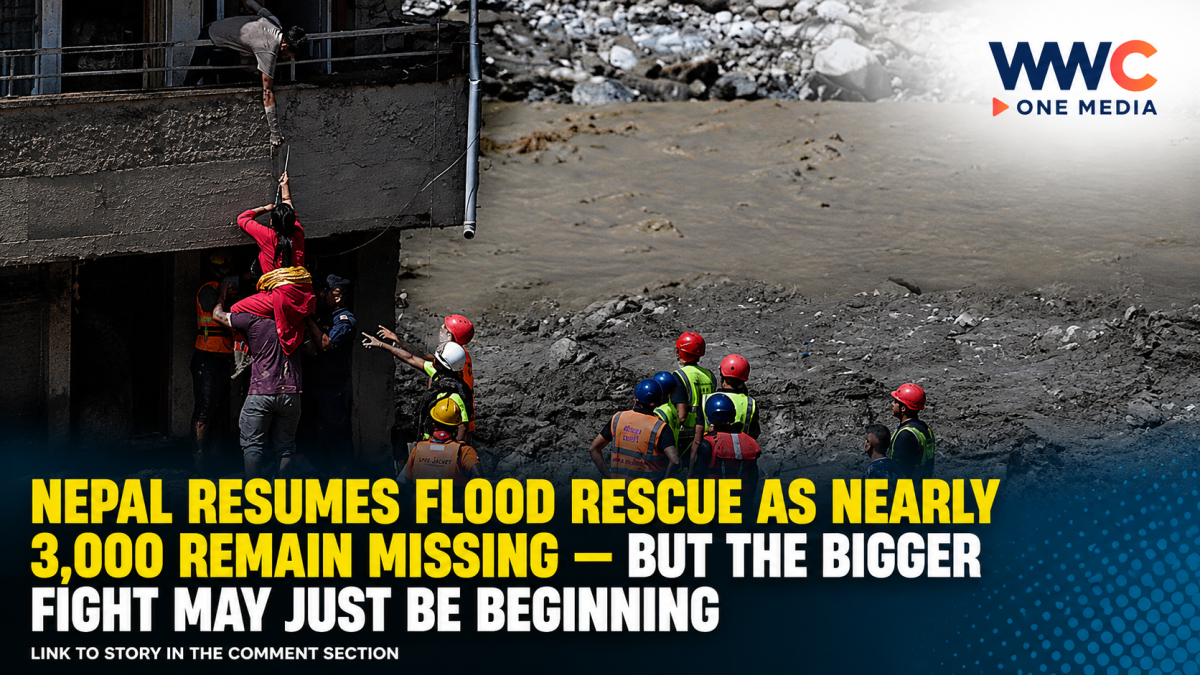
KATHMANDU — Nepal has resumed search-and-rescue operations following a catastrophic flash flood triggered by a glacier collapse along the Nepal-China border, as authorities race to locate nearly 3,000 people still reported missing and confront a reconstruction bill that could reach $5 billion.
The disaster struck on August 26 after a massive collapse of ice and rock unleashed torrents of water, mud and debris through Himalayan river valleys, devastating communities and critical infrastructure in northern Nepal and neighboring Tibet.
According to the latest Reuters report, at least 669 people have died in Nepal and seven in Tibet, while nearly 3,000 people remain unaccounted for across the affected areas. Other major outlets, including AP and The Guardian, have reported slightly different casualty figures as authorities continue updating their counts.
Rescue Operation Resumes After Weather Disruption
Nepal temporarily suspended some rescue operations because of dangerous weather conditions and concerns over rising water levels, but teams resumed operations as conditions improved.
The country’s security forces are concentrating on areas where survivors may still be trapped, including damaged hydropower facilities and tunnels buried under mud and debris.
AP reported that more than 3,700 people had been rescued in Nepal, while rescue teams continue to focus on areas where workers may still be trapped underground. One of the most urgent locations is a hydropower project where more than 100 people are feared to have been trapped inside a tunnel.
The difficult terrain is making the operation particularly dangerous. Roads and bridges have been destroyed, while several affected communities can only be reached by helicopter.
Nepal Wants Specialized Foreign Assistance — Not General Search-and-Rescue Teams
Nepal is asking the international community for help, but officials have emphasized that the country does not need foreign teams to conduct general search-and-rescue operations.
Instead, Foreign Minister Shisir Khanal said Nepal needs specialized expertise in areas where it lacks sufficient technical capacity.
Those requests include:
- rescuing people trapped inside hydropower tunnels;
- restoring damaged roads, bridges and communications;
- specialized engineering assistance;
- DNA testing and forensic identification of victims;
- equipment for recovering bodies; and
- facilities to preserve bodies for longer periods.
India and China have already provided assistance, including technical personnel and emergency supplies. Reuters reported that both countries are also working to account for their citizens who remain missing.
Reconstruction Could Cost Up to $5 Billion
The rescue operation is only the beginning of Nepal’s crisis.
Finance Minister Swarnim Wagle estimated that rebuilding after the disaster could cost between $4 billion and $5 billion.
That figure remains preliminary because authorities are still assessing the full extent of the damage. But the potential cost is enormous for Nepal, with the upper estimate equivalent to a significant share of the country’s economy.
The floods damaged or destroyed roads, bridges, buildings, hydropower infrastructure and other vital economic assets.
The destruction also threatens transportation and trade routes connecting Nepal with China, while communities dependent on tourism, agriculture and hydropower face major disruptions.
Hundreds of Foreign Nationals Are Among the Missing
The disaster has also triggered an international search for missing foreigners.
Reuters reported that more than 500 foreign nationals are among those unaccounted for. Many were traveling through the Himalayan region as tourists, workers or pilgrims.
AP similarly reported that many missing people include foreign workers, trekkers and pilgrims, while families have been gathering at hospitals and relief centers searching for information about loved ones.
The large number of foreign nationals involved has prompted governments around the world to coordinate with Nepalese authorities over identification and repatriation.
Bodies Are Becoming Increasingly Difficult to Identify
Another challenge facing authorities is the condition of recovered bodies.
Some victims have already begun decomposing, making identification increasingly difficult. Authorities are collecting DNA samples to help establish identities before remains are buried or transferred to families.
This is one reason Nepal has specifically requested foreign technical assistance for forensic identification and DNA testing.
The Disaster Was Not Simply a Conventional Rainfall Flood
The catastrophe was linked to a glacier collapse and resulting ice-rock avalanche, which unleashed enormous quantities of water, rock, mud and debris into Himalayan river systems.
The sudden release produced a devastating flash flood that moved through narrow mountain valleys, leaving residents with little time to escape.
The event has also renewed concerns about the growing risks faced by communities living downstream from glaciers and unstable mountain terrain.
Experts have warned that warming temperatures can contribute to glacier retreat and instability, increasing the potential danger from glacial collapses and related floods in the Himalayas.
Concern Remains Over Additional Flooding
Even as rescue teams search for survivors, authorities continue monitoring water bodies and unstable terrain in the region.
The Guardian reported concerns about additional flooding from a newly formed or expanding high-altitude lake, highlighting the possibility that the disaster zone could face further hazards.
That means rescuers are working against more than time.
They must also contend with unstable slopes, damaged infrastructure, unpredictable weather and the possibility of additional water surges.
Nepal’s Next Challenge: From Rescue to Recovery
For families still waiting for news, the search operation remains the immediate priority.
But for Nepal, an even larger challenge is already emerging: rebuilding communities and infrastructure destroyed in a matter of minutes.
With reconstruction potentially costing $4 billion to $5 billion, the disaster is expected to place significant pressure on the country’s finances.
The immediate question is whether rescuers can reach those still missing.
The bigger question may be how Nepal — already vulnerable to earthquakes, landslides, floods and other natural hazards — can rebuild while preparing for the next disaster.
For now, rescue teams continue moving through devastated valleys, tunnels and remote communities, searching for survivors and answers amid one of the Himalayan region’s most devastating disasters in years

Leave a Reply