
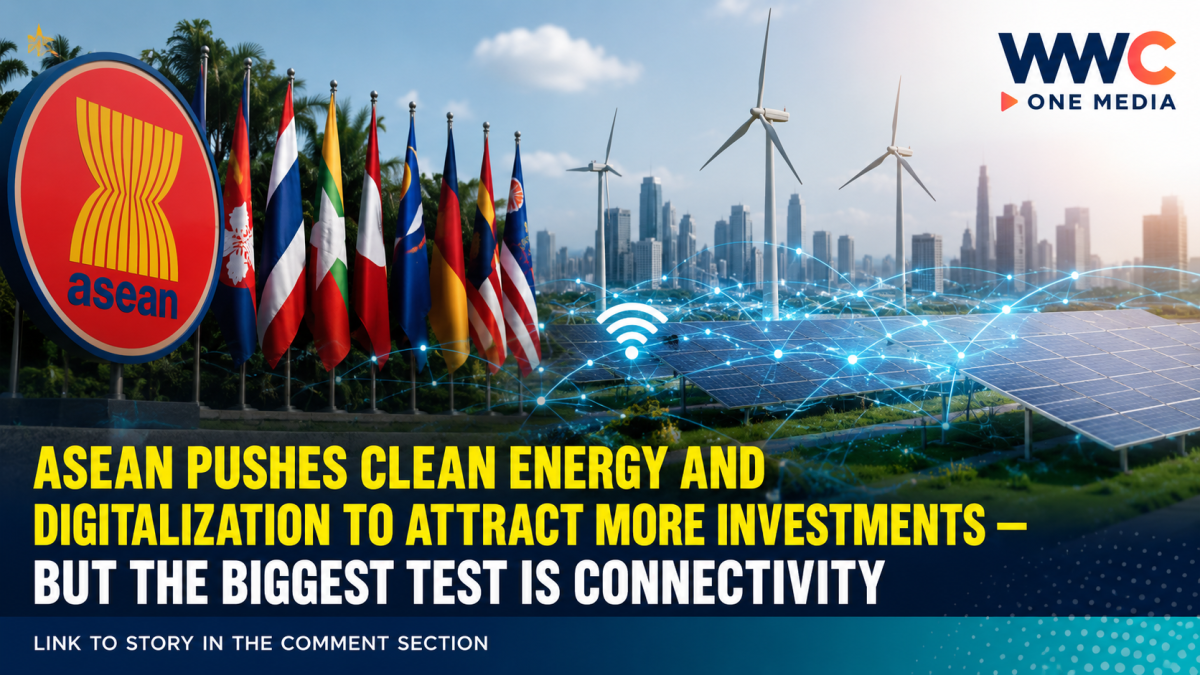
MANILA, Philippines — ASEAN is stepping up efforts to make clean energy, digitalization and regional connectivity central to its next phase of economic growth, as Southeast Asian countries compete for investments in emerging industries and seek to build a more resilient regional economy.
The push comes as ASEAN positions itself not simply as a collection of individual markets, but as a more integrated investment destination where energy, digital infrastructure, technology and cross-border connectivity can reinforce one another.
The Philippine News Agency recently reported that ASEAN is calling for greater investment in clean energy, digital infrastructure and resilient infrastructure, underscoring the growing importance of these sectors to the region’s economic strategy.
For the Philippines, the development is particularly significant as the country continues to promote regional connectivity and sustainable infrastructure under its 2026 ASEAN Chairship.
CLEAN ENERGY AND DIGITALIZATION MOVING TO THE CENTER
The ASEAN Centre for Energy has described digitalization as an important enabler of the region’s energy transition.
Digital technologies such as artificial intelligence and the Internet of Things can help modernize energy systems, improve efficiency and support the integration of renewable sources such as solar and wind.
But the transition also comes with major challenges, including differences in digital infrastructure, fragmented regulations, financing constraints, shortages of technical skills and cybersecurity risks.
This means ASEAN’s digital transformation cannot be separated from its energy strategy.
As economies expand their use of data centers, cloud computing, artificial intelligence and other digital services, electricity demand is also expected to rise. The challenge for governments is therefore to expand digital infrastructure without undermining efforts to reduce emissions.
INVESTORS ARE ALREADY LOOKING AT ASEAN
The region’s investment numbers show why the push matters.
According to the latest ASEAN investment figures based on UNCTAD’s World Investment Report 2026, ASEAN attracted a record US$243.9 billion in foreign direct investment in 2025, up 9.7% from US$222.3 billion in 2024.
The region accounted for about 15% of global FDI during the year.
Investment was particularly strong in sectors linked to the region’s long-term transformation, including communications, semiconductors, electronics, renewable energy and digital infrastructure.
Singapore remained the region’s biggest FDI recipient, while Indonesia, Vietnam, Malaysia and Thailand also attracted substantial investment. The Philippines received about US$9 billion in FDI in 2025, according to the ASEAN figures.
However, ASEAN also faces growing competition for strategic investments, particularly in artificial intelligence infrastructure, semiconductors, critical minerals and advanced manufacturing.
That is why regional integration and connectivity are becoming increasingly important.
THE ASEAN POWER GRID COULD BE A GAME CHANGER
One of the most important pieces of the strategy is the ASEAN Power Grid, which aims to strengthen electricity interconnections among member states and allow greater regional energy cooperation.
ASEAN’s Economic Community Strategic Plan 2026–2030 calls for expanded renewable-energy infrastructure and interconnections, including future land transmission and subsea power cables.
The plan also calls for pooled investment to strengthen energy security, improve power-grid infrastructure and increase cross-border connectivity.
ASEAN Secretary-General Kao Kim Hourn has likewise highlighted the need for major investment in regional power infrastructure. In remarks earlier this year, ASEAN estimated that realizing the ASEAN Power Grid could require roughly US$700 billion to US$760 billion in power generation and transmission infrastructure through 2040.
For investors, that represents a potentially enormous pipeline of infrastructure projects.
For governments, however, it also means overcoming regulatory, financing and technical barriers that can slow cross-border projects.
DIGITAL CONNECTIVITY IS THE OTHER HALF OF THE EQUATION
Energy is only one part of the regional connectivity push.
ASEAN is simultaneously working to strengthen digital infrastructure and create a more integrated digital economy.
The ASEAN Digital Master Plan 2030 includes measures to promote green and energy-efficient digital infrastructure and data centers, develop regional systems for measuring the environmental impact of digital activities, and use technologies such as AI to support environmental monitoring and climate resilience.
ASEAN Secretary-General Kao Kim Hourn also recently emphasized the importance of interoperable digital infrastructure, cybersecurity, data governance and digital skills in building a stronger regional digital economy.
The goal is not simply to get more people online.
A more connected ASEAN could make it easier for businesses to trade across borders, participate in regional supply chains, access digital services and attract technology-related investments.
PHILIPPINES SEEKS TO TURN CONNECTIVITY INTO INVESTMENT
The Philippines is particularly involved in this agenda as ASEAN Chair in 2026.
At the ASEAN Connectivity Coordinating Committee meetings held in Pasay City on August 24–25, officials reviewed implementation of the ASEAN Connectivity Strategic Plan and discussed ways to strengthen coordination and partnerships with ASEAN’s dialogue and external partners.
The Philippines is also involved in the EU-ASEAN Sustainable Connectivity Package–Investment Facility, or SCOPE-IF, which focuses on mobilizing sustainable infrastructure investment in transport, energy and digital sectors.
This creates an opportunity for the Philippines to position itself as part of a broader regional network connecting infrastructure, clean energy and digital investment.
BUT THERE IS A BIG CATCH
ASEAN’s ambition is significant, but attracting investment is only the first step.
The region still needs to ensure that projects can move from announcements to actual construction and operation.
That requires compatible regulations, stronger power grids, reliable digital networks, skilled workers, cybersecurity protections and financing mechanisms that can support projects across national borders.
ASEAN’s own energy experts have identified regulatory fragmentation, unequal digital infrastructure, financial barriers and limited technical capacity as obstacles to digitalizing the energy sector.
At the same time, ASEAN’s investment outlook shows that competition for strategic industries is becoming more intense.
The region attracted record FDI in 2025, but announced greenfield investment actually declined by about 10.1% to US$105.6 billion, showing that strong overall investment figures do not automatically mean every new project will materialize.
That makes execution critical.
THE BIGGER PICTURE
ASEAN is effectively betting that clean energy + digitalization + connectivity = stronger investment and long-term competitiveness.
The strategy could create opportunities in renewable energy, smart grids, data centers, telecommunications, semiconductors, electric vehicles, advanced manufacturing and other technology-intensive industries.
The Philippines could benefit if it can strengthen its own infrastructure and regulatory environment while taking advantage of regional initiatives.
But the real test will be whether ASEAN can turn ambitious regional plans into functioning cross-border projects.
The investment opportunity is already attracting attention. The next question is whether ASEAN can build the infrastructure fast enough to capture it.




Leave a Reply