
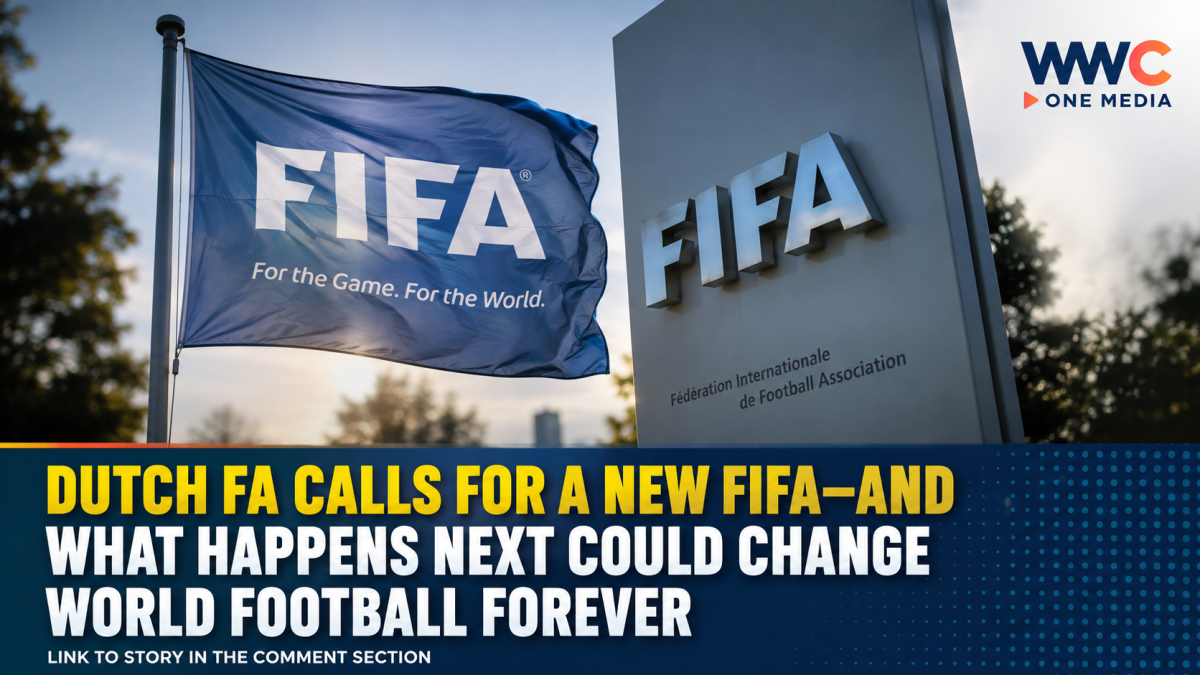
AMSTERDAM — The Dutch Football Association (KNVB) has called for sweeping changes at FIFA, declaring that replacing the world football body’s president alone will not be enough to restore trust and proposing a global summit in Amsterdam to discuss the future of the game.
In a forceful call for reform, the KNVB said it has lost confidence in FIFA President Gianni Infantino’s leadership and believes international football needs new leadership from 2027. But the Dutch federation stressed that the debate must go far beyond one person.
Its message is clear: not just a new president, but a new FIFA.
The proposal comes as pressure mounts over FIFA’s governance and follows controversy surrounding the now-withdrawn FIFA Forward Enterprise proposal, which had triggered strong opposition from European football authorities and several national associations.
A Call for Change Beyond FIFA’s Leadership
The KNVB said the concentration of power around the FIFA presidency and what it sees as insufficient separation between political leadership and the organisation’s administration have raised serious concerns.
Rather than focusing solely on who will lead FIFA after the next presidential election, the Dutch federation argues that football must first decide what kind of governing body it wants for the future.
The KNVB has outlined three major priorities for reform: stronger governance and checks and balances, greater emphasis on human rights and sustainability, and more investment in football development worldwide.
Among its proposals are a stronger and more representative FIFA Council, greater independence for the organisation’s administration and a FIFA Youth Council that would give younger generations a permanent voice in the global game.
The Dutch FA also wants human rights, sustainability and the fight against discrimination to play a more central role in FIFA’s decision-making, including in the awarding of major tournaments and commercial activities.
Up to 90% of FIFA Revenue Reinvested in Football
One of the most ambitious proposals concerns money.
The KNVB says FIFA should work toward reinvesting up to 90% of its distributable revenues back into football, with transparent rules governing how those funds are used.
The investment, it argues, could support youth and women’s football, coaching, refereeing, infrastructure and the development of national associations around the world.
The federation also wants greater international cooperation through a global knowledge-sharing platform and more opportunities to test innovations that could shape football’s future.
Its underlying argument is simple: commercial growth is important, but football’s money should ultimately serve the game—not the other way around.
Amsterdam Summit Proposed for Football’s Future
To move the conversation forward, the KNVB has proposed an International Summit on the Future of FIFA, offering Amsterdam as the host city.
Crucially, the Dutch federation says it does not want to impose a European vision on the rest of the football world. Instead, it wants all 211 FIFA member associations and the sport’s regional confederations to take part in shaping the organisation’s future.
As one of FIFA’s founding associations, the KNVB says it wants to help lead that conversation from within the global football community.
The timing is significant. FIFA’s next presidential election is scheduled for 2027, and the Dutch proposal seeks to turn the coming leadership contest into something much bigger: a debate over how the world’s most powerful football organisation should be governed.
Pressure on FIFA Continues to Build
The Dutch FA’s intervention is part of a wider wave of concern surrounding FIFA governance. Recent reporting has highlighted growing criticism from European football bodies and several national associations, including Nordic federations that have publicly expressed a loss of confidence in Infantino’s leadership.
UEFA has also continued to press for broader governance reforms, even after FIFA withdrew the controversial commercial proposal that had intensified tensions within world football.
For FIFA, the immediate crisis surrounding that proposal may have eased—but the deeper questions have not disappeared.
The Netherlands is now pushing those questions to the centre of the global football conversation.
With the 2027 election approaching, the battle may no longer be just about who leads FIFA. It may be about whether the organisation itself is ready to change.

Leave a Reply