
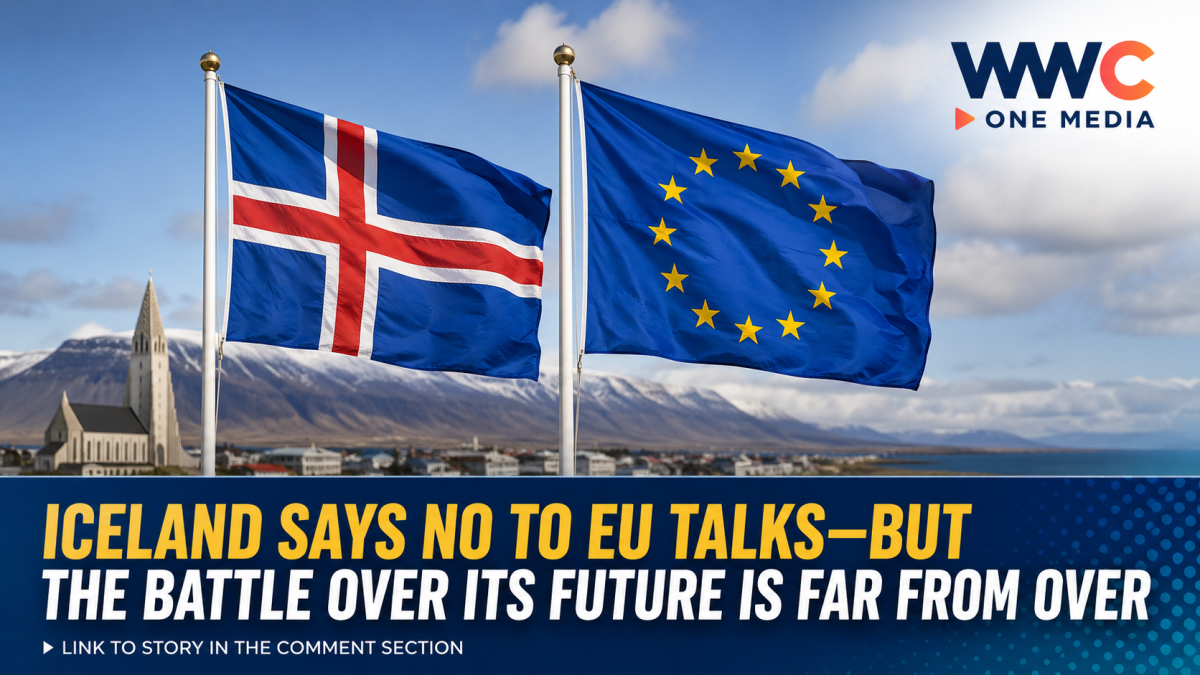
REYKJAVIK, Iceland — Icelanders have narrowly voted against reopening negotiations to join the European Union, delivering a significant setback to the government’s push for closer integration with Europe and reopening a decades-old debate over sovereignty, security and the country’s prized fishing waters.
According to results reported by Iceland’s national broadcaster RÚV and confirmed by multiple international news outlets, 52.8% voted against resuming EU accession talks, while 47.2% voted in favor, in a referendum that drew a high turnout of about 82.5%.
But the vote comes with an important distinction: Iceland did not vote directly on whether to join the European Union. Voters were asked only whether the country should restart negotiations that were suspended more than a decade ago. The referendum itself was advisory, although the government had indicated it would respect the public’s decision.
Why Icelanders Said No
For many voters, the biggest issue was not Brussels—it was the sea.
Iceland’s fishing industry remains deeply tied to the country’s economy, identity and political independence. Opponents of renewed EU talks warned that membership could eventually put Iceland’s control over its fisheries and natural resources at risk under the bloc’s Common Fisheries Policy.
Concerns about national sovereignty also proved powerful, particularly outside the capital. Reuters and other outlets reported that while supporters argued closer EU ties could strengthen Iceland economically and politically, critics questioned whether Brussels could solve the country’s domestic problems without demanding too much control in return.
The result also highlighted a geographical divide. Reykjavík was among the areas more supportive of reopening negotiations, while opposition was stronger in many rural communities, where concerns over fisheries, agriculture and national independence carried greater weight.
The EU Debate Was About More Than Membership
Supporters of restarting talks had argued that Iceland should at least explore what a future deal with the EU could look like.
They pointed to economic pressures, including the cost of living and high interest rates, as well as growing geopolitical uncertainty. Some supporters also saw eventual EU membership—and potentially joining the euro—as a way to reduce the vulnerabilities associated with Iceland’s small, independent currency.
Security concerns added another layer to the debate. Russia’s war in Ukraine, broader global instability and renewed attention on the Arctic pushed Iceland’s strategic position into the spotlight. U.S. President Donald Trump’s rhetoric about Greenland also intensified discussion about the future security of the North Atlantic and Arctic region.
Yet for the “No” camp, the question was simpler: Iceland already enjoys close economic and political ties with Europe without being a full EU member.
Iceland Is Already Closely Connected to Europe
Iceland is not an outsider looking in.
Through its membership in the European Economic Area (EEA), Iceland participates extensively in the EU single market, while it is also part of the Schengen Area and the European Free Trade Association. The European Commission says a significant share of EU legislation already applies in Iceland through the EEA framework, although Iceland does not have voting rights in EU institutions.
The country’s economic links are also substantial. The EU remains Iceland’s largest trading partner, accounting for more than half of its total goods trade, according to European Commission figures.
That raises a question that has divided Icelanders for years: Why give up more national control for full membership when Iceland already receives many of the benefits of close European integration?
Saturday’s vote suggests that—for now—a narrow majority believes the risks outweigh the potential rewards.
A Debate Decades in the Making
Iceland applied to join the EU in 2009 in the aftermath of the global financial crisis. Accession negotiations began in 2010 but were put on hold after a change of government in 2013. In 2015, Iceland’s government asked that the country no longer be regarded as an EU candidate.
The issue returned to the political agenda as economic pressures and global uncertainty changed the national conversation. However, the latest referendum result now appears to have shut the door—at least temporarily—on another attempt to restart formal negotiations.
What Happens Next?
Prime Minister Kristrún Frostadóttir’s government had presented the referendum as a major opportunity to settle the question of whether Iceland should reopen the EU debate. Following the rejection, Reuters reported that Frostadóttir said the issue would not be pursued under her administration.
For the European Union, the outcome is a symbolic disappointment. Iceland’s strategic Arctic location, stable institutions and deep existing integration with the bloc had made it one of the more straightforward potential candidates for future enlargement.
But Iceland’s voters have delivered a clear warning about the limits of integration.
For now, Iceland appears determined to remain closely connected to Europe—without becoming part of the European Union.
And with the vote decided by fewer than six percentage points, one thing is equally clear: the argument over Iceland’s place in Europe may be paused, but it is far from over.



Leave a Reply