
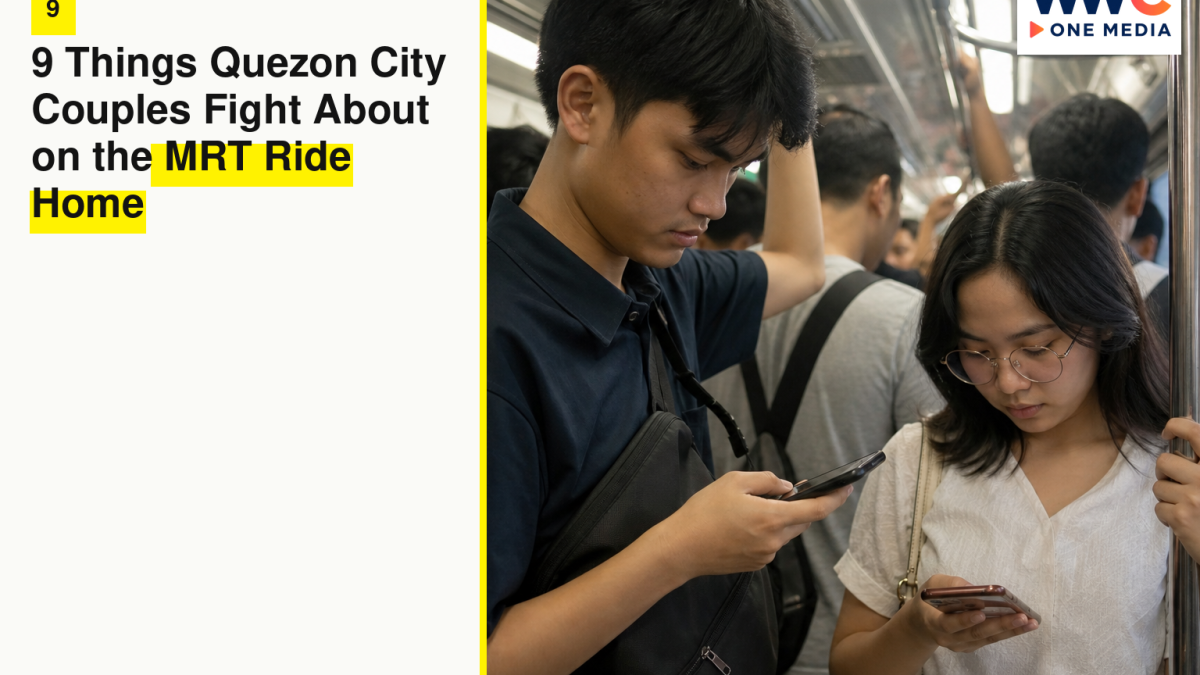
QUEZON CITY, Philippines — The office lets out. The Beep card still has load, or it doesn’t. North Ave is already a shoulder-to-shoulder argument before anyone has said a word. Quezon City couples do not usually break up over a grand betrayal. They fray on the MRT ride home: packed car, phone brightness, a transfer at Cubao that one of them did not want, the last train they both pretended was later than it is, and the Grab fare that appears if they miss it.
This is not a personality test. It is a commute with two people in it. Nine fights. They show up between Taft and the walk past Trinoma, between Santolan and the text that says I’m already downstairs. Write the rules before the car fills. The train will not wait for a better mood.
1. Who stands, who sits, and the North Ave squeeze that starts the MRT ride home
North Ave at rush is not a meeting point. It is a funnel. One of you came from a tower in Makati or a desk near Ayala. The other came from Trinoma, from a bus that crawled down Commonwealth, from a Fairview UV that dumped you into the heat. You find each other by a pillar, by the 7-Eleven, by a pin that is already wrong because the crowd moved. Then the doors open and the fight is physical before it is verbal: who gets a seat, who holds the pole, who gets shoved into a stranger’s backpack.
Couples pretend this is manners. It is logistics. If one of you is shorter, tired, pregnant, coming off a twelve-hour shift, or carrying a laptop bag that has already been through two jeepneys, that person sits if a seat exists. If no seat exists, you stand on the same side of the pole so you are not shouting across a student with a guitar. You do not perform chivalry that blocks the door. You do not sigh when the other person takes the last seat. You also do not martyr yourself into a bruise and then bill them for it at Kamuning.
Write one sentence in Notes: if a seat opens, [name] sits. If both of you are fine, the person who boarded first sits. If neither sits, you stand back-to-back so the packed car does not turn you into two separate commutes. The North Ave squeeze is ten minutes of bad air. It is not a referendum on who cares more.
What not to do: board separately “to be faster” and then text from two cars. You will not reunite at Cubao. You will reunite in a fight about who abandoned whom at the yellow line.
2. Phone brightness in a packed car
The car is dim. Someone’s screen is a floodlight. Your partner is in a group chat, a game, a work email, a thread with a sibling who always texts at 7:12. You are holding a pole with one hand and their bag with the other. The phone is the third person in the relationship, and it is brighter than the overheads.
This fight is not about “you never talk to me.” That sentence is too big for a ride between Quezon Avenue and GMA-Kamuning. It is about a setting. Lower the brightness. Turn on dark mode. Put the phone in a pocket for three stations if the car is packed enough that a stranger can read the chat. They can. They do. Couples forget the packed car is a public room.
Agree on a default: from North Ave to Cubao, phones down unless you are checking the last train, a parent, or a Grab pin. After Cubao, if you still have seats or at least a pole, you can scroll. If one of you uses the ride to decompress with a video, earphones. The speaker in a packed MRT car is how you become the couple other people describe later.
A script that fits the noise: “Brightness. People can see.” Not “you care more about your phone than me.” The second one cannot be solved before Santolan. The first one can. If the phone is work, say so in one line: “Boss. Two stations.” Then it goes away. An endless mute-and-scroll while your partner holds both bags is a scorecard. The train will store it.
3. The last train, Taft, and who decided one more drink
Taft is the south end of the line. People stay for a mall errand, a friend in a bar along that side of EDSA, a “quick” dinner that was never quick. The last train is a clock. It is not a vibe. Quezon City couples who live north of Cubao and play the last train like a dare will spend the rest of the night on a Grab they did not budget, or on a bus that smells like a lost argument.
Check the last train before you leave the office, not when you are already laughing on a sidewalk. One of you is the timekeeper. That is not nagging. That is how you get home. If you want to miss it on purpose, say so while you can still walk to a jeep or split a ride with a plan. Missing it by accident because one of you “didn’t hear” is how the packed-car mood becomes a parking-lot mood at Metropoint.
Write the rule: on weeknights, you ride a train that is not the last one. Buffer of one train. If you are at Taft and the buffer is gone, you leave the drink. The friend will survive. The last train will not wait because your table got another round. If you both want a late night, you budget the Grab from Taft toward North Ave or Cubao before the first bottle, not after the surge hits.
What not to do: stay quiet about the clock because you do not want to be the boring one. Boring is a seat on the train. Exciting is a fare you will fight about at the gate of a Fairview subdivision at midnight.
4. Cubao: the transfer, the wait, the “I’ll just meet you”
Cubao is where the MRT ride home becomes two rides. LRT-2 is there. Gateway is there. Araneta. Farmers. A mall that swallows people who said they were only transferring. One of you wants to go straight. The other wants to “pass by” a shop, a palengke bag, a sibling who works nearby. The packed car opens. The couple does not.
Decide before North Ave whether Cubao is a transfer or a stop. A transfer means you stay in the system: walk, swipe, continue. A stop means you exit, and the last train math changes. Couples who blur those two will lose each other in Gateway and reconstruct the night over chat that keeps saying “where are you” with worse spelling each time.
If one of you gets off at Cubao and the other continues to Santolan or Quezon Avenue, name the meeting point for later: not “the mall,” not “the station.” A specific exit, a specific Jollibee, a specific bus bay. Pins drift. Crowds eat pins. If you are meeting a parent who insists on picking you up “at Cubao,” they need a curb, not a feeling. Send the curb. Wait there. Do not wander into Farmers and expect the other person to telepath.
A Cubao wait of “five minutes” is twenty. Build that in or skip the errand. The MRT ride home is already long. Adding a mall loop because one of you hates going home empty-handed is a grocery problem, not a romance problem. Buy the onion on Saturday.
5. Who pays Grab if you miss it
You missed it. Taft is emptying. North Ave is a rumor. The last train is gone and the night is now a fare. Who pays Grab if you miss it is the fight Quezon City couples postpone until the driver is already on the pin.
Three cases, write them while you are still on salary and not on a sidewalk:
If you both chose to miss it — late dinner, a film, a friend — you split. GCash on the spot, not a “later” that becomes a week.
If one of you made the other miss it — “one more,” “the train is still there,” “relax” — that person pays. Not as punishment. As the cost of the call they made. If they cannot pay, they say so before the Grab arrives, and you split with a date to settle. A silent ride to Project 4 while one person stews about the fare is how Sunday starts on Friday night.
If the miss was the system — a stalled train, a crowd that would not let you board at Ayala, a Beep card that died at the gate — you split. Nobody “owes” a breakdown. What you owe is a screenshot of the fare in the thread so it does not become folklore.
Keep a small Grab buffer in the same envelope as “we might miss the last train.” If you cannot afford the buffer, you do not play with the last train. That is the whole rule. Surge from Taft toward QC on a Friday is not a cute story. It is rent.
Script at the pin: “Split now or I pay and you GCash me before we sleep.” Not tomorrow. Tomorrow the amount will feel like a character judgment.
6. Dinner that dies between Santolan and the walk
Santolan-Annapolis goes by. You are almost in the part of the city that is home, or almost at the transfer to a jeep that will take you into a side street where the aircon dies. Hunger starts. One of you assumed leftovers. The other assumed a stop at a food court you already passed. The packed car is a bad place to design a meal.
Decide dinner at North Ave or earlier, in a text that is a plan, not a mood. Leftovers, a rice meal near the station you actually alight, a delivery pin that is the house and not a gate the rider cannot enter. Quezon City couples fight about dinner because the ride is long enough to get hungry and too loud to negotiate. By the time you hit the stairs at your stop, one of you is already injured by the fact that the other person “never thinks of food.”
They think of food. They thought of a different food. Write a default: weeknights are the cheaper nearby meal or whatever is in the fridge. Weekend is the mall. If one of you cannot cook tonight, say it at Cubao, not at the door of a studio in New Manila when the other person already took out a pan.
What not to do: scroll a delivery app in the packed car with the brightness up, ask “what do you want” four times, then get angry that there is no answer. There is no answer because the car is a crush of bags and someone is playing a video without earphones. Pick two options. Send them. The other person replies with 1 or 2. That is dinner. That is not a lack of passion.
Santolan is also where people remember they were supposed to buy something for a parent. If the errand will add a jeep and forty minutes, it is not an errand for a Friday MRT ride home. It is Saturday. Put it on Saturday.
7. Work leftover that becomes a lecture between stations
One of you had a day. The boss, the client, the commute into Makati that already used up the patience. The MRT ride home looks like the first private room. It is not private. It is a packed car. A lecture about a coworker, delivered into your partner’s ear at volume because the rails are loud, is still a lecture. The stranger at your elbow now knows your org chart.
Venting is allowed. A time box is required. One station of “my day was ugly.” Then a pause. If you need more, you take it at home, on a walk around the block, not as a monologue from Ortigas to Quezon Avenue while your partner is also carrying a day. Couples who use the whole MRT ride home as a briefing will arrive at the house already in a hierarchy: one speaker, one audience. The audience will eventually skip the train.
If both of you need to dump the day, you take turns by station. It sounds childish. It is how you both get a turn before GMA-Kamuning. If one person’s job is always the louder job, admit it. Then give the quieter job the first station, on purpose. Otherwise the quieter job becomes the person who nods and then goes silent after Cubao.
Work Slack on the ride is the cousin of this fight. If you must reply, say “work, two messages.” Then lock it. An entire thread answered with your partner standing beside you, unread, is the phone-brightness fight wearing a lanyard.
8. Family group chats that light the phone in a dark car
A tita in the family GC. A mother who wants to know if you already ate. A sibling who needs a GCash for a bill you did not agree to. The packed car lights up. Your partner sees the preview. Or they don’t, and they ask, and you angle the phone away, which is its own fight.
Family texts during the MRT ride home are not always emergencies. Treat them as if the packed car can see them, because it can. If the text is money, do not negotiate a remittance between Shaw and Boni with your partner watching the amount. Say “family, money, later.” Then later is a table, not a pole.
If the text is a pickup: a cousin at Cubao, a parent at North Ave, a request to detour through a hospital or a wake. That is a change to the ride. You do not accept a detour in a GC and then surprise the person you are riding with at the doors. You show them the message. You decide together whether tonight can take a detour. If it cannot, you reply to the family from the train with a sentence you both can live with: we are on the last possible train, we can do tomorrow. Relatives will not love it. Relatives are not on the Beep gate.
Parents who track the ride — “are you on the train,” “why so slow,” “who are you with” — get one update at North Ave and one at your stop. Not a live blog. Couples who narrate the MRT ride home to two mothers will fight about whose mother is the extra passenger.
9. The silence after GMA-Kamuning that is not peace
Sometimes the fight is that nobody is fighting. After GMA-Kamuning the car thins a little, or it doesn’t, and the two of you stare at ads. The day is still on your faces. One of you wants talk. One of you wants the last stations to be quiet. Both are reasonable. Unnamed, they become “you don’t like me anymore” by the time you hit the stairs at Quezon Avenue or the walk toward Trinoma.
Agree on a default silence. The MRT ride home can be a quiet corridor if you both know it is a rest, not a withdrawal. A hand on a bag strap is enough. If one of you needs words, ask for one station of words, not a thesis. “Tell me one thing from today.” Not “why are you like this.”
Silence that starts after a Cubao almost-fight is different. That is unfinished. You do not finish it in a packed car. You flag it: “Cubao later, not here.” Then later has to exist. A flag with no later is just a threat. Sit on a bench at your stop, or walk one block before you enter a house where a sibling is watching TV. Five minutes on a sidewalk in Quezon City will do more than a whispered argument against a door.
If the silence is contempt — looking away, earbuds in, a laugh at the phone that is not shared — that is not rest. That is a conversation you are having without the other person. Get off the train and have it on the platform if you must. Platforms at North Ave are ugly. They are still better than bringing contempt into a jeepney home.
The North Ave platform script that fits in Notes
Before you treat the station like a living room, walk this once on a Sunday when the car is empty enough to think:
- Where we meet if we do not ride together: pillar, 7-Eleven, specific exit. Photo of the spot, saved.
- Who sits if a seat exists.
- Phones from North Ave to Cubao.
- Is Cubao a transfer or a stop tonight.
- Dinner in one text before you swipe in.
- Last train buffer: which train you are aiming for, not the last one.
- If we miss it: who pays Grab, GCash before sleep.
- Family GC: money and detours wait until a table, unless someone is in a hospital.
- Silence is rest unless one of us says “one station of words.”
Send the note to both phones. The MRT ride home does not need a speech. It needs a pin and a default. If one of you hates Notes, write it on the back of a Beep sleeve. Same content. The train does not grade handwriting.
Practice the meeting point once. Actually stand there. The pin that looked obvious from a desk in Ortigas is a different animal when the North Ave crowd is moving toward Trinoma and the aircon from the mall doors is the only weather you will get.
What not to do on the last train
Do not run on the platform. The last train will leave, or it will not, and a fall is a worse night than a Grab. Do not hold the doors. Do not board a car so packed you cannot get off at your stop; missing Santolan because you were crushed at the wrong end is how you end up at a station you did not budget walking from.
Do not start a relationship talk on the last train. There is no next car to move to. There is no volume that is private. There is a walk after, a jeep, a gate. Use those. Do not cry in a packed last train if you can wait three stations. If you cannot wait, get off at the next stop and sit on the platform. Another train may not come. That is still better than a scene you cannot leave.
Do not assume your partner can read your face under station lighting. Say the practical thing: I am done talking, I am hungry, I am angry about Cubao, I need quiet until the gate. Faces lie in fluorescent light. Sentences do less of that.
Do not flash a dead Beep at the gate as a couple problem. Load the card at a machine before the last-train sprint. If one of you always forgets load, that person keeps a backup card or a small cash fold. The gate queue is not a personality workshop.
Station logistics: North Ave, Cubao, Santolan, Taft
North Ave: northern end for a lot of Quezon City couples, even if the true house is a jeep further out toward Fairview, Tandang Sora, or a walk past SM North. Meet outside the worst of the platform crush if you can. If you work staggered hours, the first person waits at a spot with air and a wall, not on the yellow line. Last trains here matter in both directions; check before you linger in Trinoma “for a minute.”
Cubao: transfer brain. LRT-2, buses, malls, the temptation to turn a commute into an errand. Treat Cubao as a decision node. If you exit, you have left the MRT ride home and entered a different night. Budget that night. If you stay in, you do not wander toward Gateway “real quick.” Cubao real-quick is a documentary.
Santolan-Annapolis: easy to treat as almost-home and therefore a place to start domestic talk. It is still a packed car. Save the budget talk, the in-law talk, the “where is this going” talk for after the turnstiles. Santolan is also where Greenhills-adjacent plans get invented. Invent them on a Saturday.
Taft: south end, mall gravity, the last-train cliff for anyone whose bed is in QC. If your date or your overtime lives on that side of EDSA, the clock is the third person at the table. Put the last-train time in the calendar event, not in your memory. Memory is optimistic. Taft at night is a lot of people with the same optimism.
Between those four, the usual work spine is Ayala, Buendia, Guadalupe, Ortigas. You will fight in those cars too. The four named stops are where QC couples tend to make the night worse because they think a named stop is a plan. A named stop is only a plan if you said what happens there.
Objections Quezon City couples use to skip the talk
“We’re just tired.” Tired people still need a meeting pin and a dinner default. Tired is why you write it on a calm night.
“It’s not that deep.” The Grab fare after the last train is deep enough to ruin a Sunday. The family GC remittance previewed over your shoulder is deep enough. Depth is not the test. Recurrence is. If it happens every week, it is a system.
“I don’t want rules. We’re not like that.” You already have rules. They are just unspoken, which means the louder mood wins. Unspoken rules on the MRT ride home are how one person becomes the timekeeper and the other becomes the child who missed the train. Write them and they get smaller.
“We’ll just Grab.” That is a budget. Say the monthly cap. Pull last month’s actual rides. If the cap is zero because rent in QC already ate the salary, you do not have a Grab personality. You have a last-train personality. Own it.
“My family is my family.” Yes. They are not your seatmate’s second job. Detours and GCash requests get a pause unless someone is bleeding. A pause is not disrespect. It is how you arrive home still a couple.
If one of you refuses to talk about the commute because “it’s only a train,” notice whether they also refuse to talk about money, family, and time. The MRT ride home is often the only daily overlap. If that overlap is off-limits, the house will be too.
If one of you lives past Fairview and the other near Kamuning
The MRT ride home is not the whole way home. For a lot of Quezon City couples, the train is the middle. After North Ave there is a bus, a jeep, a UV, a walk that is its own weather. After GMA-Kamuning there might be a short walk and a rice cooker. Those two nights are not the same length. Pretending they are is how the person with the longer tail of the trip always looks “less patient.”
Map the real door-to-door once. Not station-to-station. Door to door. If one of you has forty extra minutes in a jeep after the train, the couple’s night starts later for that person. Dinner defaults should reflect that. So should who does the errand at Cubao. The person who still has a UV Express in their future should not also be the person sent into Gateway for a charger.
If you stay over at the closer house to skip the tail of the commute, that is a visitor policy, not a romance hack. Whose towels, whose toothbrush, whose mother in the next room, how many nights a week before it is just living there without paying. QC boarding houses and family homes are not hotels. Say the cap. The MRT ride home is easier if the bed at the end of it is an agreed bed.
Weeknights vs Friday: Friday can take a later train if you both have the buffer. Monday cannot. Do not run a Friday clock on a Tuesday. The packed car on a Tuesday has less forgiveness, and so does the jeep to Fairview.
Bottom line
Quezon City couples do not need a prettier commute. They need nine defaults for the MRT ride home: who sits in the North Ave squeeze, phone brightness in a packed car, a last-train buffer that starts before Taft, Cubao as transfer or stop, who pays Grab if you miss it, dinner decided before Santolan, work leftover that fits one station, family chats that wait for a table, and silence that is rest instead of a verdict. Write them once. The rails will still be loud. The night does not have to be.




Leave a Reply