
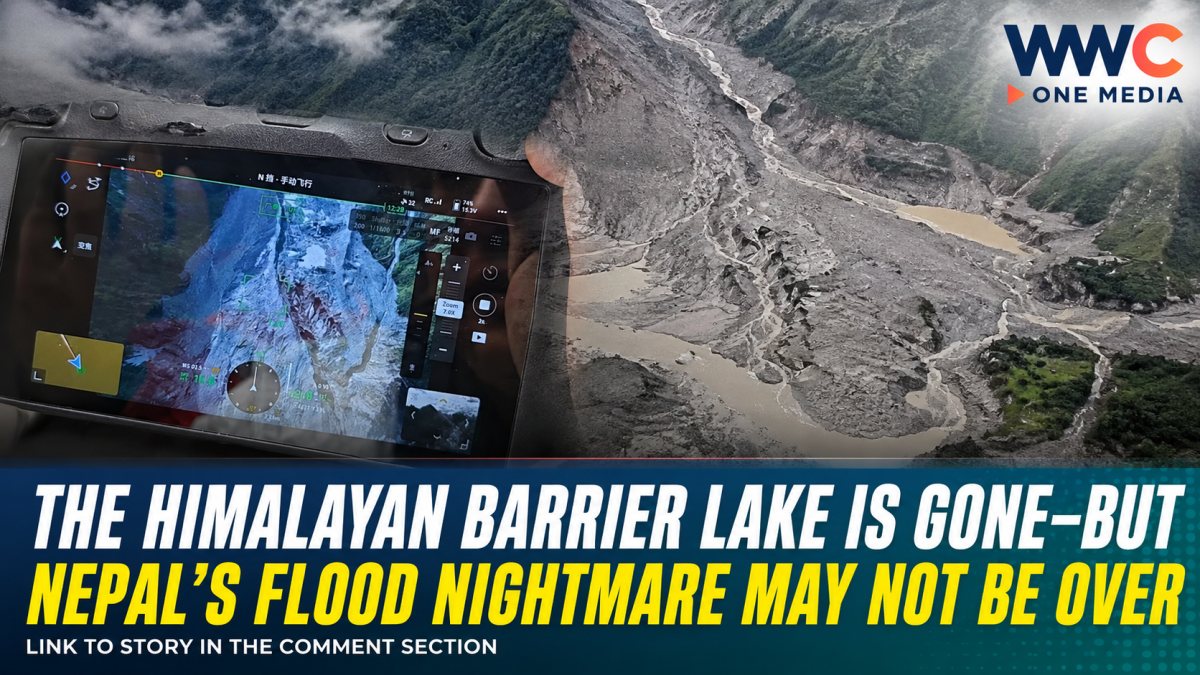
KATHMANDU/BEIJING — A dangerous barrier lake that formed near the Nepal-China border following a massive ice-and-rock avalanche has drained through a natural outflow, Chinese authorities said, easing fears of another sudden and potentially devastating flood in the already disaster-stricken Himalayan region.
The lake had formed after debris from the catastrophic avalanche blocked a river near Gyirong Port in China’s Xizang Autonomous Region, also known as Tibet. Chinese authorities said the water body had essentially drained, allowing water to flow through the affected area rather than remain trapped behind an unstable natural dam.
The development offers a measure of relief—but it does not mean the danger has completely disappeared.
The region remains highly unstable after one of the worst recent disasters to strike the Nepal-China border, where a glacier collapse triggered a massive avalanche of ice, rock, mud and debris that raced through mountain river systems and caused catastrophic flooding downstream.
A Disaster That Changed the Landscape
According to Reuters and other international news organizations, the disaster began when part of a glacier near Langtang Lirung collapsed, unleashing a powerful avalanche that transformed into a destructive debris flow as it moved through the Himalayan terrain.
The torrent devastated communities and infrastructure on both sides of the border, with roads, bridges and buildings swept away. Rescue teams reaching some of the hardest-hit areas have described scenes of widespread destruction, while search operations continue for thousands of people reported missing.
The exact toll remains subject to revision as authorities reach isolated areas and reconcile reports from different districts. Major news organizations have reported rapidly rising figures for both fatalities and missing persons, underscoring the enormous scale of the tragedy.
Why the Barrier Lake Raised Fresh Alarm
The formation of the temporary lake created fears of a secondary disaster.
Barrier lakes can form when landslides, avalanches or other massive debris flows block a river. If water accumulates behind the natural dam and the blockage suddenly fails, the resulting outburst can send a powerful surge of water and debris downstream with little warning.
Authorities had closely monitored the lake amid concerns that a sudden breach could trigger another flood in vulnerable communities.
Reports from Chinese state media indicated that the lake’s water level had been falling before authorities announced that it had essentially drained. The natural outflow has significantly reduced the immediate threat of a catastrophic lake-burst event.
However, officials and disaster experts continue to warn that unstable slopes, damaged river channels and continuing rainfall could still pose serious risks in the region.
Rescue Teams Face a Long Road Ahead
Search-and-rescue operations remain underway across the Himalayan disaster zone, where damaged infrastructure and difficult terrain have complicated efforts to reach isolated communities.
The destruction has also disrupted a key cross-border corridor and damaged infrastructure vital to local communities and regional trade.
Nepal has issued additional flood warnings in some areas as authorities continue monitoring river levels and weather conditions. The disaster has also renewed scrutiny of cross-border early-warning systems and the need for faster sharing of information on glacier movements, water levels and other hazards in the Himalayas.
Climate Change and a Growing Himalayan Risk
Scientists caution that determining the precise role of climate change in any single glacier collapse requires detailed scientific investigation. But researchers have long warned that a warming climate is accelerating glacier retreat, melting permafrost and destabilizing mountain environments across the Hindu Kush Himalayas.
These changes can increase the risk of landslides, avalanches and glacial lake outburst floods, placing millions of people living downstream at greater risk.
The disaster near the Nepal-China border is now emerging as a stark reminder of how quickly hazards in the world’s highest mountains can cascade: a glacier collapse can trigger an avalanche, block a river, create a temporary lake and threaten communities with multiple waves of disaster.
For now, the draining of the barrier lake has removed one of the most immediate threats.
But for the thousands of families affected by the catastrophe—and for rescuers still searching through devastated valleys—the crisis is far from over.
As the water recedes, the full scale of what the Himalayan disaster left behind is only beginning to emerge.




Leave a Reply