
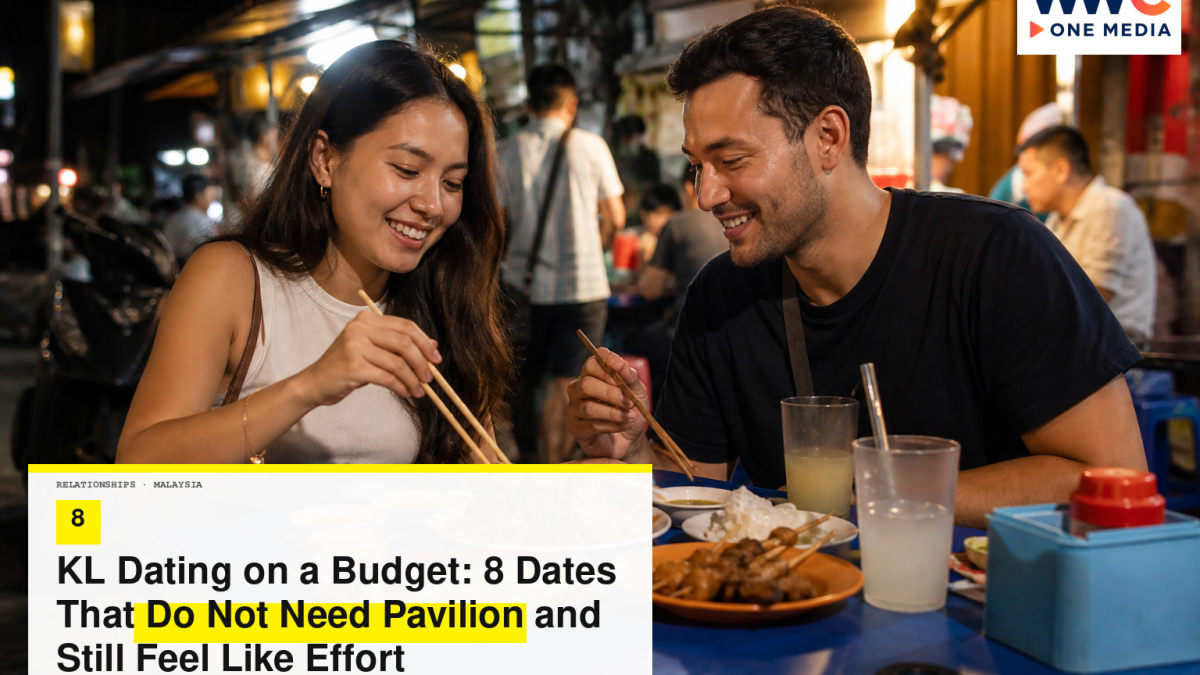
KUALA LUMPUR, Malaysia — Pavilion is a useful building. It is also a crutch. Too many KL dating on a budget plans collapse into the same loop: meet at the mall, walk until you are overstimulated, spend more than you meant to on a dinner that was supposed to prove effort, then fight about Grab in the basement car park while the rain starts. The mall did not fail you. The idea that effort has to look like a receipt from Bukit Bintang failed you.
This is not a tourist list of things to do in Kuala Lumpur. It is a relationship piece. Eight dates that still ask something of you — time, attention, a plan for rain, a decision about who pays — without requiring Pavilion, a tasting menu, or the performance of being richer than your month. KLCC park is free and still a test. Chinatown is loud and still a test. Taman Tun is a drive and a neighbourhood and a different class signal than Jalan Bukit Bintang, and that is the point.
If you are dating someone whose love language is shopping bags, say so early. These eight will not convert them. They will show you whether the two of you can make a Tuesday feel considered when the credit card is not the point.
1. KL dating on a budget starts at KLCC park at a named hour, not “around the mall”
KL dating on a budget starts with a time, not a vibe. “Let’s go KLCC” is how people end up inside Suria by accident, buying a drink they did not want because sitting down had a minimum. The date is the park. You say 6.45pm. You say the side near the fountain or the side toward the towers, specifically, because “KLCC” is a district and a mall and a park and a bus bay and a place to get lost in a sulk.
Bring water. Bring a plan for 20 minutes of actual talking without phones. The towers are pretty. Pretty is not the work. The work is: can you arrive on time from wherever you actually live. Petaling Jaya is not “nearby.” Ampang is not “nearby.” A person who is always 40 minutes late to a free park will also be 40 minutes late to your family house.
Who pays: nobody, until you eat. Then you already decided, before you arrived, whether dinner is a mamak on the way home or a split of something small. Do not wander into the mall “just to see” and then perform shock at the bill.
Rain: KLCC park in a downpour is a cancellation, not a character test. Move the date under a walkway only if you can still hear each other. Otherwise you reschedule like adults. Sitting in a car in the KLCC car park, engine on, arguing about whether this still counts, is not a date. It is a hostage situation with aircon.
What not to do. Do not use the park as a prelude to “but I already booked a place in Pavilion, surprise.” That is a budget date with a lie attached. Do not photograph them with the towers as if the towers are the relationship. Do not invite a third friend to “make it chill.” Chill is often a way to avoid being present.
Objection: “The park is basic.” Basic is the point. If you cannot be kind on a bench, a mall will not teach you.
A small script at the end of the hour: “I liked this. Next time I want to do the Chinatown walk on a weeknight, not Saturday chaos. Are you free Wednesday.” Specific is effort. “We should do this again sometime” is how KL dates die in a chat.
2. The Chinatown night walk that is a conversation, not a haul
Petaling Street at full weekend volume is a crowd, not a date. Go on a weeknight. Say 8pm. Meet at a named corner, not “in Chinatown,” which is how people spend 25 minutes calling each other from two different ends of Jalan Petaling while Grab drivers circle.
You walk. You look. You do not need to buy. If you buy, you buy one small thing on purpose, not a stack of bargains to prove you know how to haggle. Haggling as a personality on a first date is a warning. So is treating every stall uncle as free entertainment for your Stories.
The relationship frame: can they be in a messy, humid, loud street without turning it into a complaint about “this side of town.” Class leaks here. People from certain postcodes perform disgust. People from other postcodes perform authenticity. Both performances are tiring. You want someone who can eat a cheap plate, watch their bag, and still ask you a question that is not about the menu.
Who pays. Street food is small money and a large scoreboard if you let it be. Alternate items. Or one person covers the walk, the other covers the teh tarik after. Say it before the first stall. “I’ll get this round, you get the drinks after.” Silence plus a wallet race is how someone goes home feeling cheap or feeling used.
Parking and Grab. Driving into Chinatown at night is a hobby for people who enjoy circling. Grab in, walk, Grab out to a pin that is not in the middle of a jammed one-way. If one of you insists on driving “because I know a lot,” notice whether they also know how to drop the pride when the lot is full. Pride in traffic is a preview of pride in a family argument.
Rain: Chinatown rain is sudden and mean. Duck into a kopitiam. Do not keep shopping in a plastic-sheet tunnel while one of you is miserable and pretending. Misery is data. So is the person who notices your shoes are soaked and changes the plan without a speech.
What not to do. Do not turn the night into a content trip. Do not say “tourists don’t know the real KL” if you yourself only come here for dates. Do not disappear into a side lane phone call with your group chat about whether this person is “the one.” They can see your face.
3. Breakfast in Taman Tun, on purpose, like it is not a leftover slot
Dinner at Pavilion is a performance. Breakfast in Taman Tun Dr Ismail is a tell. You have to wake up. You have to pick a place that opens early. You have to sit with someone’s un-made-up morning face and the version of them that has not yet put on office armour.
TTDI is not “cheap KL” in the way people mean Chinatown. It is a neighbourhood with parking politics, families, dog walkers, and a slower clock. That is why it works as a date. You are not competing with Bukit Bintang noise. You are seeing whether this person can exist at 8.30am on a Sunday without making the waiter a villain.
Order like you intend to stay for an hour, not like you are grabbing a parcel. Phones down for the first coffee. If they cannot do that, the rest of the eight dates will feel like you are dating a screen.
Who pays. Breakfast bills are small enough that insisting on a full theatre of “no I got it” three times is embarrassing. Split, or one person takes breakfast and the other takes Grab home. If one salary is much larger, proportional is kinder than 50-50 pride. Say the number. “Let me get this, you get next week’s mamak.” Next week has to exist as a real day, not a fog.
Parking: TTDI lots fill. Arrive able to walk two streets. The person who refuses to walk two streets in the morning will also refuse small inconveniences later. Not always. Often enough to notice.
What not to do. Do not make breakfast a stealth interview about marriage in the first 20 minutes. Do not bring a laptop “in case.” Do not cancel at 7.50am because you were out in Changkat. If your nightlife cannot survive a breakfast date, you are not available in the way you are advertising on the app.
Objection: “Breakfast isn’t romantic.” Romance that can only live after 9pm in a mall is nightlife, not a relationship. You can like both. You should be able to do one without the other.
4. The rain plan you write before the sky does
KL rain is not a maybe. A budget date that dies the moment the sky opens was not a date. It was an outdoor wish. Before you meet, you already have Plan B: a specific kopitiam, a bookstore, a food court that is not Pavilion, a covered walk, a car conversation with the engine off in a legal spot, a movie only if both of you actually want a movie and not a dark place to avoid talking.
Put Plan B in the chat in daylight. “If it rains we go to X, the one near the LRT, not the one in the mall.” Specificity is care. “We’ll see” is how you end up wet, irritated, and spending Grab surge to a place neither of you chose.
The relationship frame is not “do you like rain.” It is: can you change a plan without punishing each other. Some people get sharp when wet. Some people get heroic and drag you through puddles for a story. You want the third type, the one who says “this is stupid, let’s go inside, I’m still glad I see you.”
Who pays for the pivot. Surge pricing is not a moral failing. It is a line item. If Grab triples, you can wait 20 minutes under a proper shelter, not under a leaking bus stop performing patience. You can split the surge. You can say “this one is on me because I picked the outdoor plan.” What you do not do is sulk that the cheap date became less cheap. Weather is not your partner’s plot against your wallet.
What not to do. Do not guilt them into walking in the rain so you can keep the original Instagram. Do not vanish into a parking basement with no signal and no message. Do not use rain as an excuse to cancel a date you already did not want, then stay active on the app. That last one is not logistics. That is character.
A script: “Sky looks wrong. I’m moving us to the kopitiam on Jalan X at 7. Still want to see you. If you’d rather reschedule to Thursday I can do that too.” Offer a real alternative date. Rain plus “maybe next week” is a fade.
5. A mamak you treat like a reservation
Mamak is ordinary until you treat it with attention. Choose one. Name it. Arrive on time. Sit at a table you intend to keep. Do not spend the first 15 minutes scanning for a better table like the relationship is a seat.
Order for the hour you have, not for a feast that proves generosity. Roti, teh tarik, maybe eggs, maybe a shared plate. The effort is not the menu. The effort is: I picked a place near your actual life. If they live in Cheras, a mamak in a neighbourhood you both can reach matters more than a clever spot in a richer postcode that adds 40 minutes of Grab each way.
Who pays at a mamak is where KL couples rehearse the rest of their money life. If they always let you pay and never reach, notice. If they always slam a card down and refuse your contribution as if your money is cute, notice. If they itemise every roti to the sen on date three, notice. The healthy version is boring: “I’ll get this, you get the Grab,” or a split, said once, without a speech about gender or modern values. You can have values. The mamak table is a bad seminar room.
Parking: mamak parking is chaotic. If you drive, agree who sits in the car and who runs in if the lot is full. If you Grab, pin the right entrance. “I’m here” plus a vague lot is how 10 minutes of heat becomes a mood.
What not to do. Do not take a work call for 18 minutes while they sit with roti going cold. Do not invite your friends to “drop by.” A mamak is public enough without turning it into a screening. Do not mock the place if you suggested it. Do not upgrade mid-date to a bar you cannot afford because anxiety told you ordinary is not enough.
Objection: “Mamak is what I do with my boys.” Then you have never taken someone you like to an ordinary table and paid attention. That is the date. The boys can have Thursday.
6. A neighbourhood loop in Taman Tun or a park that is not a mall annex
After breakfast, or on a late afternoon, walk a residential loop. TTDI, a park you actually know, a lake if that is your patch, a playground edge at a civil hour. This is the “do we like walking next to each other in daylight” test. No purchase required. Effort looks like sunscreen, water, and not treating the walk as filler before the real plan.
Talk about something other than work and exes for 20 minutes. If you cannot, the relationship is already a debrief. Notice pace. Notice whether they walk on the side that keeps you off the drain. Small, almost old-fashioned. Still information. Notice whether they greet a neighbour. You are seeing the civilian.
Who pays: still nobody, unless you buy drinks after. Keep it tiny. The date is the loop.
City logistics. Heat is real. 5.30pm is different from 3pm. If one of you wilts, you shorten the loop without a lecture about toughness. Fitness is not loyalty. Bringing them home dehydrated to prove a point is not a personality.
What not to do. Do not turn the walk into a stealth workout. Do not play podcasts on speaker. Do not use the loop to pass their family house “by accident” on date two. If you want them to know where you live, say so. Ambush geography is a control move dressed as a stroll.
If they only come alive in Bukit Bintang and go flat in a neighbourhood, believe that. Some people date the city, not you. Better to learn it on a free walk than on a lease.
7. The drive that is not circling Pavilion’s car park
A drive can be a date in KL because the city is spread out and cars are how a lot of people think. It can also be a trap: one person chauffeurs, the other is a passenger with an aux cord, and the night becomes petrol plus a view plus no conversation because the radio is doing the work.
Set a destination that is not a mall. A lookout you both know is safe at the hour you are going. A suburb for a specific supper. A drop at a night view that does not require a ticket you cannot name. Time-box it. Two hours. Then home. Open-ended drives are how people get sleepy, lost, and then resentful about tolls.
Who pays. Petrol is money. Tolls are money. Parking is money. If the same person always drives, the other person puts petrol in, or Grab home, or the next meal. Do not let the driver become unpaid staff. Do not let the passenger become a princess in an unpaid taxi. Say the ugly sentence: “I’ll Touch ’n Go this, you get supper.” Touch ’n Go is part of the relationship in this city. So is the person who never tops up and always has a story.
Parking: if you stop, stop legally. A romantic shoulder on a fast road is not cute. A locked Taman Tun street at 1am with the engine running can look like a problem to a neighbour. Be adults with a time and a place.
What not to do. Do not use the car as the only private room you have, every time, because neither of you will book a public table. Do not fight in a moving car on the highway. Pull over if it is getting sharp, or postpone. Do not surprise them with a long drive back to their parents’ town on date four. Geography is not a gift when it removes their ability to leave.
Objection: “I spent on petrol, that is effort.” Effort is attention plus a plan they can consent to. Petrol without a conversation is just a tank.
8. Cook at home, but only if the house is actually a kind place to bring someone
A home-cooked meal is the cheapest date that can still feel like care. It is also the one that goes wrong fastest. Whose house. Are there housemates. Is there a parent in the next room in a PJ terrace. Is the plan food, or is the plan a way to skip being in public because you do not want to be seen dating this person.
Be honest about that last one. If you will cook for them but not walk with them in TTDI or Chinatown, you are hiding. Hiding can be caution. Hiding can be shame. They are allowed to ask which.
The effort is a real meal, a real time, a clean table, a way for them to leave. Grab booked in their pocket is part of safety, not a mood-killer. If they depend on you for the ride home from a residential area they do not know, you hold extra power. Do not pretend you do not.
Who pays. Groceries. You can shop together at a normal supermarket, not a performance at a fancy hall. Split the trolley, or one cooks and one brings drink. Do not keep receipts in a mental folder for later. Do not serve a feast you cannot afford as a personality, then go quiet about lunch money for the rest of the week.
What not to do. Do not disappear into a game while they wash up. Do not invite them “to cook” and have no food in the fridge. Do not use your mother’s kitchen and then get sharp when they put a spoon in the wrong drawer. Do not make the date a movie on the sofa by default. If you wanted a movie, say movie. Cooking is a task you share with hands.
Rain is irrelevant here, which is why this date is a good Plan B you actually prepare for, not a panic pivot with Maggi and shame.
A script before they come: “I’ll cook pasta and eggs, nothing clever. My housemate will be in their room. You can leave whenever. I’ll send the pin. If you’d rather do the mamak instead, say so now.” Consent to the setting is effort.
Who pays, Grab, parking: the system under the eight dates
KL dating on a budget fails when money stays a vibe. Write a small system for the first month.
Travel: whoever picks the place considers the other person’s Grab distance. A “cheap” dinner that costs RM25 plus RM38 each way is not cheap. Alternate who crosses the city. If one of you has a car, petrol and tolls enter the split. If one of you is in a cheaper postcode with worse late-night Grab, you do not always make them come to you because your neighbourhood has prettier lighting.
The bill: pick a default. Split. Or take turns. Or proportional if the incomes are obviously different and both of you can say that without humiliation. What you do not do is improvise a new ideology at every cashier. Gender scripts can be discussed. They should not ambush a mamak uncle.
Parking: the driver is not automatically the payer of everything else. The passenger is not automatically the entertainment director. If parking is a nightmare at your chosen spot, choose a different spot. A date that begins with 25 minutes of circling is already tired.
Rain: surge is shared or skipped. Waiting is allowed. Heroics are optional.
What not to do with money. Do not keep a secret spreadsheet of their failures. Do not post the bill. Do not let your friends vote on whether they are “cheap.” Do not use budget as a way to never plan. Low cost still needs a time, a pin, a Plan B, and a sentence about who pays.
A script for “this is effort, not a cheapskate personality”
You will feel the itch to apologise for not doing Pavilion. Do not apologise for a good plan. Explain once if you need to, then stop.
“I want to see you. I don’t want our default to be a mall. I put thought into this. If you want Pavilion sometimes, we can do that on a month we both choose. Tonight is Chinatown and teh tarik. I would rather you tell me now if that feels like I am not trying.”
Then listen. Some people have been trained that love is a bag and a photo outside a lit building. You cannot sneer them out of that in one speech. You can show them a better night and see if they thaw. If they thaw only when a logo appears, you have information. If they light up on a TTDI morning, you also have information.
Objection from them: “You don’t want to spend on me.” Answer without a manifesto. “I want to spend attention. I will spend money on purpose, not as proof. If proof is the only thing that works, we should say that.”
Objection from you, internally: “If I don’t spend, they’ll leave.” Then you are not dating. You are bidding. Bidding has no bottom. Pavilion will not be the last building.
What not to do: the Pavilion apology date
You had a good cheap week. Anxiety ate you. You booked something shiny to “make up for it.” The shiny night is tense because it is a referendum. The food is fine. The bill is not fine. You both know the bill is not fine. You take it out on each other in the car park.
Do not use Pavilion as an apology. Apologise with words if you were actually inattentive. If you were attentive on a budget, there is nothing to apologise for.
Do not surprise-upgrade. Surprises that cost the other person’s comfort — dress code they did not pack, a valet they cannot tip, a reservation in a room that makes them quiet — are not generous. They are a test they did not sit.
Do not compare them to an ex who liked malls. Do not compare yourself to friends who date on company cards. Their month is not your month.
When budget dating becomes a scorecard
Keep a private honesty check every few weeks. Are you always the one planning. Always the one crossing town. Always the one paying because you are afraid. Always the one refusing to pay because you are making a point about independence. Scorecards grow in silence.
A monthly 10-minute talk, not at the mamak, not in a Grab:
“This month I felt like I did the planning. Did you feel like you did the travelling. Do we need to switch.”
If they cannot have that talk, the eight dates will not save you. Logistics is intimacy in KL. Traffic makes it so. Rain makes it so. Distance between TTDI and Cheras and Ampang and the city centre makes it so. People who refuse logistics are not mysterious. They are unavailable.
If their family thinks effort only looks like a mall
Some parents, some siblings, some group chats will ask where you went and go quiet when the answer is a park. You do not owe them a receipt. You may owe your partner a sentence they can use.
“We went to KLCC park and then mamak. It was a good night.” Delivered without shame. If their mother needs Pavilion to believe you are serious, that is a family story you should hear early. You can still do a mall date on purpose, once in a while, as a family-facing event. You should not live there. A relationship that can only be explained in shopping bags will need more and more bags.
Do not mock their family at the mamak. Do not perform rebellion via cheapness. Cheapness as ideology is as tiring as luxury as ideology. You are trying to have a Tuesday that feels like someone thought about it.
Bottom line
KL dating on a budget is not a personality of refusing Pavilion. It is eight dates with a pin, a time, a rain plan, and a sentence about who pays: KLCC park at a named hour, a Chinatown weeknight walk that is not a haul, breakfast in Taman Tun, a written rain pivot, a mamak treated like a reservation, a neighbourhood loop, a drive that is not a car-park orbit, a home meal with a way to leave. Effort is logistics plus attention. The mall will still be there when you actually want the mall. It does not need to be the proof.



Leave a Reply