
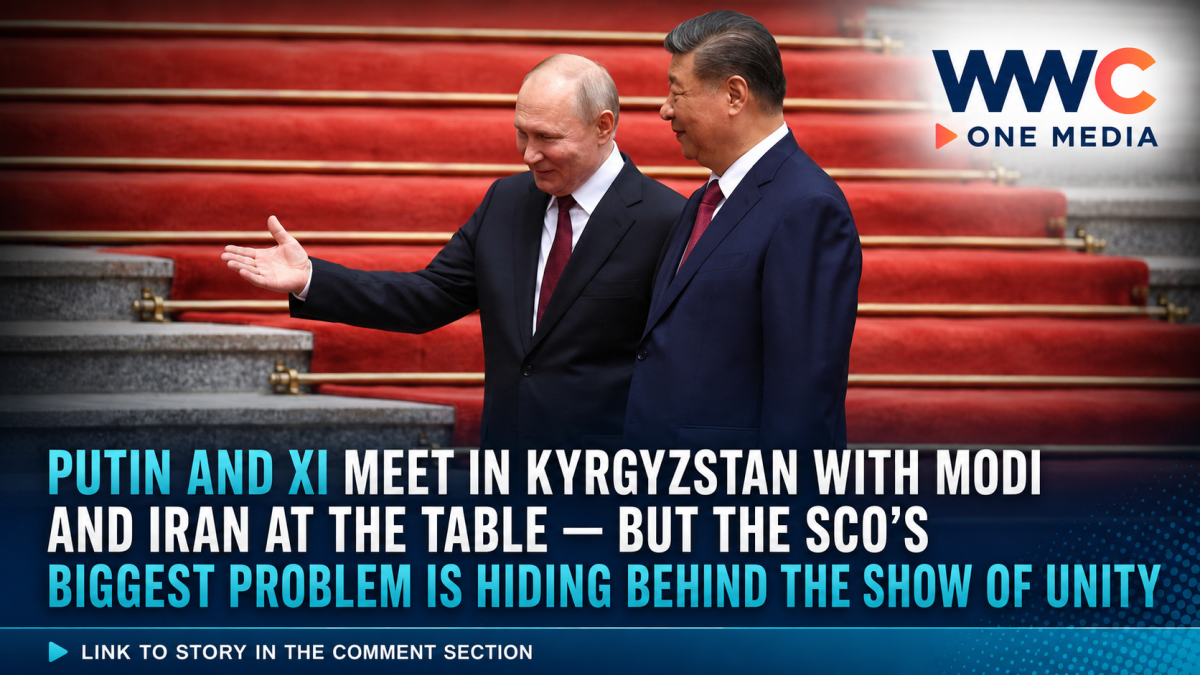
BISHKEK, Kyrgyzstan — Some of the world’s most powerful non-Western leaders are gathering in Kyrgyzstan this week, turning the 2026 Shanghai Cooperation Organisation summit into something much larger than another regional diplomatic meeting.
Chinese President Xi Jinping, Russian President Vladimir Putin, Indian Prime Minister Narendra Modi, Iranian President Masoud Pezeshkian and Pakistani Prime Minister Shehbaz Sharif are among the leaders expected at the two-day gathering in Bishkek. Turkish President Recep Tayyip Erdogan, whose country is an SCO dialogue partner rather than a full member, is also expected to participate.
The summit comes at an unusually volatile moment: Russia’s invasion of Ukraine is now more than four years old, Iran is confronting the economic and military fallout of its conflict with the United States and Israel, while Washington’s trade measures are placing additional pressure on China and India.
That backdrop is giving the SCO’s 25th-anniversary meeting a significance that goes well beyond Central Asia.
Xi and Putin will put their partnership back in the spotlight
One of the most closely watched events will be a scheduled bilateral meeting between Putin and Xi on the summit’s sidelines.
The two leaders have repeatedly promoted a more “multipolar” international system in which Western governments — particularly the United States — hold less influence over global institutions and security arrangements.
But describing the SCO simply as an anti-Western alliance would go too far.
Its founding documents explicitly say it is not an alliance directed against other countries, and its members often have competing strategic interests. India has difficult relationships with both China and Pakistan, while Beijing and Moscow themselves compete for economic and political influence across resource-rich Central Asia.
That tension between unity on the stage and disagreement behind closed doors may be the defining story of this summit.
China arrives with growing influence in Russia’s traditional backyard
Xi landed in Bishkek on Sunday for both the SCO meeting and a state visit to Kyrgyzstan.
In remarks issued upon his arrival, the Chinese leader described China-Kyrgyzstan ties as entering a “golden period” of development and said he expected further discussions on bilateral cooperation as well as international and regional issues.
The language reflects a broader shift unfolding across Central Asia.
For decades, Russia was the dominant outside power in much of the region because of its Soviet history, security relationships and economic ties. China, however, has steadily expanded its footprint through infrastructure, trade, investment and diplomatic engagement.
That leaves Bishkek in an increasingly important position: it is not merely hosting China and Russia but sitting at the heart of a region where their interests increasingly overlap.
Iran gives the summit another geopolitical flashpoint
Iranian President Masoud Pezeshkian’s presence adds another layer of urgency.
Iran became a full SCO member in 2023 and has looked to organizations involving China and Russia as a way of expanding political and economic relationships outside the Western-led financial system.
Putin is expected to hold separate talks with Pezeshkian during the gathering. Russia and Iran have expanded economic and military cooperation substantially since Moscow’s full-scale invasion of Ukraine, while both countries remain heavily sanctioned.
Washington, meanwhile, has warned Moscow and Beijing against supplying weapons to Tehran.
That means the Putin-Pezeshkian meeting will be watched not just for diplomatic statements but for any indication that Russian-Iranian cooperation could deepen further.
India makes the SCO far more complicated
India’s presence illustrates why the organization cannot easily become a unified geopolitical bloc.
New Delhi participates alongside China and Pakistan even though it has major security disputes with both.
Relations between India and China have shown signs of stabilization recently. Beijing and New Delhi reaffirmed their commitment this month to maintaining peace along their disputed Himalayan border and expanding communication mechanisms following years of tension.
For India, the SCO offers something different from what it offers Russia or China.
Rather than joining an explicitly anti-U.S. coalition, New Delhi can use the organisation to maintain strategic flexibility, engage Central Asian states and keep direct channels open with Beijing, Moscow and other regional powers.
Analysts cited by the Associated Press say the SCO gives India a place at the table even when it cannot fully shape the agenda.
That makes Modi’s attendance particularly significant: the same room contains governments that cooperate in some areas while competing fiercely in others.
The SCO is bigger than ever — but is it actually stronger?
The organisation began in 2001 as a security-focused forum led by China, Russia and four Central Asian countries.
Twenty-five years later, it has expanded to 10 full members: China, Russia, India, Pakistan, Iran, Belarus, Kazakhstan, Kyrgyzstan, Tajikistan and Uzbekistan. It also maintains relationships with numerous dialogue partners and observers.
CNA reports that the bloc’s member states collectively account for roughly 40% of the world’s population and about a quarter of global GDP.
Those numbers make the SCO look formidable.
Its challenge is turning that scale into coordinated action.
The organisation includes nuclear powers, major commodity exporters, rapidly growing economies and some of the world’s most strategically important transport routes. Yet it also includes governments that disagree over borders, security priorities, trade and foreign policy.
The contrast between size and cohesion is crucial.
Even China and Russia have unfinished business
Xi and Putin’s political alignment has deepened considerably, but their economic relationship is not without friction.
During Putin’s May visit to Beijing, the two governments again demonstrated broad strategic alignment and criticised aspects of U.S. policy. Yet they failed to finalise the long-discussed Power of Siberia 2 natural-gas pipeline, with pricing and commercial terms remaining unresolved.
That episode is a useful reminder of what to watch in Bishkek.
Political declarations are relatively easy.
Major economic agreements, security commitments and coordinated policies are much harder.
Why this summit matters
The biggest question in Bishkek may therefore not be whether Xi and Putin can produce another show of unity.
They almost certainly can.
The real test is whether the SCO can evolve from a diplomatic platform into an organisation capable of delivering meaningful economic, security and geopolitical coordination among countries with very different priorities.
For Beijing, a successful summit strengthens China’s claim that international politics no longer has to revolve around Western-led institutions.
For Moscow, it demonstrates that Russia remains connected to major powers despite Western sanctions and isolation efforts.
For India, Turkey, Iran and Central Asian governments, the summit offers something more pragmatic: another arena in which they can diversify relationships and maximise their own strategic leverage.
And that may ultimately be the SCO’s greatest strength — and its biggest weakness.
It brings an extraordinary collection of countries into one room.
What it still has to prove is whether they are actually moving in the same direction.




Leave a Reply