
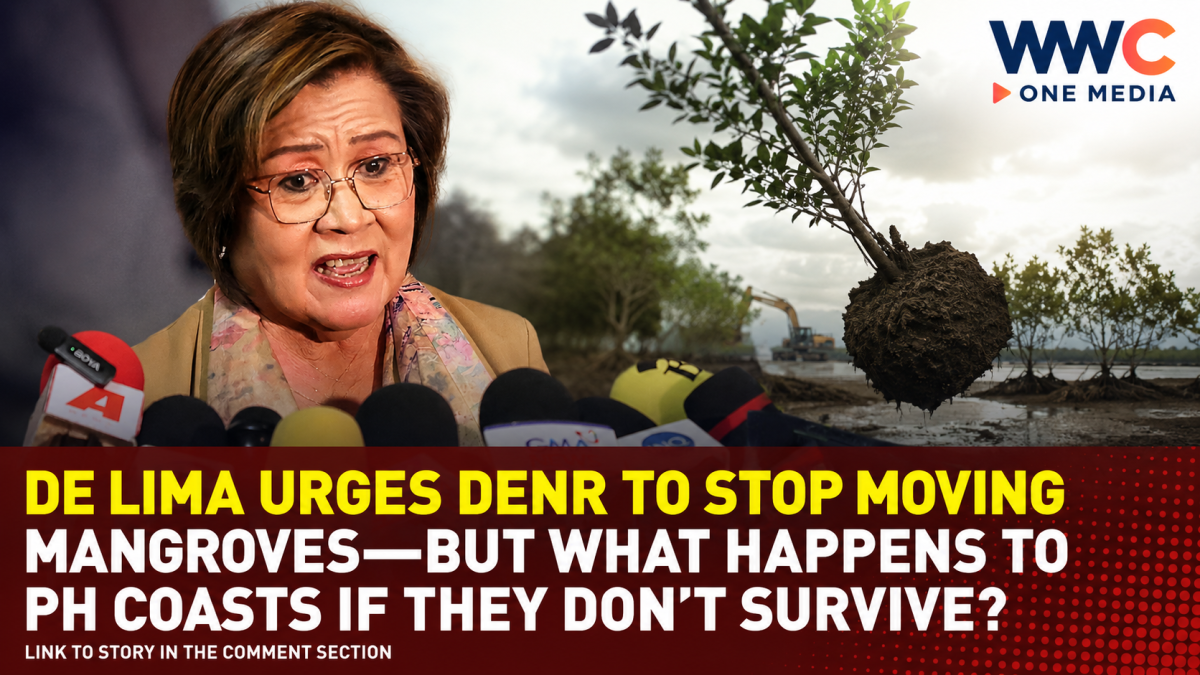
MANILA, Philippines — Mamamayang Liberal Party-list Rep. Leila de Lima has urged the Department of Environment and Natural Resources (DENR) to suspend the earth-balling and relocation of mangroves until a more comprehensive scientific study establishes whether the practice can reliably keep transplanted trees alive.
The call comes as environmental groups and scientists intensify warnings over the possible ecological consequences of moving mature mangroves—natural coastal barriers that help protect communities from erosion, storm surges and flooding.
During discussions on the DENR’s proposed 2027 budget, De Lima questioned why the agency’s interim guidelines on mangrove earth-balling were issued before broader consultations and a comprehensive scientific assessment of survival rates had been completed.
She warned that what was initially presented as temporary operational guidance could effectively become a policy allowing mangroves to be relocated for major infrastructure projects.
“What exactly is the survival rate?” De Lima asked, stressing that the science should have been established before the government allowed the practice under an interim framework.
The DENR memorandum, issued on October 8, 2025, generally states that mangroves should not be removed or disturbed. However, it allows earth-balling and relocation in limited or exceptional circumstances, including certain infrastructure flagship projects, provided mitigation measures have been exhausted and other requirements are met. The guidelines do not allow applications for commercial, recreational or other private purposes.
Environmental groups raise alarm
The controversy has grown beyond Congress.
Environmental organizations, including Oceana Philippines and the Global Mangrove Alliance Philippines, along with mangrove experts, have called for the suspension or review of the DENR guidelines, arguing that relocating mature mangroves may carry serious survival risks and weaken ecosystems that coastal communities depend on.
Reports citing studies presented by environmental groups have raised concerns about the survival of transplanted mangroves. One study cited in recent coverage reportedly recorded survival rates of only 20% to 25% for two mangrove species 10 months after earth-balling, although survival outcomes can vary depending on species, tree size, site conditions and transplanting methods. Environmental advocates have also argued that moving mature trees can disrupt the complex soil, water and root systems that mangrove ecosystems depend on.
That distinction is crucial: the low survival figures cited by environmental groups should not be interpreted as a universal survival rate for every mangrove relocation project, but they underscore why lawmakers and scientists are demanding stronger, site-specific evidence before the practice is expanded.
DENR says scientific review is underway
DENR Secretary Juan Miguel Cuna has defended the issuance of interim guidance, saying the department considered it appropriate to establish procedures while following sustainable development principles.
The agency’s Ecosystems Research and Development Bureau (ERDB), along with other DENR offices, is studying the survival of relocated mangroves. Cuna said the department was encouraged by initial findings but needs more time to complete a more extensive assessment.
Recent reports indicate the DENR expects to use the research to guide its future policy, with a policy report expected after the study is completed.
For De Lima, however, the question is whether the government should continue allowing relocations while that scientific answer is still being determined.
She urged the DENR to suspend implementation of the memorandum—or reconsider it entirely—until the evidence is clearer. Cuna, according to the latest report, committed to evaluate the issue in light of the ongoing developments.
Why the debate matters
Mangroves are more than trees growing along the shore. They serve as natural buffers against waves and coastal erosion, provide habitat for marine life and support fisheries and coastal livelihoods.
Environmental advocates argue that protecting existing, mature mangrove ecosystems may be far more valuable than attempting to replace them after removal—especially as the Philippines faces recurring flooding, stronger storms and rising coastal risks. Oceana Philippines has similarly warned that weakening mangrove ecosystems could leave coastal communities more exposed to flooding and storm surges.
De Lima has also pushed for broader legislation to strengthen mangrove protection. She filed House Resolution No. 1206, seeking an inquiry into the DENR’s interim policy, and House Bill No. 8353, which seeks to establish coastal greenbelt zones that would include mangroves and beach forests at least 100 meters wide.
The bigger question: Can a forest simply be moved?
The debate now puts the DENR at the center of a difficult balancing act between infrastructure development and environmental protection.
The agency’s guidelines impose safeguards, including requirements involving transplanting sites, root and soil preservation, timing, monitoring and rehabilitation plans. But critics argue that safeguards on paper cannot substitute for proof that mature mangrove ecosystems can be successfully relocated at scale.
As the DENR completes its scientific review, one question remains at the heart of the controversy:
If mangroves are among the country’s strongest natural defenses against storms and flooding, should they be moved at all before the government can prove they will survive?

Leave a Reply