
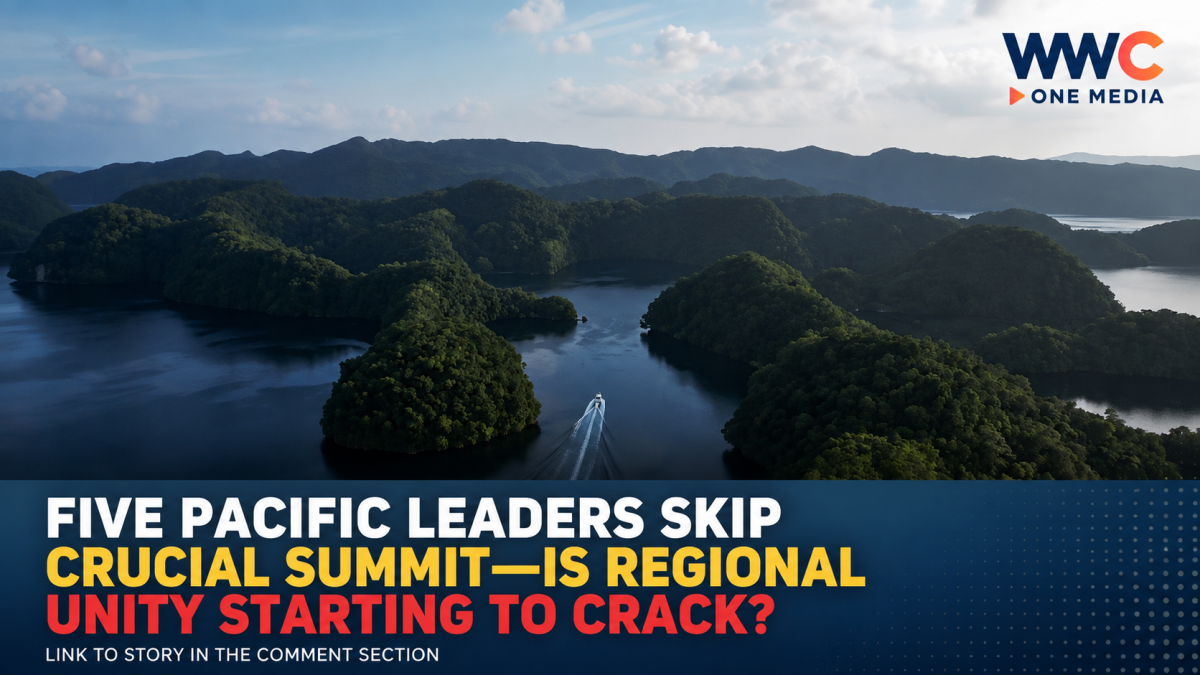
KOROR, Palau — A major gathering of Pacific leaders opened in Palau with at least five key leaders absent, casting a shadow over a summit intended to demonstrate regional solidarity at a time of growing geopolitical pressure, climate threats and economic uncertainty.
The 55th Pacific Islands Forum (PIF) Leaders Meeting, being held from August 30 to September 4, has brought together representatives from across the region under the theme “Building Economies: Life. Action. Unity.” But the absence of several heads of government has raised questions about how much progress the forum can make on some of the Pacific’s most pressing challenges.
According to reporting by Reuters, leaders from Fiji, Vanuatu, Samoa, Solomon Islands and Kiribati are among those not attending the meeting in person, although their countries are expected to be represented by senior officials.
The absence of Solomon Islands’ leader came amid political developments at home. Reuters and other international outlets reported that the country’s prime minister returned to Honiara to deal with a no-confidence challenge, underscoring how domestic political crises can quickly disrupt regional diplomacy.
More Than Just Empty Chairs
The Pacific Islands Forum has long been a key venue for Pacific nations to coordinate their positions on issues ranging from climate change and disaster resilience to security, economic development and foreign influence.
This year’s meeting comes at a particularly sensitive moment.
The Associated Press reported that Pacific leaders are trying to keep attention focused on existential concerns such as climate change and economic stability. However, the growing competition for influence among major powers—including China, the United States and their regional partners—continues to create difficult diplomatic pressures.
Palau President Surangel Whipps Jr., whose country is hosting the summit, has emphasized the importance of regional cooperation as Pacific nations navigate those competing interests.
The challenge for the forum is clear: how can the Pacific maintain a united voice while individual countries pursue their own national priorities and relationships with larger powers?
Taiwan’s Presence Adds to Diplomatic Tensions
Another sensitive issue surrounding the Palau meeting is the participation of Taiwan in forum-related activities.
Reuters reported before the summit that Taiwan’s Foreign Minister Lin Chia-lung would attend events in Palau and engage with Taiwan’s remaining diplomatic allies in the Pacific. Beijing, which claims Taiwan as part of China, has objected to Taipei’s participation.
The issue highlights the increasingly complicated diplomatic environment facing Pacific nations, several of which have switched recognition from Taiwan to China in recent years.
The Lowy Institute noted that Taiwan’s return to the forum environment follows last year’s meeting in the Solomon Islands, where external partners were excluded from the leaders’ gathering. The differing approaches underline how geopolitical issues continue to test the forum’s efforts to preserve consensus.
Security Concerns Also Loom Over the Meeting
Regional security is also expected to feature prominently on the agenda.
Earlier this month, Pacific foreign ministers failed to reach a unified position on a Chinese missile test in the Pacific, according to Reuters. The disagreement exposed differences among member states over how directly the region should respond to military activity involving major powers.
The episode reinforced a broader concern: while Pacific nations often speak of maintaining the region as an “Ocean of Peace,” reaching a common position can become increasingly difficult when national interests and outside partnerships diverge.
Australia, New Zealand and other regional partners have been pushing for deeper cooperation on security and infrastructure, while China has expanded its diplomatic and economic engagement across the Pacific.
Climate Change, Economy Still at the Heart of Pacific Agenda
Despite the geopolitical drama, climate change remains an urgent priority for many Pacific island nations, whose communities face rising sea levels, stronger storms and increasing threats to food and water security.
Economic pressures—including high transport and fuel costs, limited connectivity, employment challenges and the need for more resilient infrastructure—are also expected to be discussed.
Reuters reported that the summit will review progress on the region’s 2050 Strategy for the Blue Pacific Continent and coordinate policy priorities ahead of the COP31 climate conference.
But with several leaders missing from one of the Pacific’s most important annual meetings, the question hanging over Palau is whether regional institutions can maintain momentum at a time when unity is becoming harder to achieve.
The summit may still produce agreements and declarations. Yet the empty seats have already become a powerful reminder that the Pacific’s greatest challenge may not only be confronting threats from outside the region—but also keeping its diverse nations moving in the same direction.
As the Pacific Islands Forum continues in Palau, all eyes will be on whether the region can turn its calls for unity into concrete action—or whether growing political and geopolitical divisions will continue to pull the bloc apart.




Leave a Reply