
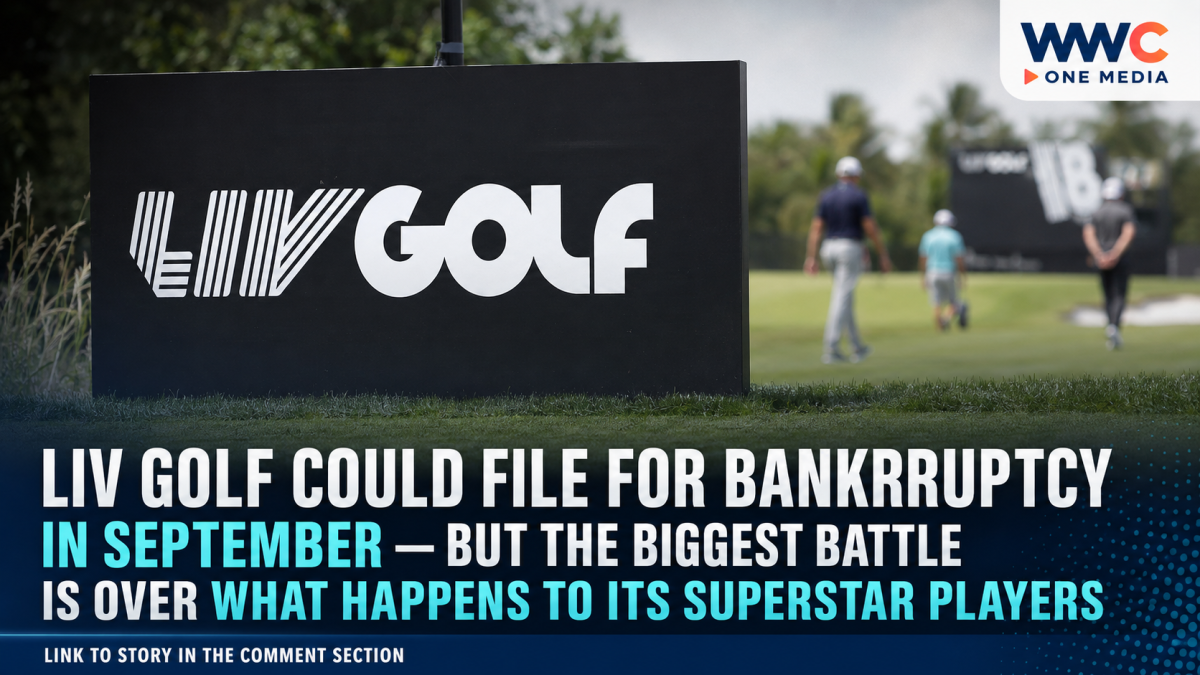
LIV Golf, one of the most disruptive forces professional golf has seen in decades, may be approaching its biggest test yet — and this time, it is happening away from the course.
The Financial Times reported on August 31 that LIV Golf is preparing for a possible bankruptcy filing as early as the week beginning September 7, 2026, citing people briefed on negotiations surrounding the league’s financial restructuring.
Reuters, whose report was carried by Channel NewsAsia, said it was unable to independently verify the FT report. LIV Golf and Saudi Arabia’s Public Investment Fund, or PIF, had not immediately commented.
That distinction matters: LIV Golf has not yet been declared bankrupt, and no bankruptcy filing had been confirmed as of August 31.
But the signs of financial pressure around the league have been mounting for months.
Saudi Arabia’s $5 Billion Lifeline Is Ending
LIV Golf launched in 2022 with enormous financial backing from Saudi Arabia’s sovereign wealth fund, allowing the new circuit to lure some of golf’s biggest names with massive guaranteed contracts and record prize money.
According to Reuters, PIF has invested more than $5 billion in LIV Golf since its creation.
That financial model was shaken in April, when PIF decided it would stop funding the league after the conclusion of its 2026 season.
Without that seemingly unlimited financial support, LIV has been forced to confront a fundamental question that critics have asked since its launch:
Can the league support itself as a conventional commercial sports business?
That question became even more urgent as LIV began cutting costs.
The league recently laid off most of its workforce while trying to secure financing for what executives have described as the next phase of the competition, widely referred to as “LIV 2.0.”
Players Are Now Part of the Bankruptcy Puzzle
Potential bankruptcy proceedings could become especially complicated because LIV’s biggest attractions are also among its largest financial obligations.
The FT reported that LIV has sent settlement proposals to players who are still owed millions of dollars under guaranteed contracts extending beyond the 2026 season.
Some initial proposals reportedly offered players only a small fraction of what they were contractually due.
That could become one of the most consequential parts of any restructuring.
LIV built its roster by offering extraordinary financial guarantees to players including Jon Rahm, Bryson DeChambeau, Brooks Koepka and others, changing the economics of professional golf and forcing the PGA Tour to respond with higher purses and changes of its own.
But some major names have already departed, while others have remained publicly cautious about what they will do next.
Ian Poulter, for example, recently said he remained uncertain about his future while expressing hope that LIV 2.0 would continue.
Bryson DeChambeau has also acknowledged the difficulty facing the organisation as uncertainty surrounds its post-2026 future.
The situation creates a difficult circle for LIV: potential investors may want star players committed before providing hundreds of millions of dollars, while players may want proof of long-term financing before committing themselves to the new league.
LIV Says It Has an Investor — But the Deal Is Not Finished
There is still a possible escape route.
Earlier in August, LIV CEO Scott O’Neil announced that the organisation had an agreement with a lead investor intended to help finance operations beyond 2026.
O’Neil said the agreement had been approved by LIV’s board and that the league hoped to complete a transaction in September.
Subsequent reporting identified the potential investor as BC Partners, with discussions reportedly involving roughly $300 million in new financing.
However, that transaction has not yet been completed.
GOLF.com reported that what LIV currently has is effectively a signed term sheet rather than a fully closed investment, with player commitments among the issues that could affect the final agreement.
That makes September potentially decisive.
Instead of simply determining whether LIV receives new investment, the coming weeks could determine whether the existing company restructures through bankruptcy before a smaller, less expensive version of the league emerges.
Bankruptcy Would Not Automatically Mean LIV Golf Is Finished
A Chapter 11 filing should not necessarily be interpreted as the immediate death of LIV Golf.
Chapter 11 of the US Bankruptcy Code allows businesses to continue operating while renegotiating debts, contracts and other obligations under court supervision.
According to the Financial Times, a possible filing could take place in New Jersey, where LIV recently established a new corporate entity. PIF could potentially provide less than $100 million in debtor-in-possession financing to help the organisation through the restructuring process, although the Saudi fund is reportedly unwilling to resume its previous level of financial support.
In other words, bankruptcy could potentially become the mechanism used to move from the expensive original version of LIV to a significantly leaner LIV 2.0.
LIV 2.0 Would Look Very Different
Whatever emerges in 2027 is unlikely to resemble the league that stunned golf in 2022.
Recent reports suggest LIV has considered reducing its schedule, dramatically lowering tournament purses and giving players a larger ownership role.
Golf Digest reported earlier this summer that LIV was looking for around $300 million in fresh capital to fund its next stage, while trying to convince investors that the operation could eventually become financially sustainable.
Cost-cutting has already become visible.
LIV canceled its planned $40 million Team Championship in Michigan, turning the Indianapolis tournament into the final event of its 2026 season. CBS Sports reported that it was the second LIV event canceled during the year.
GOLF.com has reported that the proposed 2027 model could feature roughly 10 events rather than 14, with substantially smaller prize funds.
That would represent a striking reversal.
LIV entered professional golf selling abundance: massive contracts, enormous purses and seemingly unlimited Saudi capital.
Its next chapter may instead depend on austerity.
What Happens to the PGA Tour-LIV Golf Rivalry?
LIV’s financial crisis could also reshape professional golf far beyond the company itself.
For years, the sport has been divided between the PGA Tour establishment and the Saudi-funded challenger.
But if LIV cannot preserve its biggest names, attention will quickly shift to whether players could return to traditional tours.
PGA Tour CEO Brian Rolapp said earlier this year that the Tour would consider additional pathways for LIV players who wanted to return.
That could make the coming months about much more than bankruptcy court.
The futures of players, team franchises, broadcast agreements, sponsors and the broader structure of elite men’s professional golf could all be affected by what happens next.
The Real Test Comes in September
For four years, LIV Golf demonstrated how quickly enormous amounts of capital could disrupt an established sport.
It signed major champions, created a rival global tour, pushed prize money sharply higher and forced professional golf’s traditional institutions to reconsider their own business models.
But spending billions of dollars to create a competition is different from proving that competition can survive without its original benefactor.
That is now LIV Golf’s challenge.
The reported September bankruptcy preparations do not necessarily mean the league is disappearing.
They may instead mark the end of LIV Golf 1.0 — the lavish, Saudi-funded version built around guaranteed contracts and unprecedented prize money.
The real question is what emerges on the other side.
Because if new investors, star players and creditors cannot reach an agreement in the next several weeks, the biggest disruption LIV Golf created may ultimately be followed by something equally dramatic:
a fight over who — if anyone — is willing to pay for its second act.




Leave a Reply