
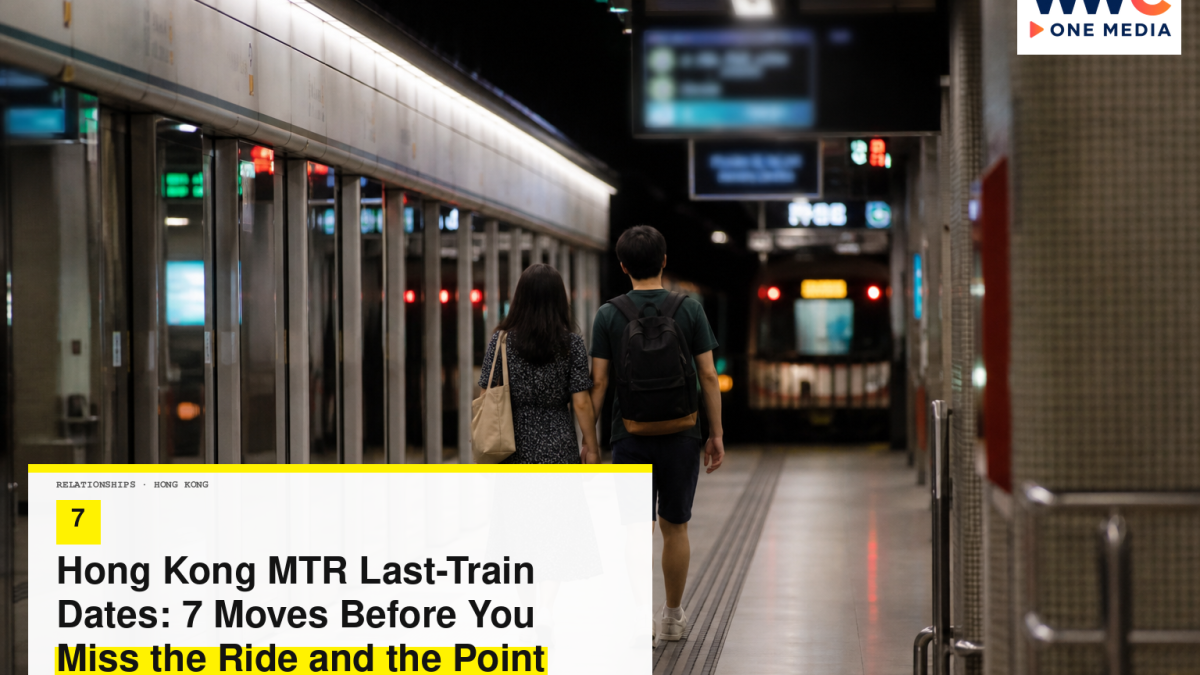
HONG KONG — Admiralty is a clock if you let it be. Central is a clock with better lighting. Tsim Sha Tsui is a clock that pretends it is still afternoon because the harbour is doing something pretty. Hong Kong MTR last-train dates fail in a specific way: two people have a good hour, then they miss the ride and the point in the same gesture. Island versus Kowloon is not banter. It is the first fact. The last train is not a vibe. A taxi is a decision, not a personality that appears when the gates stop accepting the night.
Seven moves. Do them before you sit down in a place that will pour another round because the table is still yours. The Octopus will not argue. The night can still be a date if you treat the last train as part of the invite, not as a punishment for chemistry.
1. Island vs Kowloon is the first line of Hong Kong MTR last-train dates
Before the restaurant, before the bar, before the walk along the water in Tsim Sha Tsui that always runs long, you say where sleep is. Island or Kowloon — and then the finer grain, because “Kowloon” is not a plan. Mong Kok is not Kwun Tong. Sham Shui Po is not Hung Hom. On the Island, Kennedy Town is not Tai Koo. South Island Line is not the same night as a walkable Sheung Wan.
Hong Kong MTR last-train dates start as a map, not as chemistry. If one of you is in a walk-up in Sai Ying Pun and the other is past Kowloon Tong toward a more suburban bed, the last trains that matter are different trains. You can have a beautiful evening in Causeway Bay and still have chosen a stupid theatre for the goodbye. Causeway Bay is a mall gravity. Mall gravity eats clocks.
Put it in the invite: “I need a train toward [line / district] that is not the last one. Let’s meet on my side / your side / in the middle at Admiralty.” Middle is a real option in this city. Admiralty, Central, Tsim Sha Tsui East, even Olympic on a night that wants to be quieter — middles exist so that nobody is performing a longer commute as proof of interest. Proof of interest is showing up on time and leaving on purpose.
If you refuse to say your district, notice that. Privacy is allowed on a first meeting. After a few dates, hiding the side of the harbour you sleep on is not mystery. It is a person who does not want their last train to count. Your last train should count. So should theirs.
Cross-harbour after a certain hour is a different animal than a same-side hop. The talk is not “Hong Kong is small.” Small is a tourist sentence. From a bar in Lan Kwai Fong to a bed in Tseung Kwan O is not small at 12:10 in your head and 12:40 on the platform. Say the true commute once, in minutes, door to door, at night, not the daytime MTR fantasy.
What not to do: pick a venue because it looks like a film still — rooftop, harbour, neon in Mong Kok — without checking which of you is stranded. Pretty is not a line. A line is a line.
2. Put the last-train clock in the invite, not in a panic at the gate
Look up the last train for the actual line you need, on the actual day, before you leave the office or the flat. Weeknight and weekend are different moods in this city; they can also be different clocks. Do not trust a memory from last year. Do not trust a friend who “always makes it.” Always is not a timetable.
Send the clock in the same message as the venue. “Dinner in Sheung Wan. I am on a train toward Tai Koo that I will not miss. We should be walking to the station by [time].” That is a romantic sentence if you want to see them again. It says: I want this to end well. People who only want you for the extra hour will bristle. Let them bristle in the afternoon, not on a platform in Central while a staff member is already in the closing choreography.
Buffer: you do not aim at the last train. You aim at the one before it. The last train is the emergency exit, not the plan. Missing the buffer because a dessert arrived is a choice. Missing the last train because you aimed at it and then there was a signal delay, a crowd at Causeway Bay, a toilet queue, a wrong exit at Admiralty, is how a date becomes a fare argument.
Who is the timekeeper. Rotate if you are past the first month. If one of you is always the boring one with the clock, they will start to hate the role, and you will start to call them a parent. Set a shared alarm labelled with the station, not with a joke. Joke alarms get dismissed. Station names do not.
If the date is a film, a gig in a warehouse in Kowloon, a walk that is the point, you still pick a leave-time before you enter. The leave-time can be “we will miss it on purpose.” That is move seven. What you cannot do is enter without a leave-time and then invent one in a raised voice at a gate.
What not to do: hide the clock so you do not look anxious. Anxious is missing the point because you were performing ease in a city that runs on last trains. Ease is a buffer.
3. Name the line, the interchange, the exit — not “the MTR”
Hong Kong MTR last-train dates die at interchanges. Admiralty is a beautiful example of a place where two people can be in the same station and not in the same night. Tsuen Wan line versus Island line versus Tuen Ma versus South Island. A person who says “I’ll just get the MTR” has not made a plan. They have named a system.
Write the path as if you were texting a slightly lost friend:
- We walk to [station] exit [letter].
- We ride [line] toward [terminus] to [interchange].
- If we separate, we do not improvise a different line because it “looks faster.” We send a text at the platform.
After a date, brains are worse at interchanges. Alcohol makes Admiralty into a maze you have done a thousand times and will still do wrong. Tired makes Tsim Sha Tsui’s exits into a relationship test: why did you go to that exit, I always use this one. It is not always. It is a habit. Say the exit in daylight. Take a photo of the meeting point — a specific 7-Eleven, a specific pillar, a specific Starbucks that is not the other Starbucks.
If one of you needs the Airport Express corridor, a different concourse, a mall shortcut through Harbour City or IFC, say so. Shortcuts are how people vanish. Vanishing at 11:50 is how the last train becomes a solo sport.
Octopus, phone wallet, a card that is almost empty: check before you are in a goodbye kiss. The gate queue is not where you discover you cannot tap. Top up when you are still two people in a shop, not one person in a panic and one person already through.
What not to do: run. Do not run on escalators. Do not hold doors. Do not board a packed last car you cannot exit from at your stop. Missing your stop on a last train is a worse night than missing the train. You will ride to a terminus and then you will meet the taxi as an accident, which is the expensive version of move five.
4. The “one more” tax in LKF, Soho, TST, and the mall that is still open
Lan Kwai Fong and Soho on the Island will always offer one more. Tsim Sha Tsui will offer a walk, a dessert, a view, a bar that looks like the night is young because tourists are still standing in the middle of the pavement. Causeway Bay will offer a mall that does not care about your last train. Mong Kok will offer a street that is still a street. All of these are allowed. None of them are free. The tax is the train, or the taxi, or the point of the date.
Rule: one more is a named vote. Both people say yes, out loud, with the clock on the table. If one person says yes and the other smiles, that is not a yes. That is a person who does not want to be the boring one. Make being the boring one a pre-agreed honor. “I will be the timekeeper tonight. You can be it on Friday.” Then the timekeeper can kill the one more without a character judgment.
If the one more is actually the point — you wanted a late night, you wanted to see how they are after midnight, you wanted the harbour when the offices have gone home — then you are in a different date. You budget it. You wear shoes that can stand a taxi queue. You do not pretend you are still in last-train character. Mixed characters are how people fight. They thought it was a tidy Sheung Wan dinner. You thought it was a test of spontaneity. Spontaneity that costs a cross-harbour taxi should be billed as such at 8pm, not at 00:20.
Food that delays: a hotpot that has no ending, a dessert that has to be Instagrammed in Central, a street snack in Mong Kok that becomes a second dinner. Decide the last bite before the last bite. It sounds controlling. It is how you do not chew your way past a timetable.
What not to do: punish them for being the timekeeper by calling them unromantic in front of a waiter. The waiter has a last train too. Romance is getting home still liking each other. Unromantic is a 2 a.m. argument about whether Soho “counts” as close to a station. It counts if you leave. It does not count if you keep sitting.
5. Taxi is a decision, not a rescue personality
When the last train is gone, or about to be gone, a taxi is a choice with a number. Cross-harbour tunnel, traffic after rain, a queue in Central that looks like a verdict on your life, Uber if you use it, a red taxi with a driver who does or does not want your district. None of this is a cute story unless you already agreed it could be the story.
Move five: you decide the taxi policy before the first drink.
- Cap: we will take a taxi up to [amount] if we miss the buffer. Split, or one of us pays because they chose the late venue, or the person with the longer ride pays less because they already spent the night commuting. Pick one. Write it.
- If the quote or the meter will blow the cap, we do not go out as if we had a taxi personality. We go out as last-train people.
- If one of us cannot split, they say so at dinner, not in the taxi queue while it is raining on a Friday in Tsim Sha Tsui.
- If the taxi is also a privacy problem — a driver as an audience for a fight, a conversation you should not have in Cantonese or English in a small cabin — you ride quiet. You finish the talk on a pavement, in a McDonald’s, in a lobby that will tolerate you.
Black cabs, red cabs, apps, a hotel rank: pick the method while you still have humour. A fight about which queue is faster is not chemistry. It is two anxious people failing a logistics exam. One person stands in the queue. The other handles the map pin for the true door, not the mall entrance that will add ten minutes of one-ways in Kowloon.
If you live in a place taxis hate at night — a steep walk in the Mid-Levels, a village in the New Territories that is a story, a building with a name the driver will argue — you do not make the other person solve it at 1 a.m. You know your pin. You know the building name in the language the driver wants. You send it before the door shuts.
What not to do: “We’ll just taxi” as a personality you have not budgeted. That sentence has ended more Hong Kong MTR last-train dates than bad food. Taxi is money and time and a tunnel. Say those words. If the money is ugly this month, the last train is the date. A shorter date that ends at a gate is a successful date. A long date that ends in a silent meter is a meeting with a bill.
6. The goodbye at the gate versus the walk to the taxi rank
The point of the date often dies in the last ten minutes because nobody named the goodbye. Are you kissing at a gate in a station that has cameras and a crowd. Are you walking them to a taxi rank in Central and then walking back to your own last chance. Are you both getting into a taxi that is a third location. Are you splitting at Admiralty because that is the interchange that keeps both of you honest.
Move six: pick the goodbye geography with the same care as the restaurant.
Same-side, both on trains: you ride together to the interchange and you do not start a heavy talk in the car. You say the sweet thing, the plan for next time, the “text me when you tap in at home,” and you separate with enough minutes that neither of you sprints. A sprint is not a movie. A sprint is how you fall.
Opposite sides of the harbour: you do not both “wait to see.” You pick the station where the night ends. Tsim Sha Tsui if the night was Kowloon. Central or Admiralty if the night was Island. You do not follow them into a cross-harbour ride “for five more minutes” unless those five minutes were in the plan. Five more minutes is how last trains get missed in a tunnel, which is a special kind of stupid, because you cannot even get out and take a taxi until the next station.
If one of you is going to a taxi and one to a train, the train person leaves first. The taxi can wait in a way a last train cannot. Couples get this backwards because the taxi person looks more abandoned on a kerb. Reverse it. The train person is on a cliff. The kerb is annoying. Annoying loses to cliffs.
Text when you are through the gate, and text when you are inside a door. Hong Kong buildings have enough doors — metal gates, lobby doors, a walk-up with a lock that sticks — that “I am home” should mean inside, not “in the neighbourhood.” The other person can sleep after inside. They should not have to guess.
What not to do: start the “what are we” talk at the gate. The gate is loud. The gate is public. The gate has a clock. Take that talk to a Saturday table in a cha chaan teng in a district that is not trying to close on you. If the feeling is urgent, you can say “I like you, I want a next date, I am getting this train.” That is a full point. A thesis can wait.
7. If you miss it on purpose, spend the extra hour like adults
Sometimes you will miss the ride on purpose. That can be the point. Move seven is to not miss the point while missing the ride. The extra hour is a decision with a shape: another place to sit that is not a street argument, a budget for the taxi, a consent conversation if the hour is someone’s flat, a plan for the morning if the hour becomes a night.
If the extra hour is a flat in Sai Wan or a studio in Kwun Tong, you both say that before you miss the train. A missed train that “accidentally” becomes a sleepover is a story people tell themselves so they do not have to ask. Ask. Ask on the pavement, not in a lift. Ask about work in the morning, an octopus, a parent, a roommate, a dog, a mattress on a floor, a need to leave at 6am for a site in Fanling. Logistics are not a mood killer. Logistics are how the extra hour stays kind.
If the extra hour is more drinking, you set a second clock: last round, water, food if the last food was theatre. Hong Kong after last train is a different city — quieter stations, brighter 7-Elevens, a taxi market that knows you have no alternative. You can enjoy it. You should not pretend it is still the same date with the same judgment.
If the extra hour is a fight, you have already missed the point. Get two taxis. Or one taxi and a silence that you agree is a pause, not a verdict. Do not trap a fight in a cross-harbour tunnel. Tunnels hold words too well. Words in tunnels come back uglier at breakfast.
Pay the taxi as you decided in move five. Then the inside text. Then you do not reopen Line or WhatsApp to relitigate the last round. The extra hour already cost the train. It does not also get your sleep and your next three days.
What not to do: miss it on purpose and then punish them for the fare. Purpose includes the fare. If you cannot afford purpose, you catch the ride. That is not a lack of passion. That is a person who wants a next date more than a story.
Island vs Kowloon: a cheat sheet, not a personality
Island, west: Kennedy Town, Sai Ying Pun, Sheung Wan, Central — walkable goodbyes if the date was already there. Last trains still exist. Hills still exist. A Mid-Levels walk after a missed train is a different fitness test than you think when you are in indoor shoes.
Island, east: Wan Chai, Causeway Bay, North Point, Quarry Bay, Tai Koo, Chai Wan — the Island line is a spine. Malls will try to keep you. Do not let Times Square be your timekeeper.
South Island: a pretty date that is a commitment. Ocean and hills are not a quick hop back to a Kowloon bed. If one of you lives south, the last train is the date’s boss unless you budget a taxi like a person who can.
Kowloon, harbour: Tsim Sha Tsui, Jordan, Yau Ma Tei, Mong Kok — neon and crowds, easy to feel like the night is endless. It is not. These stations are also where you can lose each other by walking ten metres apart.
Kowloon, east and north: Kwun Tong, Kowloon Bay, Wong Tai Sin, Diamond Hill, and out toward the New Territories — a last train missed here is not a “we’ll find a taxi in Central” story. It is a longer night. Respect it in the invite.
Interchange brains: Admiralty, Central, Tsim Sha Tsui, Mong Kok, Hung Hom. Treat them as decision rooms. If you enter one without a line name, you are improvising at the worst time.
What not to do on the platform
Do not fight. A platform is a corridor with an audience of people who also missed a softer night.
Do not cry if you can walk up to street level and cry there. If you cannot, sit on a bench, not on the edge of a plan.
Do not board different cars as a sulk. You will not reunite. You will text in a tunnel and get angry at the lack of signal like it is their fault.
Do not use the last train as a test of whether they will stay. Tests are how you get people who stay for the wrong reason, or leave for the right one while you are still performing.
Do not assume an Octopus on a phone that is at 2 percent will behave. Charge at the restaurant. Carry a cable. Carry a backup card if you are a person who knows you are a person who forgets.
Do not follow a stranger’s advice about “there is still a train” unless you can see it on an official board. Rumours on platforms are a sport.
Notes both phones should carry
- My district, my line, my usual last train window, my true door-to-door at night.
- Tonight’s venue, tonight’s leave-time, the train we are aiming at (not the last one).
- Interchange and exit letters. Photo of the meeting pillar.
- Taxi cap and who pays if we miss it.
- Goodbye geography: gate, rank, or interchange split. Train person leaves first.
- Inside text. Then sleep.
- If we miss on purpose: flat / more drinks / two taxis. Named. Not accidental.
If they will not look at a clock with you, they are dating a version of Hong Kong that does not exist after a certain hour. You can like that version in a film. You should not use it as a transit plan.
Objections
“We’ll see how we feel.” Feeling is allowed. Feeling does not move a last train. See how you feel by the leave-time. Then feel on the train, or feel in a taxi you already priced.
“It’s so early.” It is not early if your bed is in Tseung Kwan O and the date is in Sheung Wan. It is physics.
“I always taxi.” Then this is not an MTR last-train date. Call it a taxi date and put the number in the plan. Do not bait-and-switch a person who came in last-train clothes, last-train budget, last-train head.
“Don’t be so HK.” Being on time for a last train is not a national stereotype you have to rebel against to be hot. It is how you see them on Thursday.
If one of you lives with family in the New Territories and a missed last train is a household event, that is not cute. That is a parent at a door. Plan like a person with a door that has other people behind it.
Bottom line
Hong Kong MTR last-train dates keep the ride and the point when you make seven moves: Island versus Kowloon as the first fact, the clock in the invite, the actual line and exit, a named vote on one more, taxi as a priced decision, a goodbye geography that lets the train person leave first, and an extra hour that is adult if you miss on purpose. Admiralty will still be a maze. The harbour will still show off. You do not have to miss both the train and the meaning.

Leave a Reply