
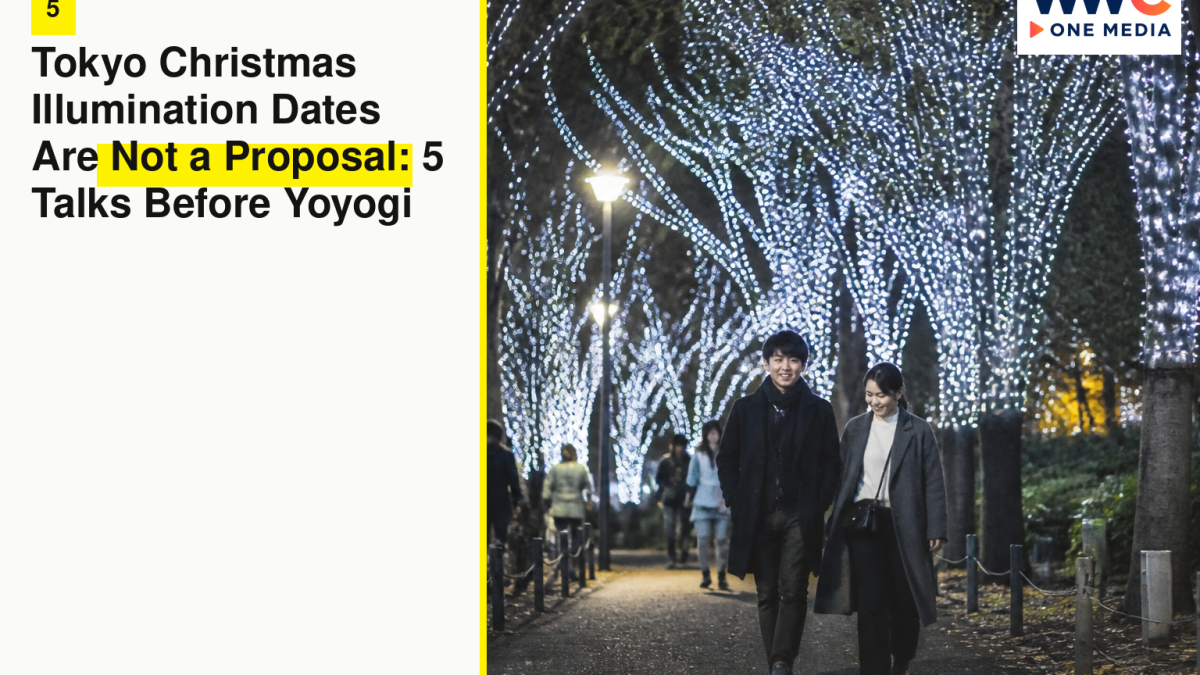
TOKYO, Japan — Yoyogi Park in winter is a walk, a wind, a dog, a couple in matching scarves who may or may not be a couple. Meiji Jingu is a gravel path and a quiet that tourists treat like a secret even when it is not one. Omotesando is a corridor of lights and shop windows that will photograph you whether you asked or not. Tokyo Christmas illumination dates are not a proposal. They are a seasonal walk with a camera roll and a last train. If you need a talk, have the talk before Yoyogi, not under a tree that makes every sentence sound like a vow you did not mean to offer.
This is not a war on lights. Lights are fine. Winter is fine. A date in Harajuku in December is fine. The mess is the script people import: illuminations equal climax, climax equals definition, definition equals a ring or a key or a moving-in that nobody said out loud in November. Five talks. Boring on a weekday in a chain cafe near Shinjuku. Better there than in a crowd that is already filming you.
1. What Tokyo Christmas illumination dates mean, said before Yoyogi
Tokyo Christmas illumination dates pick up meaning from films, from last year’s stories, from a friend who got a surprise they wanted, from a friend who got a surprise they did not. Your pair may not share that meaning. One of you thinks December lights are a pretty commute through Shibuya. One of you thinks this is the night the situationship has to choose a noun. Both of you can be kind and still be on different walks.
Talk one happens before tickets, before a reserved cake, before you tell a group chat you are “going to the illuminations.” Ask a small question, not a trap. “For you, is this just winter, or is this a checkpoint.” Then you answer the same question. If both of you say winter, you can enjoy Yoyogi without a second agenda. If one of you says checkpoint, you do not walk into Meiji as if the shrine will do the language for you. You sit in a cafe in Takeshita’s less stupid side streets, or in a kissaten in Shinjuku, and you use daylight words.
Words that are allowed:
- I like you. I want to keep dating next year.
- I like you. I am not exclusive and I will not pretend a tunnel of lights changed that.
- I want exclusive. I do not need a ceremony. I need a sentence.
- I do not want to be photographed as a proposal couple because we are not that.
If you cannot say those in a cafe, you will not say them better while your fingers go numb on a path in Yoyogi. Cold makes people brief. Brief plus lights makes people grandiose and then sorry on the Chuo line.
Couples who already live together still need this talk. A winter walk can become a complaint about money, in-laws, a visit to a hometown in December, a round of oseibo you did not budget, a mother who thinks Christmas Eve is a couple exam. Name whether the walk is a rest or a meeting. If it is a meeting, put the agenda in Line before you put on the coat. Yoyogi is a park. It is a bad conference room.
What not to do: plan a route that looks like a proposal — hidden photographer, a particular tree, a kneel, a crowd you hope will clap — if you have not already heard a yes to the relationship you actually have. Theatre is not clarity. Theatre is content. Content is how you get a story you cannot walk back on the train.
2. Photos versus the talk: who the night is for
Illuminations in this city are built to be seen, which means they are built to be photographed. Omotesando will arrange your faces. Yoyogi will put trees in the background. Meiji’s path will make you look serious even if you were talking about convenience-store oden. Decide, before you go, whether the night is for photos, for a talk, or for a quiet walk that produces neither.
If it is for photos, say how many, where they go, whether they go on Instagram, whether faces are in them, whether a shared account exists, whether an ex can see them, whether a parent in another prefecture will receive them as an announcement you did not make. Tokyo Christmas illumination dates become accidental introductions. A mother in Sendai does not know you were only dating. A photo under lights reads as a season. If you are not ready for a season, you keep the photos in the camera, or you take the tree and not the faces, or you skip the pose that looks like a couple exam.
If the night is for a talk, the camera stays in a pocket for a stretch you name. Twenty minutes with gloves on and phones away, walking a loop you both know how to exit. Then you can take the picture. A talk that is interrupted every four minutes for a shot will become a mood and then a fight about who is more present. Present is a stretch, not a personality.
If you are the one who loves the camera, you can still be decent. You ask. “One photo here, then we walk.” You do not direct their face as if they are staff. You do not make them retake until the lights look like an advert. You do not get angry that they are cold. Cold is the weather. The weather is not a lack of romance.
If you hate photos, say so before you are already under the thing they wanted to capture. Offer a compromise: one photo at the start, then food, then the talk, then home. A person who cannot date you without a grid of winter shots is dating the season. You are allowed to not be the season.
What not to do: post in real time while the other person thinks you are still in a private walk. A story is a crowd. Ask. If they say no, no is a full answer even if the tunnel of lights is pretty. Pretty is not consent.
Also do not use the photo as the talk. A caption is not “we need to define this.” A caption is a caption. If you need a definition, you use a sentence in a place where you can see their actual face, not their face arranged for a stranger’s camera behind you.
3. Last train from Harajuku, Shibuya, Shinjuku — winter version
December walks run long because the lights trick your clock. You think you have been outside for twenty minutes. You have been outside for ninety. Your toes know. Your JR timetable does not care. Talk three is the last train, named, with a buffer, in winter clothes that make you slower than you were in October.
Harajuku station, Meiji-jingumae, Shibuya, Shinjuku: pick the exit strategy when you pick the meeting point. If you are coming from a walk in Yoyogi toward Meiji, you are not “near Shinjuku” in the way a person on a sofa thinks. You are a cold walk plus a crowd plus a station that will be full of other people who also thought they had twenty minutes. Aim at a train that is not the last. Say the leave-time out loud when you still have feeling in your mouth.
Winter adds the taxi temptation. A taxi from Shibuya after illuminations is a number that can look like a shrug and then look like rent. Decide the cap before you go, same as any late date in this city. If one of you lives on a private line that dies earlier than JR, that line is the boss. Do not let a person who lives on the Yamanote lecture a person who has to make Odakyu or Keio or a last bus that is not a story.
Convenience stores are part of the last-train plan, not a failure. Heat a karaage, a can of hot tea, a packet of hand warmers. Sit for ten minutes in a place with light and a toilet. Then you go to the gate as people, not as two frozen arguments. Tokyo Christmas illumination dates often skip food because the lights were supposed to be the meal. Lights are not a meal. Cold plus hunger plus a definition talk is how you say something you will try to unsend on Line.
If you miss the last train on purpose, that is a different night — a karaoke box, a diner, a flat, a love hotel if that is honestly on the table, a manga cafe if you are both being practical and a little sad. Name it before you miss. Accidental all-nighters after a shrine path are how people confuse endurance with devotion. Endurance is a timetable failure. Devotion is a sentence in November.
What not to do: run in a crowd on gravel in Meiji in leather shoes you wore for the photo. The last train is not worth a fall. Walk. If you miss it because you walked, you are in talk five’s cousin: the taxi decision. You already priced it, or you did not go this far from a station with a live clock.
Platform manners: you do not have the definition talk against the doors. You do not cry in a packed car if you can wait three stations. You do not block a door for a hug that belongs at a quieter exit. Winter coats already make you larger. Be smaller in the car. Be a couple later, on a side street in Shinjuku that is not a scramble.
4. The lights are free. The night is not.
Illuminations as a public walk can cost nothing at the entrance and still cost a dinner in Harajuku, drinks in Shibuya, a second cafe because the first one had a queue, a taxi, a pair of hand warmers, a convenience-store haul, a reservation you made to feel like the night was an event. Talk four is money, said in yen, before you perform a winter fairytale.
Split, host, or trade: pick it in Line. “I will get dinner, you get the drinks, we split the taxi if we miss the buffer.” Or: “This is my invite, I will cover the table, you can cover nothing, I am not buying a definition.” That last clause matters. Generosity that expects a relationship noun at the end of a path in Yoyogi is not generosity. It is a setup. If you are the one paying, you say what you are paying for. Dinner. Not a future.
Queues will push you into more expensive rooms. A crowded cafe in Omotesando will make you walk into a place with a table charge you would have refused in July. Agree a cap. Agree a backup: a standing bowl in Shinjuku, a depachika snack eaten under an awning, a convenience store that is actually fine. Tokyo Christmas illumination dates go sour when one person thinks the backup is a failure of romance and the other person thinks the main place was a failure of sense. Sense is allowed in December.
Gifts: a small thing can be sweet. A large thing can be a speech. If you want to give something, give it in a place where they can refuse without an audience. Not under a tree with strangers’ cameras. A refusal in public becomes a scene. A refusal in a cafe is a preference. If you do not want gifts, say so before they enter a shop in Harajuku and invent a test.
Hometown money also shows up in December even if you do not name Christmas. Travel back, gifts for parents, a partner who is suddenly poorer, a partner who is suddenly generous because their bonus landed. If the walk is where you were going to confess a tight month, confess it before the expensive table. Lights do not require a course menu. They require a coat and a sentence.
What not to do: keep a quiet ledger of how much the illumination night cost so you can present it later as proof of seriousness. Proof of seriousness is repeated Tuesday dinners, not a December invoice. If you cannot afford the night, say so and pick Yoyogi plus a convenience store plus a train with a buffer. That is a date. Anyone who needs a more expensive winter is telling you about their audience, not about you.
5. The December sentence: are we a couple, or are we a photo
Talk five is the one people try to make the lights say. Do not. The lights are electrical. You are a person. Before Yoyogi, you try a sentence with a calendar in it.
“I want to date you in January, as a couple, not as a winter event.”
“I want to keep this casual. I still want the walk. I do not want a caption that says otherwise.”
“I will meet your friends in January if we are still doing this. I will not meet them as a surprise under lights.”
“If we are going to end, I do not want to do it in a park that is trying to be a postcard. Let’s do it in a cafe on a Tuesday.”
Tokyo Christmas illumination dates are a bad breakup venue and a bad proposal venue for the same reason: the set is louder than the people. If you already know you are proposing, you should already know the answer, and you should pick a place that is about the two of you, which might still be Meiji at an hour that is not a crowd, or might be a kitchen in Koenji, or might be a walk you take in March when the lights are gone and the relationship still exists. If you need the set to create the answer, the answer is not ready.
If you are not Japanese, or not from Tokyo, December can carry extra import you did not vote on — Christmas Eve as a couple exam, a hotel that was supposed to be booked months ago, a dinner course that is a social object. Ask what the calendar means to them. Do not assume. Do not mock. Do not import a foreign script either. You are in this city, in this pair. The talk is local even if your families are not.
If you are both from here, you still should not skip the sentence because “it is obvious.” Obvious is how people walk around Yoyogi for three Decembers and then discover one of them thought this was a pre-engagement and the other thought this was a nice park. Three years of lights is not a noun. A noun is a noun.
After the sentence, you still can walk. The walk is better when it is not doing unpaid labour as a relationship committee. Look at the dogs. Look at the stupidly pretty trees. Take the one photo you agreed on. Eat something hot. Make the train. That is a successful winter date. A proposal is a different document.
What not to do: ambush. No hidden friends. No public kneel unless you have already lived the answer. No “I need to know tonight” under a light that makes refusal look like cruelty. Need-to-know-tonight is a Tuesday cafe with an easy exit to a station. Yoyogi’s exits are paths. Paths are a bad place to trap a face.
Yoyogi, Meiji, Omotesando, Shibuya: pick a loop, not a pilgrimage
Yoyogi Park: space, wind, mud if it rained, room to talk if you keep off the most photographed knots. Good for talk two’s phone-in-pocket stretch. Bad if you are in shoes that cannot do dirt. Meet at a specific entrance, not “Yoyogi.” Pins fail here too.
Meiji Jingu: quieter, gravel, rules, a different head. Fine for a walk. Odd for a speech about sex, money, or a breakup. Dress like you might be in a precinct that expects a little respect. You can still be two people on a date. You do not have to perform a shrine as a couple exam.
Omotesando / Harajuku streets: lights, crowds, shopping weather, photos whether you like it or not. Good if the night is for looking. Bad if the night is for a hard sentence. Use it after the cafe talk, not as the cafe talk.
Shibuya: scramble, heat leaking from stations, a thousand other dates. Useful as a start or an end because the trains are there. Useless as a place you expect privacy. If you need privacy, you already lost it at the scramble. Walk toward a side street or give up and talk tomorrow.
Shinjuku: a practical winter animal — food, cover, multiple lines home, a park of its own if you want a quieter green. A decent plan is cafe in Shinjuku, talk five, then a shorter illumination walk, then a train you will catch. That order is adult. Illumination first, talk later is how the talk never happens because you are frozen and polite.
Do not stack all four in one night as a personality. That is a tour. Tours make couples mean. Pick one loop. Leave.
What not to do under lights that look like a proposal
Do not kneel unless the relationship already has a yes that was said in a room.
Do not film strangers’ dates. They did not come to Yoyogi to be your content.
Do not compare this walk to someone else’s winter on social media while you are still on the walk.
Do not get drunk before the talk. A convenience-store highball is not illegal. A definition delivered through one is sloppy. Sloppy in December gets remembered in April.
Do not use English or Japanese as a hide. If they are stronger in one language, the sentence happens in the language they can answer in. A pretty sentence they cannot catch is not a pretty sentence.
Do not drag a third person as a photographer unless both of you asked for a third person. A friend with a camera is a crowd.
Do not stay until you hate the lights. Leave while you still like them. That is the whole trick of seasonal dates.
Notes before you put on the coat
- What this night means to each of us: winter walk, checkpoint, or photos. One.
- Camera rules: how many, where they go, faces or no faces, posted or not.
- Leave-time, station, buffer train, taxi cap.
- Money: who pays for what, backup food, no ledger.
- The December sentence, tried in a cafe first if it is heavy.
- Loop: one area, not a pilgrimage.
- If we miss the last train: named place, named cost, named consent.
Send it in Line as a note, not as a joke sticker. If they reply with a joke sticker and nothing else, you still have data. You can go look at lights with a person who will not do a talk. You should not expect a proposal, a definition, or a caption that tells the truth. You should expect a photo. Decide if a photo is enough.
Seasonal, without making the city a statistic
December in Tokyo is cold, busy, pretty in places, ordinary in most places. Convenience stores still sell the same onigiri. Trains still run until they do not. Parks still close in sections. People still work the next morning. You do not need a ranking of illumination spots or a claim about how many couples get engaged under them. You need a coat, a buffer, and a sentence.
If the relationship is already a relationship, the lights are decoration. If it is not, the lights will not finish the paperwork. Before Yoyogi, you do the paperwork in the small way: a talk, a train, a photo you both agreed to. Then you can look up. The trees will still be trying. You can let them try without making them your lawyer.
Bottom line
Tokyo Christmas illumination dates are not a proposal. Five talks before Yoyogi will keep the season from writing your life: what the lights mean, photos versus the talk, the last train in winter, money in yen with a backup convenience store, and a December sentence with a calendar in it. Meiji will still be quiet. Omotesando will still perform. You can walk. You do not have to vow. You do have to catch the train or admit you are choosing not to.


Leave a Reply