
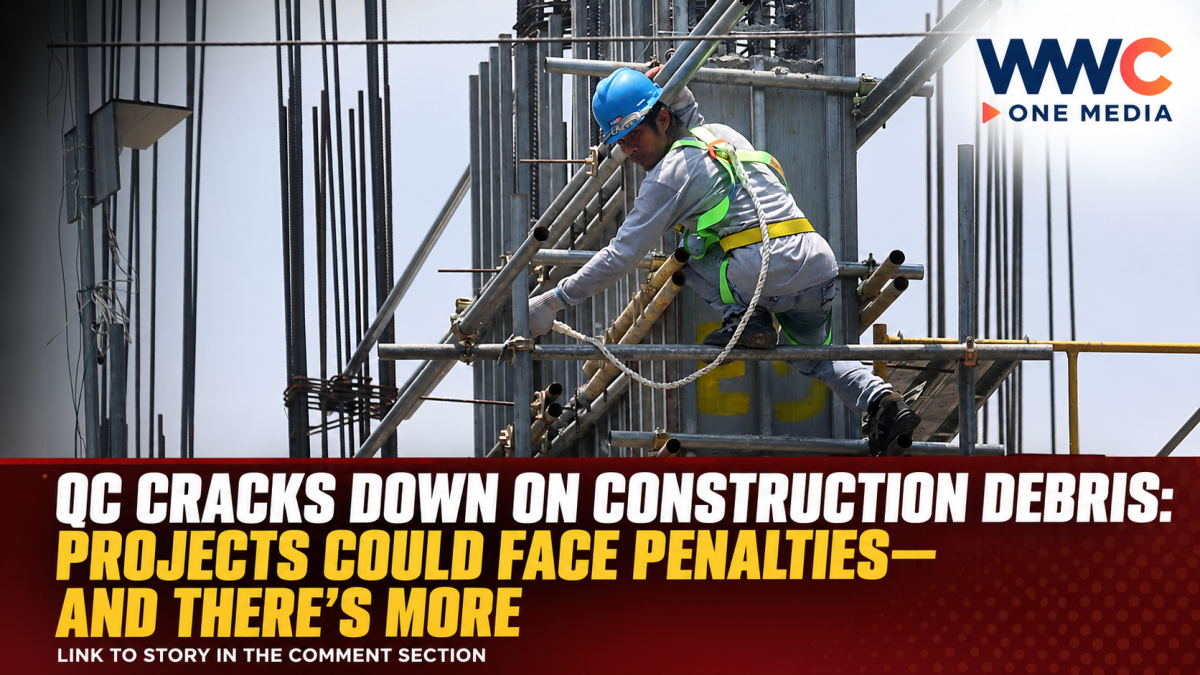
QUEZON CITY, Philippines — Construction projects that leave behind piles of debris, damaged roads, blocked drainage systems or other public hazards could face penalties and delays under a new Quezon City ordinance aimed at making contractors and project proponents accountable for restoring areas affected by their work.
The Quezon City Construction Site Restoration and Cleanup Compliance Ordinance (SP-3519, S-2026) requires public and private infrastructure projects in the city to secure a Certificate of Site Restoration and Cleanup Compliance (CSRCC) before they can receive final project acceptance or certain building-related authorizations.
The measure was approved by the Quezon City Sangguniang Panlungsod and is intended to ensure that construction sites are not simply abandoned after the work is completed, particularly when debris and damaged infrastructure remain in areas used by the public.
No cleanup, no final acceptance
Under the new rules, project proponents must clear construction and demolition debris, restore roads and sidewalks affected by construction, repair or restore drainage systems and rights-of-way, and comply with applicable engineering, environmental and waste-management requirements.
Construction materials and debris must also be transported, disposed of, recovered or recycled through authorized facilities.
The CSRCC is not simply a paperwork requirement. The ordinance provides that the certification may only be issued after the project obtains the necessary technical and environmental clearances.
Among these is a Technical Restoration Clearance from the Quezon City Department of Engineering, which covers requirements such as proper backfilling and compaction, restoration of affected public infrastructure and compliance with applicable engineering and safety standards.
An Environmental Compliance Inspection Report from the Department of Sanitation and Cleanup Works is also required.
Projects could face more than fines
The consequences for noncompliance go beyond monetary penalties.
According to the city government, violators may face the withholding of project acceptance until the CSRCC is secured, suspension or denial of building-related permits—including occupancy permits—and the forfeiture or non-release of performance bonds or guarantees for public infrastructure projects.
Ongoing construction operations may also be suspended or closed until the project complies with the requirements.
The city’s Department of Building Official will oversee privately owned or privately funded projects, while the Quezon City Department of Engineering will have jurisdiction over projects owned or funded by the city government. District Action Offices and barangays will also assist in monitoring and reporting violations.
Why construction debris is a flooding concern
The crackdown comes as Quezon City continues to address flooding and drainage problems, with city officials repeatedly pointing to obstructions in waterways and drainage systems as a serious concern.
In July 2025, the city government conducted clearing operations involving construction debris from an MRT-7 project along Commonwealth Avenue. Officials said the debris was contributing to drainage obstruction and could worsen flooding in the area.
The issue has also surfaced in the city’s review of flood-control infrastructure.
In September 2025, Quezon City officials said they had identified 331 DPWH flood-control projects worth about P17 billion within the city. Officials reported that many of the projects had coordination, documentation or implementation issues, while some sites had construction debris or were located in or near waterways.
Those findings provide important context for the city’s latest effort: the new ordinance places greater emphasis on what happens after construction work is completed, requiring project proponents to restore affected areas rather than leaving cleanup and repairs to government workers or residents.
A new layer of accountability for developers and agencies
The ordinance applies broadly to individuals, businesses, companies and government agencies involved in vertical or horizontal construction projects within Quezon City.
The CSRCC must be secured before final acceptance or turnover of a project by the concerned government agency, before the issuance of certain building-related authorizations, and before the release of performance bonds or guarantees for public infrastructure projects.
For ongoing projects, proponents are also expected to maintain proper site management and debris control to prevent construction activities from obstructing roads, rights-of-way, drainage systems and other public spaces.
Quezon City Mayor Joy Belmonte said the policy is intended to ensure that infrastructure development is carried out without leaving behind hazards for communities.
“Every infrastructure project must be completed in a safe, orderly, and environmentally responsible manner,” Belmonte said, stressing that developers and project proponents should not leave debris that threatens residents or the environment.
The ordinance was introduced by Minority Floor Leader Councilor Doray Delarmente, together with other members of the Quezon City Council.
The bigger picture
For residents, the significance of the new policy may extend beyond cleaner construction sites.
Construction debris can obstruct sidewalks, roads and drainage infrastructure. In a flood-prone urban environment, even temporary blockages can become a public-safety concern when heavy rain overwhelms drainage systems.
The new QC policy therefore creates a direct link between project completion, site restoration and government approval: finishing the physical structure is no longer enough. Project proponents must also demonstrate that the surrounding area has been properly restored and cleared before receiving the required certification.
And that could make the cleanup phase of major infrastructure projects just as important as the construction itself.




Leave a Reply