
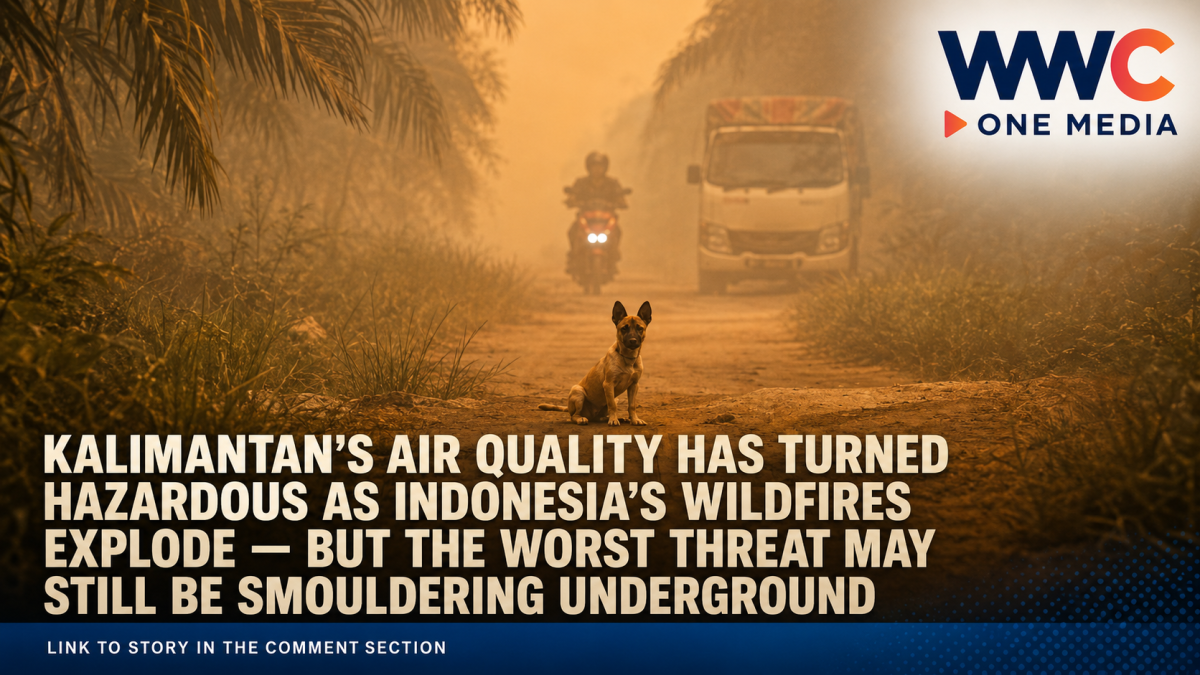
JAKARTA — Thick wildfire smoke has pushed air pollution to dangerous levels across parts of Indonesian Borneo, deepening a fire crisis that has already burned hundreds of thousands of hectares, sickened thousands of people and sent haze across Southeast Asia.
Central Kalimantan’s capital, Palangkaraya, recorded an extraordinary US AQI reading of 780 on the private air-quality monitoring platform IQAir late Monday morning, Aug. 31, placing conditions firmly in its “hazardous” category. Pontianak in West Kalimantan was also ranked among Indonesia’s most polluted cities, with a reading of 593 around the same period.
CNA reported the same readings as smoke blanketed communities across Central and West Kalimantan. The figures are real-time measurements and can change rapidly depending on monitoring station, wind direction and fire activity, but government data has independently confirmed dangerous pollution in affected areas. Indonesia’s Health Ministry said Pontianak recorded an official pollution index reading of 328 on Aug. 27, also classified as hazardous.
And the health consequences are becoming increasingly difficult to ignore.
Indonesia’s Health Ministry said about 5.4 million people were living in areas affected by smoke from the forest and land fires. As of Aug. 27, authorities had recorded 13,449 cumulative cases of acute respiratory infection in affected regions, with 4,082 active cases being monitored. A day later, Deputy Health Minister Dante Saksono Harbuwono put the cumulative figure at approximately 13,500 cases since July.
Health authorities have deployed medical personnel, oxygen concentrators and emergency supplies while advising residents in heavily polluted areas to wear masks and reduce outdoor activity.
But this is no longer simply an air-quality emergency.
More Than 202,000 Hectares Burned in Seven Months
Indonesia’s Forestry Ministry says at least 202,010 hectares of land burned between January and July 2026, Reuters reported. The pace accelerated dramatically in July, when nearly 95,000 hectares burned in a single month — almost as much as the previous six months combined.
The number of detected fire hotspots has also surged.
Reuters reported that Indonesia recorded more than 9,000 hotspots during August, substantially above the 5,077 recorded during August 2015, when Indonesia experienced one of the most devastating haze disasters in its history. The current crisis has not yet reached the overall destruction of 2015, but authorities are increasingly worried about the trajectory of the fires.
Indonesia is facing an exceptionally strong El Niño pattern, which does not start the fires itself but creates hotter and drier conditions that allow vegetation and peat to ignite and burn more easily.
The problem is particularly dangerous in Kalimantan because enormous areas contain peatlands.
Unlike ordinary surface vegetation, dried peat can continue burning underground for long periods, making fires difficult to detect and extinguish. Even when flames appear to have disappeared, heat can remain below the surface and later ignite new fires.
That is one reason firefighters can face a frustrating cycle: extinguish the visible fire, only to find smoke and flames returning nearby.
More Than 24,000 Firefighters Deployed
Indonesia has dramatically expanded its response.
The Associated Press reported that more than 24,000 ground firefighters have been deployed across Sumatra and Borneo. Some hotspots are difficult to reach by land, forcing authorities to rely increasingly on helicopters and aircraft for water bombing and weather-modification operations.
AP reported that Indonesia was operating around 30 aircraft for water bombing and cloud-seeding over Kalimantan, while another 22 helicopters were supporting operations over Sumatra.
Cloud seeding attempts to encourage rainfall by dispersing particles into suitable clouds, but it depends heavily on atmospheric conditions and cannot guarantee precipitation.
The fires have also become a law-enforcement issue.
Indonesian police had arrested 72 people suspected of starting forest and peatland fires, while four companies were being investigated over allegations that fire had been used to clear land cheaply, according to AP.
Indonesia has struggled for decades with fires linked to land clearing. Plantation development, agricultural burning and degradation of peatlands have repeatedly been identified as major factors behind severe fire seasons.
Smoke Is Crossing National Borders
The crisis has already spread beyond Indonesia.
Smoke from fires in Sumatra and Kalimantan has crossed into Malaysia and Brunei, reviving memories of the transboundary haze emergencies that have periodically disrupted Southeast Asia.
Nearly 600 schools in Malaysia’s Sarawak state were closed as air quality deteriorated, affecting roughly 200,000 students, AP reported. Indonesia has also allowed Malaysian aircraft to enter its airspace for cloud-seeding operations near the shared border.
Earlier in August, Indonesia’s disaster management agency warned that prevailing winds could transport smoke from Indonesian territory toward Malaysia. Satellite monitoring had already detected smoke moving across the border on several days.
The potential regional consequences make what happens in Kalimantan especially important for Malaysia, Brunei and — depending on winds and the location of fires — other parts of Southeast Asia.
Japan Is Sending Heavy-Lift Helicopters
International assistance is now joining Indonesia’s firefighting operation.
Japan’s Ministry of Defense confirmed on Aug. 28 that it had ordered an international disaster-relief mission after receiving a formal request from Indonesia.
The deployment will include the Japanese transport ship JS Kunisaki carrying three Ground Self-Defense Force CH-47 transport helicopters, which are expected to support aerial firefighting operations in Indonesia.
The deployment illustrates how serious the situation has become: Indonesia is not simply dealing with scattered seasonal fires, but with a sprawling emergency involving public health, aviation, forests, peatlands, wildlife and neighboring countries.
Wildlife Is Already Paying the Price
The effects are also visible inside Borneo’s forests.
Reuters reported that a roughly 20-year-old orangutan, later named Sampurna, was discovered critically weakened near a fire-affected palm-oil plantation in Ketapang, West Kalimantan.
Rescuers said the animal had suffered hypoxia after inhaling thick smoke and showed symptoms consistent with an acute respiratory infection. Wildlife rescuers said seven orangutans had been rescued because of fires so far.
The discovery provides a glimpse of damage that is much harder to quantify than burned hectares or pollution readings.
Animals fleeing fires can lose feeding grounds, become separated from forest habitat or enter farms and plantations where they face additional risks.
The Biggest Question Is What Happens Next
Indonesia’s fire season has not yet produced destruction on the scale seen during the catastrophic 2015 haze crisis.
But several warning signs are moving in the wrong direction.
Hotspot numbers have climbed sharply. Peatlands remain dangerously dry. Smoke has crossed international borders. Respiratory illnesses are rising. Firefighters are struggling with inaccessible terrain. And exceptionally hot, dry weather is allowing new fires to spread faster.
Reuters reported that emissions from Indonesian fires over one recent seven-day period reached 17.1 million metric tons of carbon, about 429 per cent above the seasonal average, according to the Copernicus Fire Emissions Watch.
That means Indonesia’s next battle will not simply be extinguishing the flames already visible from roads and satellites.
It will be preventing thousands of hotspots — particularly those burning in dry peat — from combining into something far more difficult to control.
And with the dry season still underway, Kalimantan’s hazardous air may be less a conclusion to this year’s fire emergency than a warning of what could come next.




Leave a Reply