
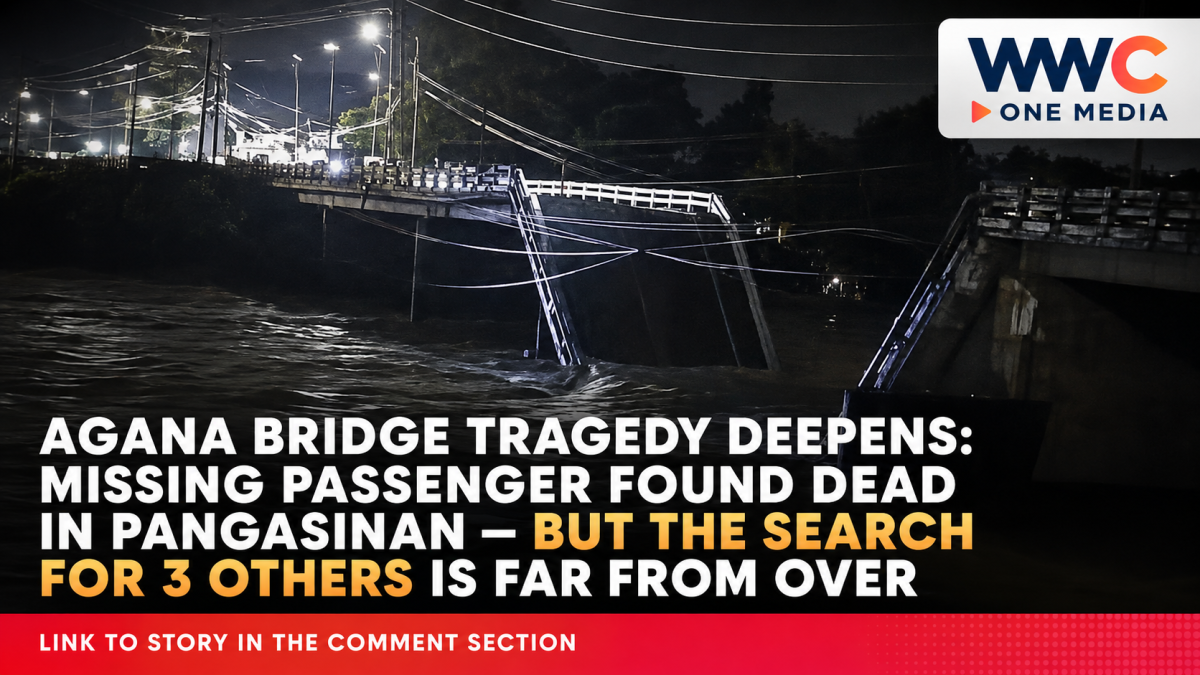
TARLAC CITY, Philippines — What began as a desperate search for four people swept into the raging Tarlac River has taken a heartbreaking turn.
One of the four passengers reported missing after a vehicle plunged into the river during the collapse of the Agana Bridge in Tarlac City has been found dead in Dagupan City, Pangasinan, authorities confirmed — leaving three people still unaccounted for days after the disaster.
The victim was identified by the Tarlac City government as James Patrick Taborlupa. His body was recovered Monday, August 31, in waters in Dagupan, more than a day after the vehicle carrying five people fell into the flood-swollen river when a portion of Agana Bridge gave way on the night of August 29.
According to the Philippine Coast Guard, Coast Guard Station Dagupan received a report at around noon Monday about a body spotted floating in the area by a motorbanca operator. Responders were dispatched and retrieved the victim before turning the body over to local police. Tarlac City Mayor Susan Yap subsequently confirmed that the recovered person was one of those involved in the Agana Bridge incident.
As of September 1, authorities were still searching for three other passengers who remain missing.
Reports have identified them as Paul Harvey Collado, Sheila or Shiela Mae Taborlupa, and Shanen Tuhao, although spelling variations of some names have appeared in different news reports. Search and retrieval teams have continued looking downstream as authorities confront the possibility that the powerful current carried people and debris far from the bridge collapse site.
One Passenger Survived
There was one survivor.
Nathaniel Dizon, 20, survived after the vehicle plunged into the river, according to reports from the Tarlac City government and responding authorities. The Philippine Air Force earlier said its Tactical Operations Wing Northern Luzon and Tactical Operations Group 3 joined search and rescue operations following the accident.
Dizon later drew public attention after alleging in a social media post that he largely had to save himself and that some people at the scene were more focused on recording videos than immediately helping.
The allegation, reported by the Inquirer, reflects Dizon’s personal account and has not been independently established as a complete account of the emergency response.
Agana Bridge Was Already an Alternative Route
The tragedy becomes even more significant because Agana Bridge was not simply another local crossing.
It had been serving as an alternative route after part of the nearby Aquino Bridge collapsed on August 28, just one day before the Agana Bridge disaster.
The Aquino Bridge failure happened during heavy rainfall associated with the southwest monsoon. With that route damaged, motorists had increasingly relied on Agana Bridge — until that crossing also failed amid the swollen Tarlac River.
The Agana Bridge, reportedly built in the 1980s, is an important connection between Tarlac City and several western municipalities, including Sta. Ignacia, Mayantoc, Camiling and San Clemente. It also forms part of a route used by travelers heading toward Mangatarem, Pangasinan.
The back-to-back failures therefore created more than a rescue emergency: they disrupted one of the area’s key transportation corridors.
Tarlac Governor Christian Yap has described both damaged bridges as old, while motorists have been forced to use alternative routes, including connections through Gerona.
DPWH Begins Emergency Work
The Department of Public Works and Highways has begun emergency works aimed at restoring connectivity in the affected areas.
Public Works Secretary Vince Dizon ordered structural assessments, safety measures and temporary repairs following the bridge failures. DPWH has also mobilized equipment and materials for temporary bridge solutions while engineers assess how the damaged crossings can safely be reopened.
The disaster has also renewed questions about the vulnerability of bridges and river infrastructure during extreme flooding.
Heavy monsoon rains and powerful river currents have been cited in reports surrounding both collapses. Questions have additionally been raised by some residents and officials about whether riverbed changes or quarrying may have contributed to weakening bridge foundations.
However, no engineering investigation cited so far has established quarrying as the cause of the Agana Bridge collapse, and such claims should not be treated as proven. Daily Tribune noted that determining whether quarrying contributed to bridge failure would require a proper engineering investigation.
Search Now Extends Beyond Tarlac
The discovery of Taborlupa’s body in Pangasinan demonstrates just how far the floodwaters may carry people and debris from the original accident site.
That reality has added urgency to the search for the remaining three passengers.
The Philippine Coast Guard said search and rescue efforts were continuing as of Tuesday, September 1. Other local disaster offices in Tarlac and Pangasinan have also been involved in riverine search operations.
For the victims’ families, every hour now matters.
And while engineers work to reconnect communities divided by two damaged bridges, the more immediate mission remains unchanged:
Find the three people who are still missing — and determine exactly how a vital crossing failed while motorists were still using it.




Leave a Reply