
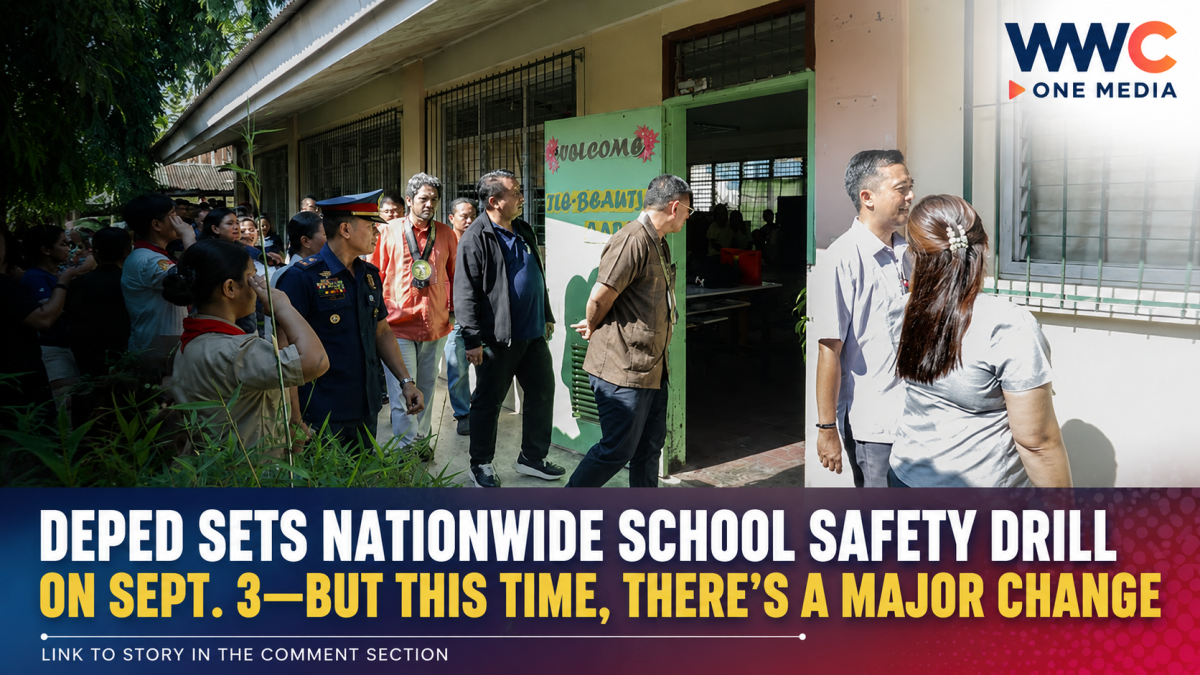
MANILA, Philippines — Students and teachers nationwide are set to take part in a simultaneous school safety drill on September 3, 2026, as the Department of Education (DepEd) moves to strengthen preparedness for possible active-attack incidents while placing greater emphasis on the psychological well-being of learners.
The nationwide drill, which was originally scheduled for August 25, has been rescheduled to Thursday, September 3, at exactly 9 a.m. DepEd has directed public and private elementary and secondary schools to carry out appropriate preparedness activities based on their localized contingency plans.
But unlike the earlier approach that drew criticism from medical and mental-health groups, DepEd now says the exercise must focus on calm, practical preparedness—not fear.
Education Secretary Sonny Angara said the goal is to develop what he described as “calm operational confidence” and the muscle memory needed to respond properly during an emergency.
“Preparedness saves lives, and trauma-informed execution protects our learners,” Angara said.
No weapons, graphic scenes or frightening simulations
DepEd has instructed schools to avoid hyper-realistic, graphic or fear-inducing simulations during the September 3 exercise.
That means schools are not supposed to use simulated attackers, weapons, graphic injuries or other elements designed to make the exercise resemble an actual violent attack.
Instead, students and school personnel will focus on basic protective actions, communication, coordination, accountability and recovery. Activities include reviewing how entry points can be secured, practicing silent concealment away from windows, checking evacuation routes and strengthening emergency communication procedures.
Police participation is also being adjusted. Rather than conducting aggressive tactical demonstrations inside schools, police are expected to concentrate on external perimeter security, emergency notification, dispatch coordination and post-incident learner tracking.
Why the drill was changed
The revisions come after medical and psychiatric organizations raised concerns about the possible psychological impact of realistic active-shooter simulations on children.
The Philippine Psychiatric Association and Philippine Society for Child and Adolescent Psychiatry previously urged DepEd to defer live-shooter simulations, arguing that existing evidence does not establish that highly realistic drills reduce casualties or prevent attacks and warning that such exercises may cause psychological harm.
The Philippine Pediatric Society likewise said evidence regarding active-attack and lockdown drills involving children remains limited or mixed. It recommended nonsimulated preparedness activities and warned against deception, surprise, simulated gunfire, realistic weapons, graphic injuries and aggressive role-playing.
The Philippine Medical Association also called for a pilot implementation and comprehensive evaluation before a nationwide rollout, saying the program should be safe, evidence-guided, age-appropriate and adapted to the Philippine setting.
DepEd subsequently said the additional preparation time would allow it to align the exercise with recommendations concerning disaster preparedness, child protection and psychosocial support.
Parents and children will be informed beforehand
The revised approach also puts greater emphasis on preparation before the drill begins.
Schools are expected to provide age-appropriate orientation and advance notice to learners, parents and personnel. DepEd-related guidance also calls for appropriate consent and accommodations for learners who may have disabilities, sensory sensitivities or other individual needs.
After the exercise, guidance personnel and school health officers are expected to provide first aid and post-drill debriefing and psychosocial support when necessary.
The objective is straightforward: students should know what to do in an emergency without being made to feel as though they are actually experiencing a violent attack.
Police and schools also strengthening security
The September 3 drill is taking place amid heightened concern over school security following deadly incidents in Tacloban City and Zamboanga City.
The Philippine National Police has said it is ready to work with DepEd in training teachers and parents to recognize behavioral warning signs and other red flags associated with violence and criminal activity. Police units are also prepared to provide technical assistance to schools.
In Cebu City, police have increased their presence around public schools, while Lapu-Lapu City has identified six schools as pilot sites for the September 3 exercise. Those campuses will undergo pre-orientation and tabletop exercises involving school officials, parents, police, fire authorities and disaster-response personnel.
More than a drill
For DepEd, the September 3 exercise is intended to be more than a one-day simulation.
The department’s broader objective is to ensure that schools have workable contingency plans, clearly defined responsibilities and stronger coordination among teachers, administrators, parents, police, firefighters, local governments and emergency responders.
The challenge, however, is finding the right balance: schools must be prepared for real emergencies without exposing children to unnecessary fear or trauma.
That balance will be closely watched when schools nationwide conduct the simultaneous safety exercise on September 3.
For DepEd, the message is clear: preparedness should build confidence—not panic.




Leave a Reply