
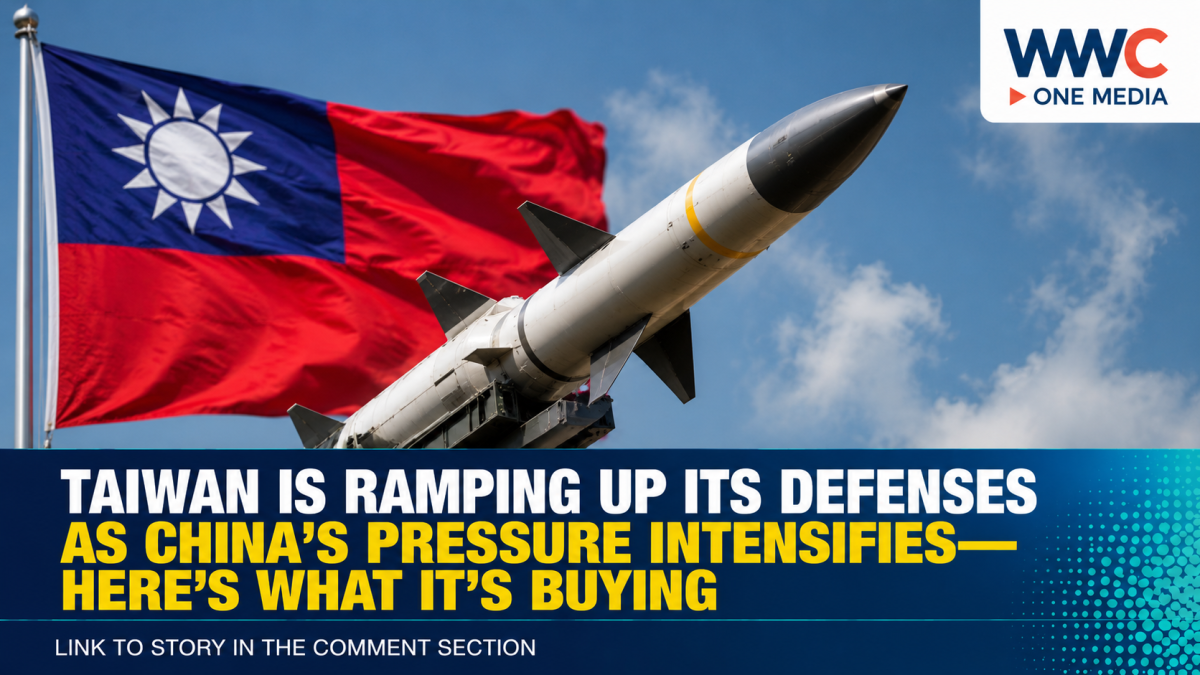
TAIPEI — Taiwan is accelerating efforts to strengthen its military capabilities as Chinese military activity around the island intensifies, with the Ministry of National Defense laying out a wide-ranging plan to redirect resources toward weapons, air defense, drones, communications and combat readiness. The ministry said it is reviewing how defense funds are being used and postponing non-urgent projects so available resources can be directed toward the military’s most pressing requirements. The details were included in its five-year force buildup and administration plan submitted to Taiwan’s legislature. The plan comes as Taipei says China’s “gray zone” activities around Taiwan have intensified. According to the ministry, Beijing continues to conduct joint combat-readiness patrols, military exercises and China Coast Guard operations, while also employing maritime militia, legal and psychological warfare, and economic pressure. Taiwan is building a multilayered shield One of the biggest priorities is air and missile defense. Taiwan plans to deploy the Strong Bow medium-range anti-tactical ballistic missile system as part of a multilayered defense network under its “Taiwan Shield” or T-Dome framework. The Strong Bow system is designed to intercept tactical ballistic missiles at ranges of up to 1,000km and is intended to operate alongside systems including Patriot and Sky Bow III. Delivery is scheduled to begin in 2028, although the exact number of systems remains classified. The air force has budgeted NT$36.04 billion from this year through 2032 for the Strong Bow system. That investment reflects Taipei’s growing focus on protecting the island from potential missile attacks. Drones are becoming a major priority Taiwan is also expanding its unmanned capabilities. The military plans to continue acquiring Altius 600M and Switchblade 300 systems, while adding Altius 600ISR and 700M attack drones. The emphasis on unmanned systems reflects lessons Taiwan says it has drawn from recent conflicts, particularly the wars in Ukraine and the Middle East, where drones, intelligence systems and resilient communications have become increasingly important on the battlefield. The military’s modernization program also includes uncrewed boats and additional drone capabilities. A new generation of armored vehicles Taiwan’s army is preparing for a significant armored-vehicle expansion. It has budgeted NT$57.07 billion from next year through 2033 for 178 domestically developed Cheetah armored fighting vehicles, each equipped with a 105mm cannon. The Cheetah D3 prototype has already passed evaluation, with procurement scheduled to begin next year. The vehicles are expected to have a maximum speed of 100kph, a range of approximately 500km, and the ability to fire while moving. The army also plans to spend: NT$10.7 billion through 2032 on 4,647 light tactical off-road vehicles NT$79.54 billion through 2034 to replace aging CM21 armored personnel carriers with 410 wheeled combat and command vehicles Taiwan is also preparing for a long war The modernization plan goes beyond weapons. Taiwan’s military is strengthening its command-and-control networks, intelligence resilience, ammunition stocks, mobilization systems and training readiness. It also plans to establish an islandwide fiber-optic backup network designed to strengthen communications resilience. The military says these measures are informed by recent conflicts, where damaged communications infrastructure and disrupted supply lines can severely affect battlefield operations. Night-vision equipment becomes another priority The army is also addressing shortages in night-fighting equipment. It has allocated NT$10.73 billion from next year through 2030 for a second phase of night-vision procurement, including 41,000 monocular devices and 10,778 binocular devices. The move follows concerns that some troops conducting nighttime exercises in Taipei had been seen without adequate night-vision equipment. The army said shortages could affect guard duties during wartime. Taiwan is replacing aging protective equipment too The military is also spending NT$2 billion through 2031 on 129,759 protective masks and 264,278 filters. The procurement is intended to replace aging T3-75 masks manufactured in 1986, which the military says are no longer sufficient for chemical, biological, radiological and nuclear threats. Meanwhile, Taiwan’s navy is preparing for the arrival of more domestically built submarines. It has budgeted for additional rescue vessels and a submarine rescue ship as the Hai Kun and subsequent indigenous submarines enter service. US-made weapons remain part of the strategy Taiwan’s defense modernization also includes continued procurement from the United States. Among its priorities are M109A7 self-propelled howitzers and HIMARS multiple-launch rocket systems. The military is therefore pursuing a combination of domestically developed weapons and systems acquired from foreign partners. The bigger picture Taiwan’s latest defense plan signals a shift toward readiness, resilience and rapid modernization rather than simply increasing the number of military projects. The ministry says it is reviewing previous budget execution and delaying projects that are not immediately necessary so money can be concentrated on capabilities considered essential to Taiwan’s defense. At the center of the strategy are air and missile defense, drones, armored vehicles, submarines, communications, ammunition, mobilization and training. The message from Taipei is increasingly clear: Taiwan is preparing its military not only for a potential attack, but for the possibility of having to sustain operations under prolonged pressure. And as Beijing continues expanding its military capabilities and conducting operations around Taiwan, the island’s race to strengthen its defenses is only accelerating.
WWC ONE MEDIA J.M.D


Leave a Reply