
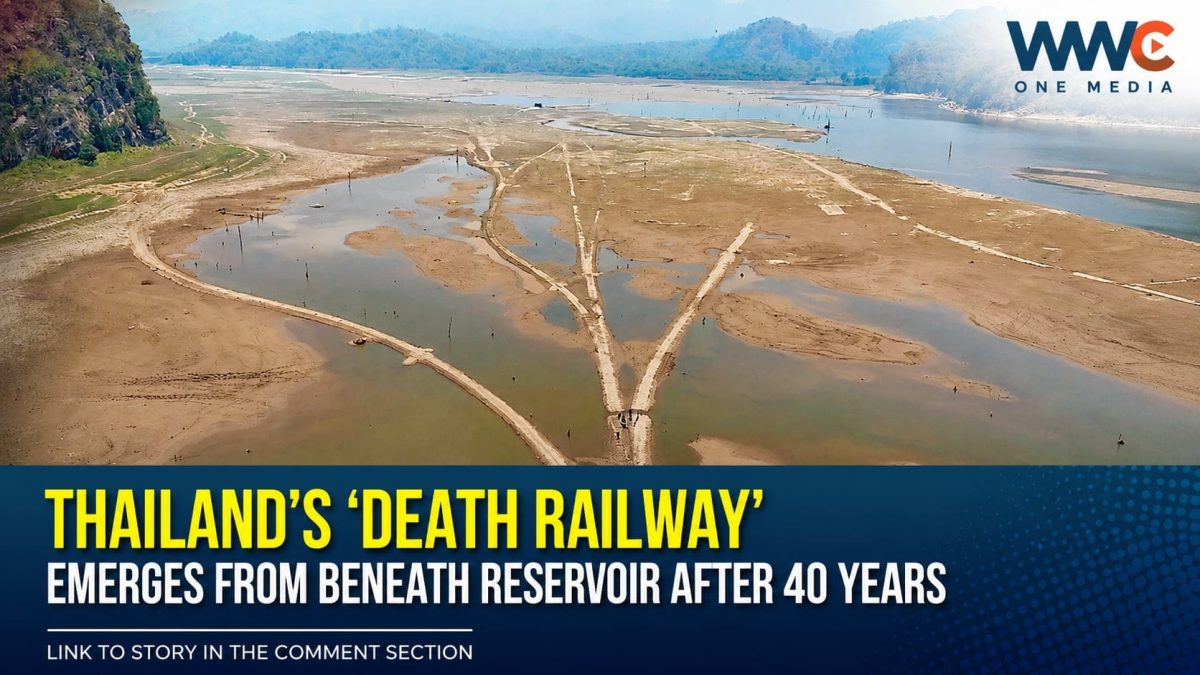
A long-submerged section of the infamous Thai-Burma Railway has briefly resurfaced in western Thailand, exposing remnants of a World War II railway station and offering a rare glimpse into a painful chapter of wartime history.
The remains appeared after water levels in the Vajiralongkorn Dam reservoir in Kanchanaburi Province were lowered during maintenance work. The drawdown revealed parts of the railway for the first time since the valley was flooded in 1984.
For 52-year-old Pichai Sairantee, the discovery was more than an archaeological curiosity. It gave him an unexpected chance to return to the village where he spent his childhood.
Pichai grew up in Nithe Village, which once stood along the river before the dam transformed the area. His grandparents and other elders had passed down stories about life during the war and the railway that once ran through their community.
As a child, he remembers being able to walk along the railway tracks.
Now, decades later, he was able to walk across the same landscape again.
A strategic railway station
The former Nithe station was known as “Neekey” during the Japanese occupation. It formed part of the approximately 415-kilometer Thai-Burma Railway, constructed during World War II as a military supply route for the Japanese Army.
Neekey served as an important railway facility. Locomotives transporting troops and supplies could be serviced there before continuing toward the front.
The station had a distinctive Y-shaped track arrangement that allowed trains to change direction. Evidence of other railway infrastructure has also been found, including what researchers believe was an inspection pit used by mechanics and remnants of a water tank that supplied steam locomotives.
When the reservoir receded, the station’s former track layout became clearly visible from above.
A railway built at a terrible cost
The Thai-Burma Railway was completed in roughly 15 months, but its construction came at an enormous human cost.
The Japanese military relied on Allied prisoners of war and Asian forced laborers to build the railway under extremely harsh conditions. Workers faced disease, hunger, exhaustion and brutal treatment.
Thousands died during the construction of the railway, contributing to its enduring name: the “Death Railway.”
Physical evidence of the old railway remains visible in places, including impressions left by the wooden sleepers that once supported the tracks.
Memories beneath the reservoir
For Pichai, the exposed railway also brought back memories of stories he heard as a child.
He recalls being told that the area was heavily targeted during the war and that villagers had to extinguish all fires at night to avoid attracting the attention of Allied aircraft.
He also remembers stories about villagers secretly helping Allied prisoners.
According to Pichai, his grandfather and other residents sometimes passed food such as bananas to prisoners working on the railway, despite opposition from Japanese soldiers.
The railway itself became part of Pichai’s childhood landscape. He remembers walking along the tracks between his home and the fields where his father worked.
His parents, however, warned him not to take anything from the site.
Villagers believed that the souls of people who had died during the railway’s construction remained in the area, and they feared disturbing them.
A disappearing piece of history
The railway was dismantled in many places after the war. Other sections were abandoned or eventually covered by reservoirs.
Today, only around 130 kilometers of the original railway remain in operation in Thailand. The surviving section has become a popular tourist attraction, particularly around the famous River Kwai Bridge.
But the submerged remains near the Vajiralongkorn Dam are rarely visible.
The recent exposure offered researchers an unusual opportunity to document the station’s layout and surviving structures.
Professor Kakizaki Ichiro of Yokohama City University, whose research includes military logistics, forced labor and the railway’s history in Thailand, said the preservation of the remains was remarkable.
He noted that the site provides an unusually clear picture of how railway tracks were arranged within a wartime station.
For historians, the remains are significant not simply because of their physical condition, but because they help connect present-day communities with events that occurred more than eight decades ago.
A brief window into the past
The railway remains did not stay exposed for long.
Authorities expected the site to remain accessible for only a few months before seasonal rains raised the reservoir level again. By the time the site was visited in May, vegetation had already begun covering some of the surviving structures.
The water has now returned, once again hiding the railway beneath the reservoir.
For Pichai, however, the brief reappearance provided something he never expected: the opportunity to stand once again on the ground where his childhood home once stood.
The village may be underwater, and much of its physical history may have disappeared, but the memories remain.
“Even underwater, I know exactly where it is.”
WWC ONE MEDIA J.M.D




Leave a Reply