
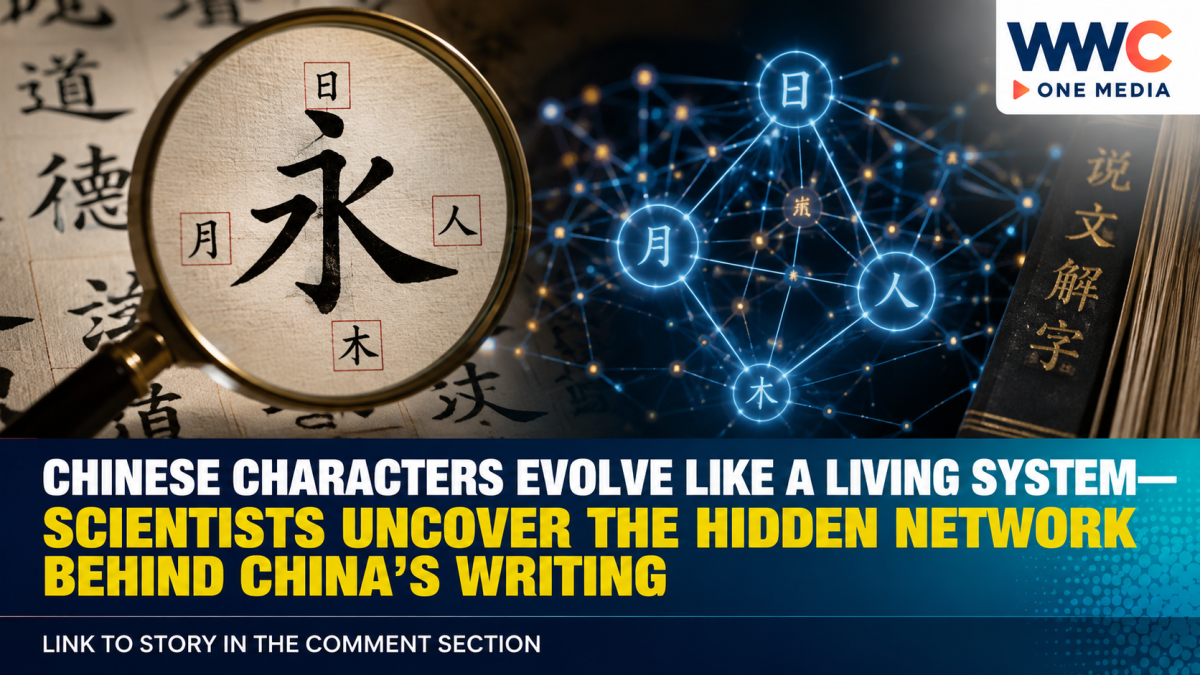
China’s writing system may be far more organized—and surprisingly evolutionary—than it appears.
A new study examining modern simplified Chinese characters has found that thousands of characters can be represented as a complex network built from just 514 basic components, revealing patterns that researchers say resemble the organization of complex systems found elsewhere in nature.
The research, led by Wei Huang of Beijing Language and Culture University, together with Yonghui Xie of Shanghai Normal University and Junting Li, analyzed the structural formation of modern simplified Chinese characters using complex-network methods. The study was published in Digital Scholarship in the Humanities in January 2026.
The surprising 514-component finding
Researchers examined the structural components used to form modern simplified Chinese characters and found that a relatively small number of basic elements are repeatedly combined to produce a much larger character system.
Among the frequently recurring components are characters or elements associated with concepts such as sun 日, moon 月 and human 人. These components can appear repeatedly in different combinations and structural positions.
The result is a writing system that may look enormously complicated on the surface but is built around a comparatively limited set of recurring structural elements.
In other words, thousands of characters do not necessarily mean thousands of completely independent designs.
Instead, many are constructed through combinations and relationships among reusable components.
A “social network” of Chinese characters
To understand this structure, the researchers treated the components almost like nodes in a network.
Components that appear together become connected, allowing researchers to study how the entire system is organized.
The study constructed co-occurrence, directed and weighted networks, then compared their characteristics with corresponding random networks. Researchers evaluated 17 network metrics to determine whether the observed structure was simply accidental or reflected deeper organization.
The results showed five notable network characteristics:
- Small-world structure
- Scale-free organization
- Disassortative mixing
- High centrality
- Hierarchical organization
Together, the researchers said these characteristics reveal three major properties of the Chinese-character formation system: complexity, robustness and economy.
So, are Chinese characters really “evolving”?
This is where the study becomes particularly interesting.
The researchers argue that frequently used components tend to occupy more important positions within the system, while less-connected components remain more peripheral.
SCMP reported Xie describing Chinese characters as evolving “like living organisms,” with usage frequency acting as a form of selective pressure.
But this should not be interpreted to mean that Chinese characters are biological organisms.
Rather, the comparison describes an evolutionary pattern: components that are frequently used and structurally useful become increasingly important within the writing system, while less-used elements play smaller roles.
The researchers also point to the principle of economy—the tendency for a system to generate substantial output through relatively efficient combinations of existing elements.
Why does this matter?
The findings could have implications beyond academic linguistics.
If thousands of characters are organized around a smaller number of highly connected components, learning Chinese could potentially be approached differently.
Instead of treating every character as an entirely separate object to memorize, students could learn the building blocks and relationships that repeatedly appear across the writing system.
That could be particularly relevant for people learning Chinese as a second language.
SCMP reported that the researchers believe their findings could influence how Chinese writing is taught.
A writing system shaped by efficiency
The research also challenges the idea that the apparent complexity of Chinese characters means the system itself is unstructured.
Quite the opposite.
The network analysis suggests that Chinese characters form a highly organized system in which components are connected according to recurring patterns.
Some components occupy central positions and participate in many combinations, while others remain less connected.
That structure gives the system both flexibility and stability.
A limited collection of components can therefore participate in a much larger number of combinations without requiring every character to be created from scratch.
What the study does—and does not—prove
The researchers are not saying that biological natural selection literally created the Chinese writing system.
Their study is primarily a complex-network analysis of the structural formation of modern simplified Chinese characters. Its strongest finding is that the system displays measurable network properties associated with complexity, organization, robustness and efficiency.
The evolutionary comparison provides an additional way of understanding how usage and structural relationships may shape a writing system over time.
And that may change how researchers—and potentially educators—think about Chinese characters.
Rather than thousands of isolated symbols, the study presents them as parts of an interconnected system.
A writing system that looks incredibly complex from the outside may, underneath, be governed by a surprisingly small set of recurring rules and building blocks.
Why this story could go viral
The strongest hook isn’t simply that “Chinese characters evolved.”
It’s the 514-building-block revelation.
That gives the story a concrete, easily understandable number while the “living system” comparison creates curiosity without overstating what the research actually proves.
WWC ONE MEDIA J.M.D




Leave a Reply