
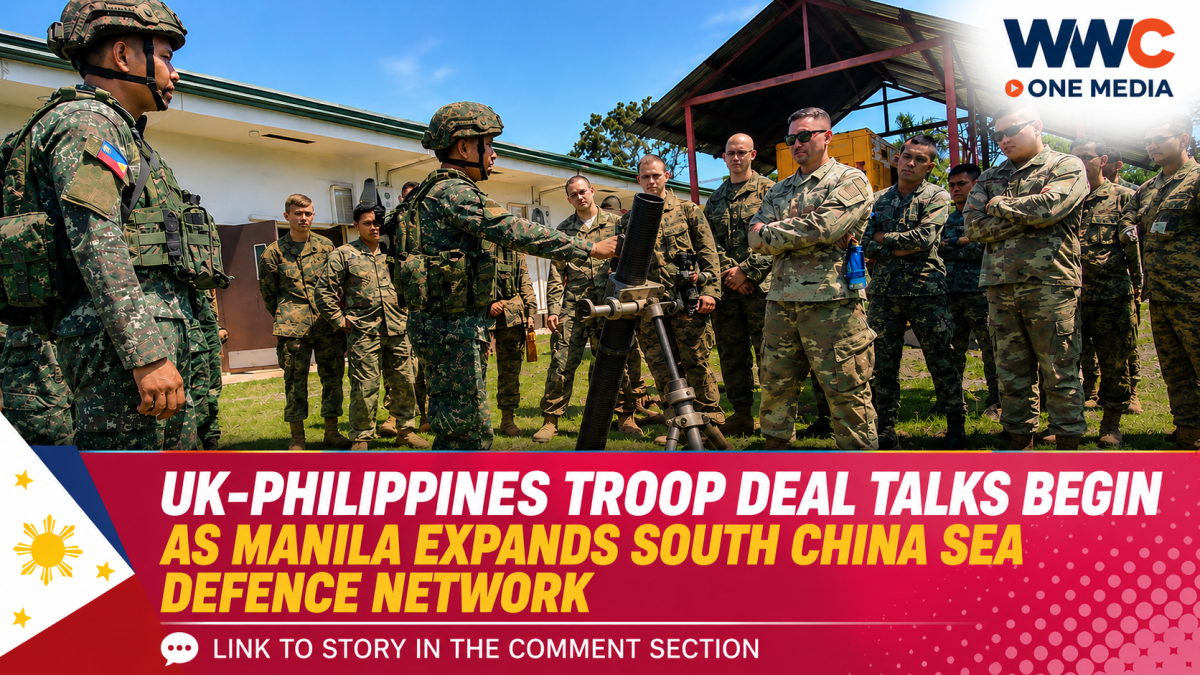
MANILA — The Philippines and the United Kingdom have opened formal negotiations on a proposed visiting forces agreement that would allow British and Philippine troops to train and temporarily operate on each other’s territory.
The talks mark another step in Manila’s effort to expand its network of security partnerships as tensions in the South China Sea continue to intensify.
If concluded, the agreement would make Britain the fourth NATO member to establish this type of troop-access arrangement with the Philippines, after the United States, Canada and France. The UK is a NATO member, but the proposed pact itself would be a bilateral Philippines-UK agreement, not a NATO treaty.
First formal negotiations begin in Manila
Philippine and British defence officials held the first formal negotiating round on August 27, 2026, in Manila.
The Philippine delegation was led by Defence Undersecretary for Acquisition and Resource Management Salvador Melchor Mison Jr., while the British side was headed by Amy Senior, the UK Ministry of Defence’s head of Indo-Pacific.
The proposed Status of Visiting Forces Agreement (SOVFA) would establish the legal and practical framework for British personnel entering the Philippines and for Philippine forces operating in Britain.
The negotiations cover issues associated with temporary military deployments, including joint exercises, training, humanitarian assistance and disaster-response activities.
Why Britain matters to Manila
The proposed agreement would give the Philippines another European security partner at a time when Manila is seeking to broaden defence cooperation beyond its traditional alliance with Washington.
The Philippines already has visiting-forces arrangements or comparable defence agreements with several partners, including the United States, Australia, Japan, New Zealand and Canada. France signed its own agreement with Manila in March, making it another European partner.
The UK agreement would therefore add another European military to the Philippines’ growing network of defence relationships.
That network is becoming increasingly important as the Philippines faces more frequent confrontations with Chinese vessels in disputed areas of the South China Sea.
It is about more than combat exercises
The proposed pact is not limited to military drills.
According to the Philippine government, the broader defence relationship with Britain includes cooperation in humanitarian assistance and disaster relief, military education, logistics, defence technology, armaments and research.
The two countries’ existing defence cooperation framework also covers the air, land, maritime, space and cyber domains.
A 2025 UK-Philippines enhanced partnership framework further identified cooperation in maritime security, maritime-domain awareness, hydrography, cyber defence, military medicine, geospatial intelligence and crisis preparedness.
That gives the proposed troop agreement a wider strategic context.
The South China Sea is central to the relationship
For Manila, one of the biggest benefits is likely to be greater international involvement in maintaining a free and open maritime order.
Britain and the Philippines have both emphasized the importance of international law and the 1982 United Nations Convention on the Law of the Sea (UNCLOS).
The UK has also joined the Philippines and other countries in reaffirming the 2016 South China Sea arbitral ruling, which Manila says supports its maritime rights.
The Philippines has repeatedly faced confrontations with Chinese vessels around disputed maritime features.
At the same time, China’s military and maritime presence in the wider South China Sea continues to expand. Recent satellite imagery reviewed by Reuters showed construction and new installations around China’s expanding facilities in the disputed Paracel Islands, adding to concerns about the region’s militarisation.
Britain is increasing its Indo-Pacific role
The proposed agreement also fits Britain’s broader effort to deepen security relationships across the Indo-Pacific.
London and Manila already have an enhanced partnership and a defence cooperation memorandum signed in January 2024, which took effect in July of that year.
Britain has committed to providing military training and expertise to Philippine forces and to expanding cooperation in areas such as maritime security and disaster response.
The UK has also been working with ASEAN on a wider Indo-Pacific agenda, including peace, stability and a rules-based regional order.
The pact is not a new military alliance
Despite the headline geopolitical significance, the proposed SOVFA should not be confused with a mutual-defence treaty.
It would primarily establish legal and operational rules for visiting military personnel.
It would not automatically require Britain to defend the Philippines in the event of an armed attack, nor would it bring the Philippines into NATO.
Instead, the agreement would make it easier for the two militaries to conduct exercises, training and other approved activities while establishing rules governing their presence in each other’s territory.
That distinction is important as the agreement remains under negotiation.
Manila is building a wider defence network
The UK talks come as the Philippines accelerates military modernisation.
Defence Secretary Gilberto Teodoro has said Manila intends to expand its drone capabilities and acquire additional major defence assets as part of its external-defence strategy. The proposed 2027 modernisation allocation is 50 billion pesos, a 25% increase from the current year’s allocation.
The Philippines is therefore pursuing several tracks simultaneously: strengthening its alliance with the United States, expanding relationships with European and Indo-Pacific partners, and developing its own military capabilities.
The UK agreement could become another piece of that larger strategy.
What happens next?
The two sides still have to negotiate and finalise the agreement before it can take effect.
But the opening of formal talks sends a clear signal: Manila wants more partners involved in the security of its surrounding waters, while London is seeking a deeper defence role in one of the Indo-Pacific’s most strategically important locations.
If the pact is eventually concluded, British troops could gain a new framework for training and operating temporarily in the Philippines—bringing another NATO member into Manila’s expanding network of defence partnerships.
And as tensions continue to build in the South China Sea, the question is no longer simply who has a military presence in the region—but how many countries are willing to work alongside the Philippines.
WWC ONE MEDIA J.M.D




Leave a Reply