
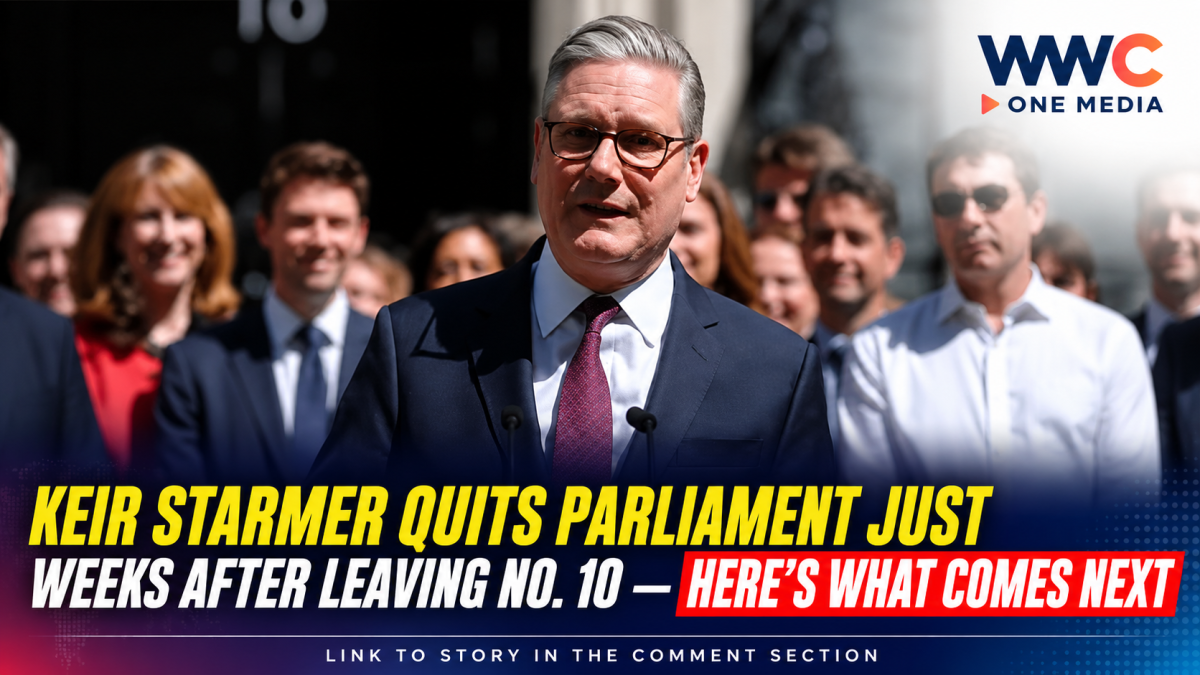
LONDON — Former British Prime Minister Sir Keir Starmer is leaving Parliament, ending his 11-year career as the MP for Holborn and St Pancras just weeks after stepping down as prime minister.
Starmer announced on Tuesday, September 1, that he will resign as a Member of Parliament and focus on international affairs, including defence, security, trade and technology.
The decision marks another major turning point in the political career of the former Labour leader, who led his party from one of its worst general election performances in modern history to a landslide victory in 2024.
In a statement to the Camden New Journal, Starmer said he had reflected over the summer and concluded that it was time to “pass the baton to a successor.” He said representing Holborn and St Pancras had been a “huge honour and privilege.”
Starmer also said he intends to continue his long-standing work on combating violence against women and girls.
From Downing Street to the Commons — and Now Out of Parliament
Starmer resigned as prime minister on July 20, 2026, after losing political support within the Labour Party. He was succeeded by Andy Burnham, who became prime minister the same day.
When Starmer left Downing Street, he had indicated that he planned to remain in Parliament as a backbench MP until the next general election.
His decision to leave now therefore represents a change from that earlier position.
The BBC reported that Starmer had previously said he would stay on as an MP until the next general election, which must be held by 2029. His latest announcement instead means his North London constituency will face a by-election.
Why Starmer’s Seat Matters
Starmer has represented Holborn and St Pancras since 2015, making his departure more than a personal political decision.
The constituency has traditionally been a Labour stronghold, but the 2024 election revealed signs of a changing political landscape.
Official UK Parliament figures show that Starmer won the seat in 2024 with 18,884 votes and a majority of 11,572. Independent candidate Andrew Feinstein finished second with 18.9% of the vote, while the Green Party candidate received 10.4%.
That means the upcoming by-election could become an early test of Labour’s popularity under Prime Minister Andy Burnham.
The Guardian and Financial Times reported that potential contenders include Green Party leader Zack Polanski, while Andrew Feinstein’s strong 2024 performance could also make the contest more competitive.
Starmer’s International Legacy
Although Starmer struggled to maintain support at home, international affairs were considered one of the stronger aspects of his premiership.
According to Reuters, he worked closely with French President Emmanuel Macron on the Coalition of the Willing in support of Ukraine, sought to reset Britain’s relationship with China, recognized a Palestinian state and attempted to maintain relations with U.S. President Donald Trump.
Starmer has now indicated that international affairs will be a major focus of his work outside Parliament.
He specifically identified defence, security, trade and technology as areas he wants to concentrate on as global tensions and economic competition continue to reshape international politics.
A Dramatic Rise — and Abrupt Exit
Starmer’s political journey has been unusually rapid.
He became Labour leader in 2020 after the party’s disastrous 2019 general election result. Four years later, he led Labour to a landslide victory, bringing the party back into government with one of its largest parliamentary majorities in modern British history.
But his time in Downing Street was also marked by political setbacks, policy reversals and declining public and party support.
By July 2026, the pressure had become too great, and Starmer stepped aside as prime minister.
Now, less than two months later, he is leaving Parliament altogether.
The timing gives his former constituency another immediate political question: who will take over a seat once regarded as one of Labour’s safest?
What Happens Next?
Starmer’s resignation will trigger a by-election in Holborn and St Pancras, although the exact date had not yet been announced in the reports available on Tuesday.
The contest could become an important political test for Burnham’s government, particularly because Parliament is returning at a time when the new prime minister is seeking to establish his political direction.
Burnham became Labour leader on July 17 before taking office as prime minister three days later.
Starmer, meanwhile, appears ready to close the Westminster chapter of his career.
His next political chapter may now take place far beyond the Commons chamber — with international affairs, defence, security, trade and technology at the centre of his attention.
And the by-election triggered by his departure could provide the first major indication of just how much Britain’s political landscape has changed since Labour’s sweeping victory in 2024.
WWC ONE MEDIA MJE




Leave a Reply