
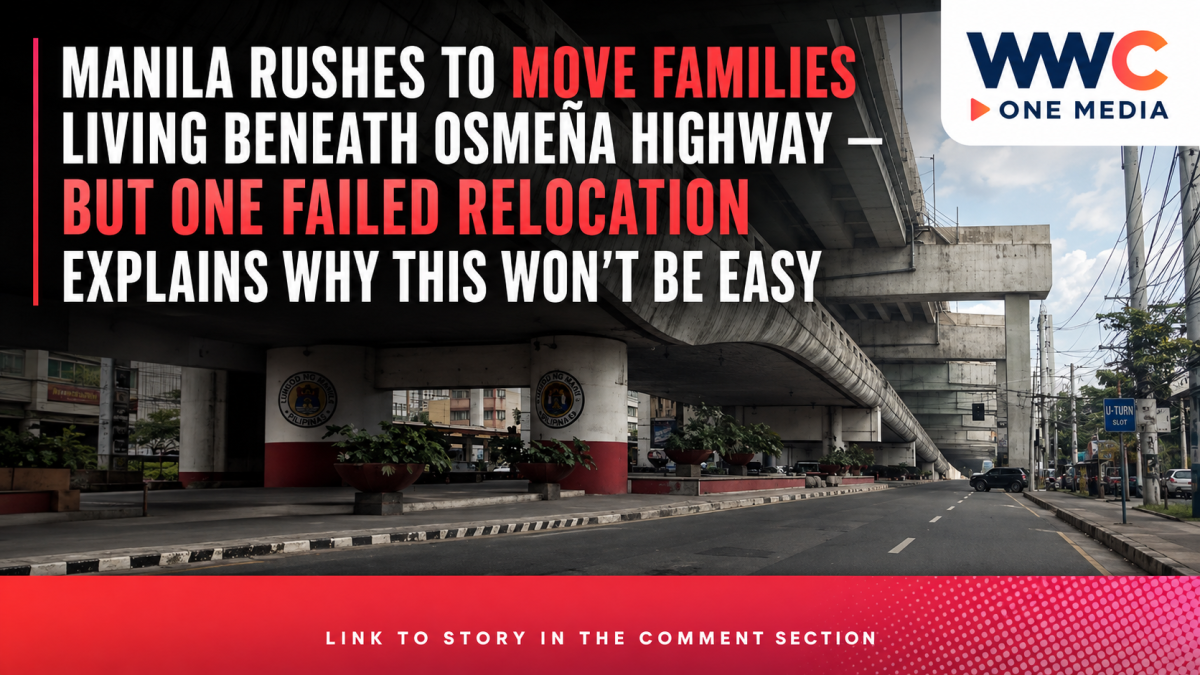
MANILA, Philippines — The Manila city government is moving to accelerate the relocation of families living beneath Osmeña Highway, reviving efforts to remove residents from one of the capital’s most unusual—and dangerous—informal settlements.
But getting families out from under the highway may prove to be the easier part.
The harder question is whether they can stay away.
The latest move by the Manila local government, reported by ABS-CBN News on September 1, again puts the spotlight on the community that has spent years living in cramped spaces beneath one of Metro Manila’s major roads.
Previous investigations by other news organizations show why officials are facing more than a simple housing problem.
Some residents have already been relocated before.
And some came back.
Why Families Returned to Osmeña Highway
GMA News reported in May that families from the so-called “tunnel community” had previously been transferred to Cabuyao, Laguna. Barangay officials said some eventually returned to Manila because they struggled to find jobs and other sources of income at the relocation site.
That history has become crucial as Manila attempts another relocation.
Many of the residents earn their living in or near the capital. Earlier reports identified delivery work and other low-income jobs among their sources of livelihood. Moving dozens of kilometers away from those jobs can turn free or subsidized housing into another economic problem if transportation costs rise or employment disappears.
It explains the uncomfortable reality behind the underground settlement: residents are not necessarily choosing the highway because they believe it is a good place to live.
For some, it has simply remained closer to where they can earn money.
Life Beneath One of Manila’s Busiest Roads
Conditions inside the settlement have been documented repeatedly.
GMA News reported that some passageways are less than 1.5 meters high, while certain living spaces have less than a meter of clearance between the floor and the concrete highway above.
Residents have had to crouch, sit or crawl through portions of their homes. Electricity has been tapped from nearby connections, while shared toilets and limited sanitation have added to health and safety concerns.
Flooding is another constant threat.
Daily Tribune reported that residents have learned to watch rainfall closely because water can quickly enter the underground spaces. Families have also described previous fires, extreme heat and the risks posed by living beside waterways and beneath major infrastructure.
Some residents have reportedly lived in the area since the 1990s, meaning children and grandchildren have grown up in circumstances that were originally never intended to become permanent housing.
Manila Had Already Promised Permanent Relocation
The September push is not the first government attempt to solve the problem.
In June, Manila Department of Social Welfare director Jay dela Fuente said Mayor Francisco “Isko Moreno” Domagoso had ordered the transfer of families living in underground areas to safer housing.
Daily Tribune reported at the time that Manila was coordinating with the national Department of Social Welfare and Development to identify possible relocation locations, including sites in Rizal and Laguna. Officials said livelihood opportunities were being considered specifically because previous relocation efforts had failed to keep some families permanently resettled.
Another Daily Tribune report said the city was preparing a permanent relocation program and acknowledged that insufficient employment opportunities and post-relocation support had contributed to families returning to the highway.
That makes the latest effort particularly significant.
The question is no longer whether government understands the problem.
Officials have known for months what went wrong before.
The test is whether the next relocation will be designed differently.
DSWD and DHSUD Have Been Profiling Families
The national government has also been involved.
DSWD previously said social workers had profiled residents to understand the circumstances of individual households—including where parents work, where children study and what kind of relocation arrangement families could realistically accept.
The Department of Human Settlements and Urban Development has likewise discussed housing options that can include rental arrangements or eventual home ownership, depending on a family’s circumstances and ability to pay.
That household-by-household assessment matters because relocation is rarely solved by handing people keys and moving them outside Metro Manila.
Jobs, schools, transportation, healthcare and daily expenses follow families wherever they go.
Philippine Law Already Recognizes the Livelihood Problem
In fact, Philippine housing law specifically recognizes this problem.
Republic Act No. 7279, or the Urban Development and Housing Act, allows relocation from danger areas and public spaces under prescribed conditions. But the law also says resettlement sites should have basic services and facilities as well as access to employment and livelihood opportunities sufficient to meet families’ basic needs.
That provision goes directly to the heart of what happened to some Osmeña Highway residents.
Housing cannot be treated independently from employment.
Move a worker far enough away from a job, and inexpensive housing can quickly become unaffordable once transportation costs, lost working hours and reduced income are calculated.
DSWD’s broader Pag-abot Program has increasingly emphasized the same principle. The department says assistance for people living in street situations can include temporary shelter, reintegration and livelihood interventions rather than simply removing people from public spaces.
The Real Test Comes After the Families Leave
Relocating families from underneath Osmeña Highway is difficult to argue against from a safety standpoint.
Nobody should have to raise children beneath moving traffic, beside flood-prone waterways, surrounded by exposed electrical connections and inside spaces where adults sometimes cannot even stand upright.
But Manila’s experience also demonstrates why clearing an informal settlement is not the same thing as solving homelessness.
The real measure of success will come six months or a year after the relocation trucks leave.
Are the families still living in their new homes?
Can parents still get to work?
Can children remain in school?
Are transportation costs manageable?
Are water, electricity, healthcare and other essential services available?
And most importantly: do residents have enough income to remain there without being forced back toward Manila?
The Osmeña Highway community has already shown what can happen when relocation provides distance from danger but not a viable economic future.
This time, Manila has the benefit of knowing exactly why part of the previous solution failed.
Whether the city can prevent history from repeating itself is now the bigger story.
WWC ONE MEDIA MJE



Leave a Reply