
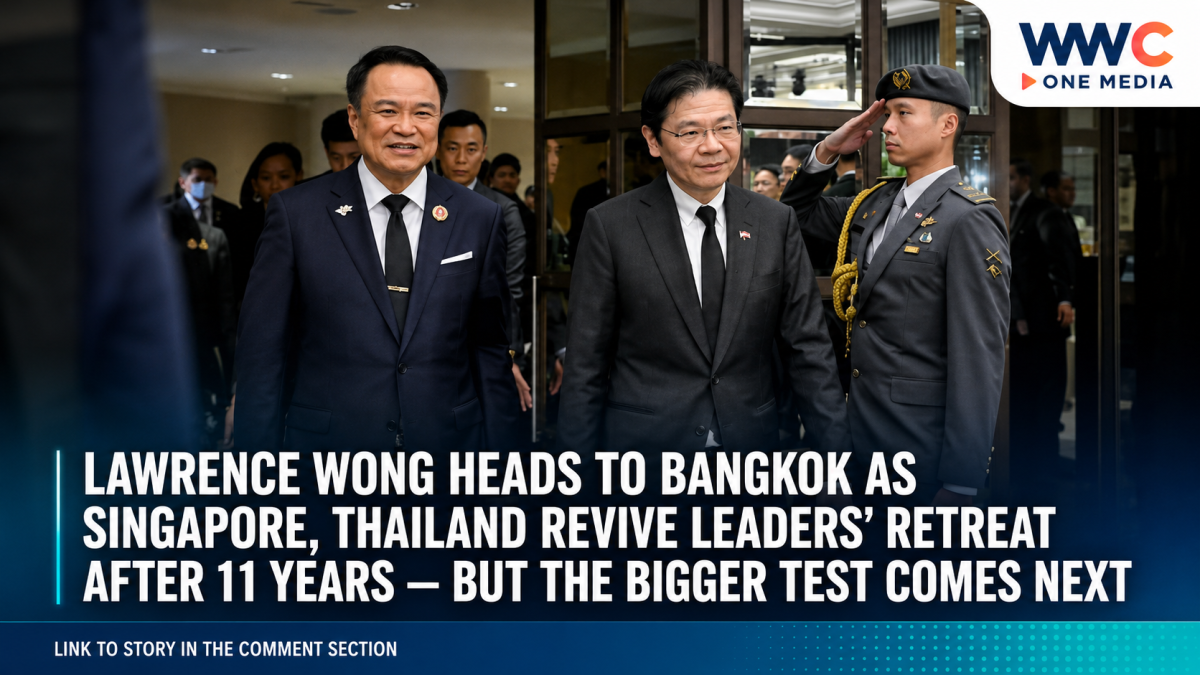
SINGAPORE/BANGKOK — Prime Minister Lawrence Wong will travel to Bangkok on Wednesday, September 2, for a meeting that looks like a routine bilateral summit on paper but could have wider consequences for Southeast Asia’s economic and strategic direction.
Wong will meet Thai Prime Minister and Interior Minister Anutin Charnvirakul for the fifth Singapore-Thailand Leaders’ Retreat—the first such gathering between the two countries in 11 years and the first between the two current leaders. The last retreat was held in Singapore in 2015.
The long gap alone makes the meeting notable. But what gives the Bangkok talks added weight is the timing.
Singapore is preparing to take over as ASEAN chair in 2027, while Thailand is due to follow in 2028. Thai officials say the retreat will therefore help lay the groundwork for cooperation between two countries that will hold the regional bloc’s leadership in consecutive years.
That turns Wednesday’s meeting from a diplomatic reunion into something potentially more strategic: an opportunity for Singapore and Thailand to align priorities before both governments gain greater influence over ASEAN’s regional agenda.
Energy, food, digital trade and security are on the table
According to Singapore’s Prime Minister’s Office, Wong and Anutin are expected to review their countries’ established defence and economic relationship while pursuing deeper cooperation in the green and digital economies, energy resilience, food security and the fight against transnational crime.
Regional and international developments are also expected to feature in their discussions.
The breadth of the agenda is significant because several of those areas have moved from diplomatic talking points into concrete Singapore-Thailand projects.
The countries already operate one of Southeast Asia’s most advanced cross-border financial links. Singapore’s PayNow and Thailand’s PromptPay were connected in 2021, creating what officials described as the world’s first linkage of national real-time payment systems.
They followed that in 2023 with an exchange-level depository receipts arrangement allowing investors greater access to companies listed in each other’s markets.
Climate cooperation has also accelerated.
Singapore and Thailand signed an implementation agreement on carbon credits in August 2025—Singapore’s first such agreement with an ASEAN member. The first call for carbon-credit project applications under that framework was launched in March 2026.
Energy connectivity may prove even more consequential.
Both countries participate in the Laos-Thailand-Malaysia-Singapore Power Integration Project, a pioneering cross-border electricity arrangement designed to bring renewable hydropower from Laos through Thailand and Malaysia into Singapore.
Its first phase enabled imports of up to 100 megawatts. The expanded second phase raised the potential electricity trade to as much as 200MW, making the project an important test case for the much larger ASEAN Power Grid envisioned by regional governments.
The issue has become increasingly strategic as governments worry about energy security, volatile global commodity markets and the need to move towards lower-carbon power without undermining reliability.
Food security is no longer a side issue
Food is another area where the relationship has recently become more practical.
During Anutin’s official visit to Singapore in November 2025, Singapore and Thailand signed a rice-trade cooperation agreement aimed at strengthening Singapore’s food security while creating more opportunities for Thai agricultural exporters.
The two sides also discussed carbon markets, healthy ageing and cooperation against scams and cybercrime during that visit.
Wong said at the time that both governments wanted to strengthen cooperation against scams as their economies became increasingly digital, with Singapore’s Infocomm Media Development Authority and Thailand’s National Broadcasting and Telecommunications Commission already developing a partnership in the area.
That concern has only grown across Southeast Asia, where transnational scam networks have become a major law-enforcement challenge.
The economic numbers explain why Bangkok matters
Commercial ties between Singapore and Thailand have also expanded sharply.
Bilateral trade reached about S$52.4 billion in 2025, an increase of 17.8 per cent from the previous year. Thailand was Singapore’s ninth-largest trading partner globally and third-largest within ASEAN.
Singapore, meanwhile, was Thailand’s largest source of foreign direct investment in 2025, with investment valued at about US$17.57 billion.
Those figures help explain why the Bangkok meeting will not be limited to government officials.
The Business Times reported that a delegation of Singapore corporate leaders is expected to attend the official dinner hosted by Anutin. Executives represented include companies and organisations spanning banking, telecommunications, logistics, aviation services, technology, property, data centres and energy.
Their presence adds a clear commercial dimension to a retreat officially focused on government-to-government ties.
A new social-sector agreement is expected
One tangible outcome is already being prepared.
Wong and Anutin are expected to witness the exchange of a memorandum of understanding between Singapore’s Ministry of Social and Family Development and Thailand’s Ministry of Social Development and Human Security aimed at strengthening cooperation in social-sector development.
Wong will also be hosted by Anutin for a private lunch before the leaders hold a joint press conference, followed later by an official dinner in the Singapore leader’s honour.
The Singapore delegation includes Wong’s wife, Loo Tze Lui, along with Defence Minister Chan Chun Sing, Foreign Affairs Minister Vivian Balakrishnan, Sustainability and the Environment Minister Grace Fu, Social and Family Development Minister Masagos Zulkifli, and Digital Development and Information Minister Josephine Teo.
Why this retreat matters beyond Singapore and Thailand
Singapore and Thailand marked 60 years of diplomatic relations in 2025, and their partnership already stretches across defence, investment, finance, energy, food, sustainability and public-sector cooperation.
The Bangkok retreat is therefore less about starting a new relationship than deciding how an already mature one should evolve.
And the most important outcome may not be a memorandum signed on September 2.
With Singapore preparing to chair ASEAN in 2027 and Thailand scheduled to take over in 2028, the two governments have an unusual opportunity to create continuity across two consecutive ASEAN chairmanships at a time when Southeast Asia faces pressure from geopolitical competition, supply-chain disruption, energy uncertainty, cybercrime and a rapidly changing global trading system.
That is why Wong’s one-day Bangkok visit deserves closer attention.
The immediate headlines may focus on carbon markets, electricity, trade or a new social-development agreement.
The bigger question is whether Singapore and Thailand are quietly building the policy alignment that could shape ASEAN’s agenda for the next two years.
WWC ONE MEDIA



Leave a Reply