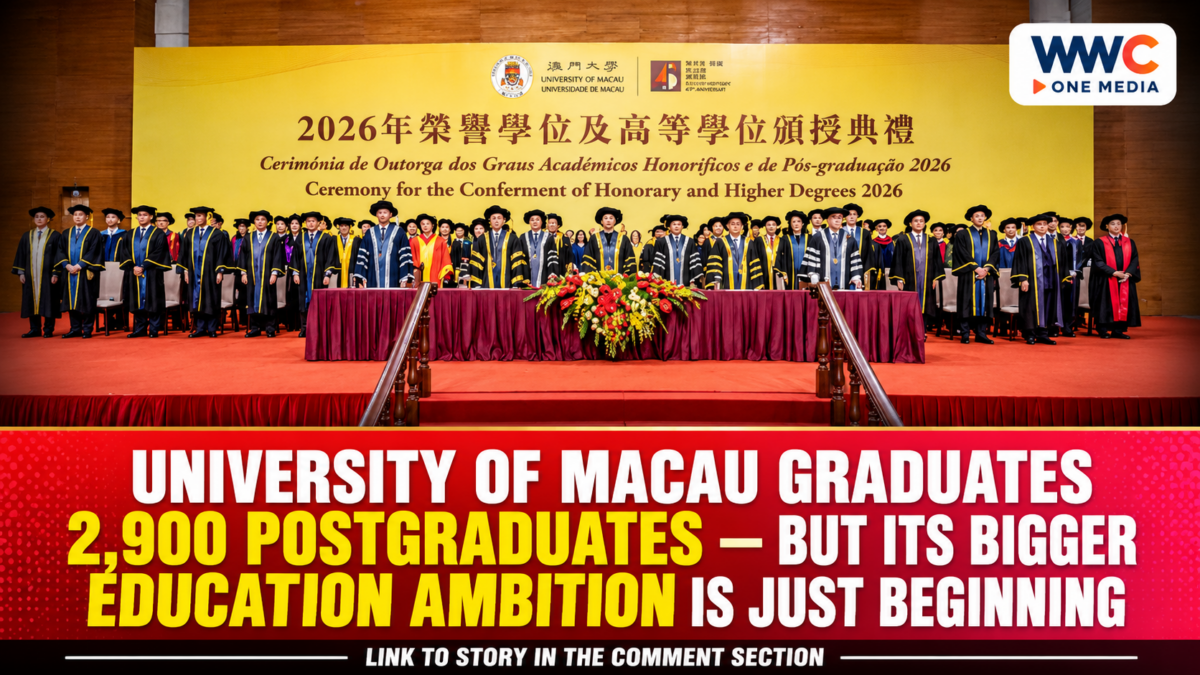
The University of Macau graduated more than 2,900 postgraduate students during its 2026 Ceremony for the Conferment of Honorary and Higher Degrees on November 28, marking another major milestone for the institution as it expands its academic and research activities across Macao and Hengqin. The graduating group included 513 doctoral graduates, 2,331 master’s graduates and 64 postgraduate diploma recipients.
The ceremony also put a broader institutional direction in focus: the university wants its graduates to apply their expertise to economic and social development, continue learning as artificial intelligence changes professional work, and build resilience in a rapidly changing environment.
The numbers matter, but the university’s longer-term plans may be more consequential. Its expansion into Hengqin, restructuring of academic faculties and development strategy show how it intends to strengthen postgraduate education while building a larger research presence in the Greater Bay Area.
University of Macau graduates reflect a growing postgraduate system
The latest graduation figures cover students from a wide range of academic units, including arts and humanities, business administration, education, engineering, information science and computing, science, law, medicine, social sciences and specialised research institutes.
The breakdown shows the scale of the university’s postgraduate output. Doctoral recipients accounted for 513 graduates, while master’s degrees represented the largest group at 2,331. Another 64 students completed postgraduate diploma programmes.
These figures offer a snapshot of the university’s role in producing advanced qualifications across professional and research disciplines. They do not, by themselves, establish employment outcomes, research impact or how many graduates will remain in Macao after completing their studies.
The university’s wider academic system is also substantial. Its postgraduate admissions information says UM has more than 16,900 students and offers over 90 postgraduate programmes. The institution has also reported international academic standing across several university rankings.
For the region, the important question is whether this growing academic base can support the skills and research capacity needed by employers, public institutions and emerging industries.
Artificial intelligence is changing the university’s expectations
Artificial intelligence featured prominently in Rector Yonghua Song’s message to graduates.
He set out three expectations: graduates should apply their professional knowledge to the economic and social development needs of the country and Macao; pursue lifelong learning to strengthen their competitiveness in the digital intelligence era; and develop resilience when facing challenges and adversity.
The message reflects a change in what advanced education must prepare students to do. A postgraduate qualification provides specialised knowledge, but professional skills can lose relevance when technology changes the way industries operate.
For graduates entering fields affected by automation and AI-assisted work, the ability to keep learning may become as important as the qualification itself.
UM has also been building academic and research capacity in technology-related fields. Its institutional restructuring in 2026 established new faculties in medicine, engineering, science, information science and computing, and design. The university has separately developed an Institute of Artificial Intelligence and Brain Sciences.
This direction connects with a wider regional discussion about the use of AI in education. WWC previously examined how artificial intelligence could widen the support gap for Philippine students. The issue is relevant beyond one country: access to technology matters, but so does the ability of teachers, students and institutions to use it effectively.
Hengqin gives the university a cross-border expansion platform
One of UM’s most significant developments is its participation in the first phase of the Macao-Hengqin International Education (University) Town.
The university describes the initiative as part of its “one university, two campuses” model. Postgraduate teaching and research activities are being conducted both at its main campus in Macao and at its teaching facilities in the Guangdong-Macao In-Depth Cooperation Zone in Hengqin.
The model is designed to connect academic operations rather than treat the two locations as unrelated institutions. UM’s published arrangements include shared access to its learning platform, connected research resources and network access across the campuses.
Its Hengqin facilities also include teaching laboratories and research infrastructure. The university lists more than 40 high-performance GPU-powered computers for academic and experimental work, while two State Key Laboratories’ Hengqin branches and several joint laboratories have been put into operation.
The expansion is part of a wider regional education plan. Macao’s education authorities reported that the first phase of the University Town project was inaugurated in August 2026, with the University of Macau, Macao Polytechnic University and Macao University of Tourism already operating there. The project offered 39 postgraduate programmes across participating institutions, covering fields that include artificial intelligence, microelectronics, big data and the Internet of Things.
This creates opportunities for cross-border teaching and research, although the long-term value will depend on the quality of programmes, student access, research collaboration and the ability to translate academic work into practical outcomes.
A five-year plan sets a much larger target
UM’s development strategy extends beyond the latest graduation ceremony.
Its Five-Year Development Plan for academic years 2026/27 to 2030/31 sets out a goal of developing the institution into a first-class university in China with global excellence. The plan places emphasis on science, engineering and medical disciplines, research collaboration, international partnerships and stronger links between academic research and innovation.
The university also plans to expand its residential college system into a network of 20 colleges across its two campuses.
By the 2030/2031 academic year, UM projects that its student population will exceed 22,000. That is a future target, not its current enrolment figure.
Research development is another central part of the plan. The university identifies artificial intelligence and brain sciences, biomedical sciences and clinical translation, intelligent medical engineering, and energy and carbon neutrality among its major research areas.
The university’s direction also reflects a broader regional effort to connect higher education with industry requirements. WWC has reported on young AI innovators presenting solutions in Macau, where projects addressed education, healthcare and accessibility. Those initiatives illustrate the range of applications being explored, while the university’s strategy focuses on developing the research and academic environment that could support future work.
More graduates will test the value of expansion
Producing thousands of postgraduate graduates is a significant institutional output, but the next measure of success will be what happens after graduation.
For students, the value of advanced study depends on whether their qualifications and research experience translate into opportunities. For employers, the question is whether graduates bring skills that match changing professional needs. For Macao, the challenge is whether a larger university and research system can contribute to economic diversification and regional cooperation.
The expansion into Hengqin may increase the university’s capacity to offer programmes and research facilities. However, infrastructure and enrolment targets alone cannot establish academic quality or economic impact.
The same is true of AI-focused education. New research institutes and technology programmes can strengthen a university’s capabilities, but meaningful results will require sustained investment, effective teaching, credible research and partnerships beyond the campus.
What happens next
UM will continue implementing its Five-Year Development Plan while expanding postgraduate programmes and research activities across its Macao and Hengqin locations.
The university’s next academic milestones will include the development of additional programmes, stronger cross-border research cooperation and progress towards its projected student population of more than 22,000 by 2030/2031.
For the graduates of 2026, the immediate challenge is to apply their advanced training in workplaces, research institutions and communities. For the university, the larger test is whether its expanding academic footprint can produce lasting educational, scientific and economic value.
FAQ
How many postgraduate students graduated from the University of Macau in 2026?
More than 2,900 postgraduate students graduated on November 28, 2026. The group included 513 doctoral graduates, 2,331 master’s graduates and 64 postgraduate diploma recipients.
Who is the rector of the University of Macau?
Yonghua Song is the rector of the University of Macau. He set out three expectations for graduates during the 2026 degree ceremony.
What is the University of Macau’s one university, two campuses model?
It is the university’s cross-border operating model linking its main campus in Macao with its teaching and research facilities in the Guangdong-Macao In-Depth Cooperation Zone in Hengqin.
What is the University of Macau’s student population target for 2030/2031?
The university’s Five-Year Development Plan projects that its student population will exceed 22,000 by the 2030/2031 academic year.
Why is artificial intelligence important to the University of Macau’s development?
Artificial intelligence is among the areas identified in the university’s research and academic development direction. Its rector also urged graduates to pursue lifelong learning and strengthen their competitiveness in the digital intelligence era.